

NEA calls for shift towards skill-based education and job creation
With 71,034 job seekers registered with the State Employment Exchange, concerns over educated unemployment and the gap between academic qualifications and employable skills came into focus at the observance of National Education Day 2026 in Kohima on Wednesday.
Speaking at the programme organised by the Nagaland Education Association (NEA) in collaboration with the Directorate of State Council of Educational Research and Training (SCERT), Advisor for SCERT and Food Processing, Achumbemo Kikon, questioned whether the state’s educated youth were becoming assets to society or a liability, despite their academic qualifications.
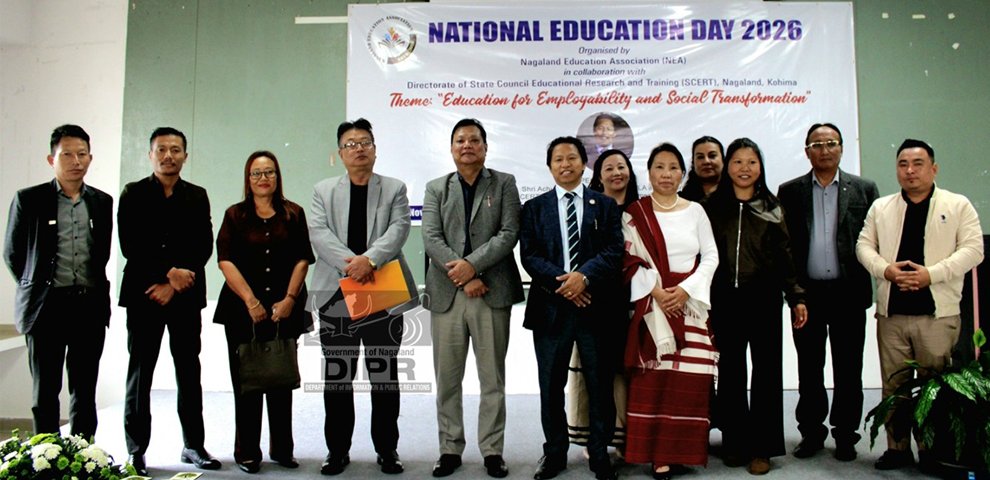
Addressing the gathering at the SIEMAT Conference Hall, Kikon said that many educated youths continued to view education primarily as a means of securing government employment, often overlooking the dignity of labour and the value of other professions. He urged young people to pursue different livelihoods irrespective of their academic qualifications, stressing that no honest work should be considered beneath one’s status.
He also called on the teaching community to examine how the education system could adapt to changing times, particularly with the rapid emergence of artificial intelligence. Expressing concern over students’ growing reliance on shortcuts and information from social media platforms, he stressed the need for education that develops comprehensive understanding rather than superficial knowledge.
In her welcome and keynote address, NEA president Dr Bweyhunle Khing highlighted the scale of educated unemployment in the state, citing survey figures which indicated that 65% to 80% of unemployed youth were educated, while approximately 92% reportedly lacked skill-based or vocational training.
She called for a shift from a job-seeking to a job-creating mindset, emphasising that education must equip students with practical skills and prepare them for diverse livelihood opportunities rather than concentrating predominantly on government employment.
Among the measures proposed were the integration of skill-based training into education, mandatory career guidance orientation programmes before the commencement of academic sessions, and greater exposure to alternative professions. She identified fields such as business, hospitality, digital marketing, agriculture, poultry farming, floriculture, handicrafts, carpentry, fashion design, and beauty and wellness as potential avenues for employment and entrepreneurship.
Khing also called for an examination of education policies and social attitudes that contribute to educated unemployment, pointing to parental expectations and the tendency to prioritise conventional career paths while overlooking vocational and practical training.
The program was held under the theme, “Education for Employment and Social Transformation”, coinciding with the birth anniversary of Maulana Abul Kalam Azad, India’s first Education Minister. Kikon highlighted Azad’s contributions to the development of higher and technical education in the country, including the establishment of institutions such as the University Grants Commission and the All India Council for Technical Education.
Joint Director, SCERT, Moalong Imti delivered the greetings message, while NEA General Secretary Dr Daili Kholia chaired the program. Joint Secretary, NEA, Dr Medotsino Nakhro proposed the vote of thanks.