

On National Press Day, editors and reporters warn that paid news, unverified content and collapsing editorial boundaries threaten to hollow out the profession from within.
On National Press Day 2025, journalists across Nagaland confronted a question that cuts to the heart of the profession: What does credibility mean in an era where misinformation spreads faster than truth, and where paid news and unverified content continue to blur the boundaries of journalism? From Mokokchung to Dimapur, speakers warned that without a collective and deeply personal commitment to accuracy, ethics, and independence, the press risks losing the trust that sustains it.
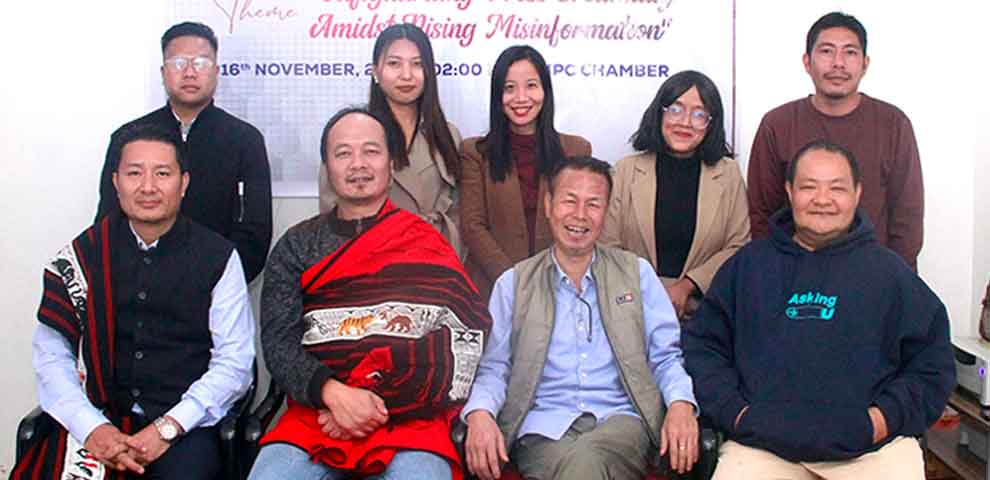
At the program organized by the Mokokchung Press Club and supported by the Department of Information & Public Relations Nagaland, Limalenden Longkumer, Editor of Mokokchung Times, said the profession’s “most important foundation” is credibility itself. “Credibility is built on trustworthiness, and once it is lost whether for an individual or for professionals, there is no foundation to stand upon,” he said. Misinformation, he noted, has become one of journalism’s most serious threats, amplified by smartphones and social platforms where “fake news and false narratives often go more viral than the truth.”
Framing his address in three parts: general, Nagaland-specific, and Mokokchung-focused, he said the profession needs “deliberate steps” to maintain credibility in an era of rapidly generated misinformation. Journalists, he stressed, are not influencers or content creators, and therefore must not prioritize virality over accuracy. Rushing to publish without verification, he warned, undermines credibility and the very purpose of journalism. “Verification should guide journalism,” he said, calling for insights and truth to take precedence over speed.
Longkumer also stressed on the importance of editorial independence and warned against bending journalism to special-interest groups. “When there is no credibility, there is nothing left to safeguard,” he said. Media literacy, he argued, must be strengthened so that the public can distinguish truth from falsehood. “No one else will come to build our credibility for us,” he said, calling for collective effort while insisting that responsibility ultimately rests with individual journalists.
Turning to Nagaland, he observed that the state’s journalism continues to function “with a mindset of the past century.” While the world’s media has moved beyond basic formats, he said Nagaland remains stuck in “5Ws and 1H”. He said, we should continue to improve ourselves professionally by comparing and learning the best practices from others.
He described the expanding practice of paid news as one of the most troubling developments. Paid news, he said, often appears in political, corporate or public relations forms and, while it may not be entirely avoidable, it becomes ethical only when clearly disclosed as sponsored content. Calling paid news “illegal, unethical, and self-defeating,” he warned that journalists risk being reduced to “presstitutes” if the line between journalism and sponsored messaging continues to blur. Hidden sponsorship, he added, misleads the public and manipulates opinion. “If paid news becomes accepted as real news, there will be no need for journalists,” he cautioned.
Focusing on Mokokchung, he recalled the essence of forming the Mokokchung Press Club and the role district correspondents have played in bringing Mokokchung issue to limelight. But he cautioned that the future of journalism in the district will depend not on institutions alone, but on individual integrity. Institutional frameworks, he said, can only go so far: “If individual journalists fail to uphold credibility, the profession itself will be lost.” The challenge, he noted, is ongoing and has no foreseeable end.
In Dimapur, the Press Club observed National Press Day at Ethnic Table, Notun Bosti, with Dr Moalemba Jamir, Associate Editor of The Morung Express, delivering the theme address.
Dr Jamir said the Press Council’s theme could not have been more relevant at a time when news, rumours, entertainment clips, political messaging, and promotional content all appear in identical formats on the same screen. This, he said, has blurred the distinction between what is news and what is not, placing extraordinary pressure on journalists to remain fair, transparent, and accurate.
He called credibility journalism’s most valuable asset -more important than printing presses, digital reach, or click counts. Credibility, he said, allows the public to trust journalists “even when truths are difficult and when facts are uncomfortable.” A lapse in one outlet, he warned, can damage institutions, communities, and the wider public.
He stressed that credibility must begin with introspection. Newsrooms, he said, must be transparent about who they are and how they operate. Many digital outlets, he noted, lack basic identifiers such as an “about us” page, which leads to visibility without accountability. This gap, he added, is not limited to new entrants – legacy and traditional media also struggle with transparency.
Dr Jamir highlighted the weakening of editorial-commercial boundaries, especially through undisclosed paid coverage. He described this as “structural misinformation,” not because the content is necessarily false, but because the public is misled about why it was published. “When journalistic duty becomes a service for hire, it undermines public trust,” he said, acknowledging the financial pressures many outlets face.
He added that sensationalism, speed-driven errors, unlabelled sponsored content, and failure to acknowledge mistakes all contribute to the erosion of trust over time.
On external threats, he said AI-generated videos, synthetic voices, doctored images, and fabricated text could cause real harm in regions like Nagaland, where identity, land, and law-and-order narratives are sensitive. AI, he said, “is not the enemy but magnifies weaknesses,” and urged newsrooms to adopt clear AI policies and be honest about how they use such tools.
He suggested strengthening internal transparency, maintaining websites with editorial information, publicly correcting mistakes, separating commercial and editorial functions, and applying public-interest tests for coverage. Sponsored content, he insisted, must always be clearly labelled. He also encouraged collaboration among press bodies to create ethical charters, conduct transparency audits, and promote media literacy. He said the Dimapur Press Club could also come up with guidelines based on PCI norms of journalistic ethics. He added that a media-literate public is the best ally against misinformation and encouraged awareness programmes, fact-checking workshops, and explainers in writing and video.
Earlier, Dimapur Press Club President Henlly Phom said the day celebrates the power of a free and fearless press and urged journalists to stand for truth and impactful storytelling. The event included a Q&A session and was chaired by Kekhriésenuo Lily Kiewhuo, with the vote of thanks delivered by Niboli H Yeptho.