
Nagaland’s senior bureaucrat Kesonyu Yhome, IAS, has urged the Nagaland Secretariat Service Association (NSSA) to revive its work culture and reclaim its central role in policy formulation, warning that a diminishing presence of the cadre in key governance processes could weaken the State’s administrative stability.
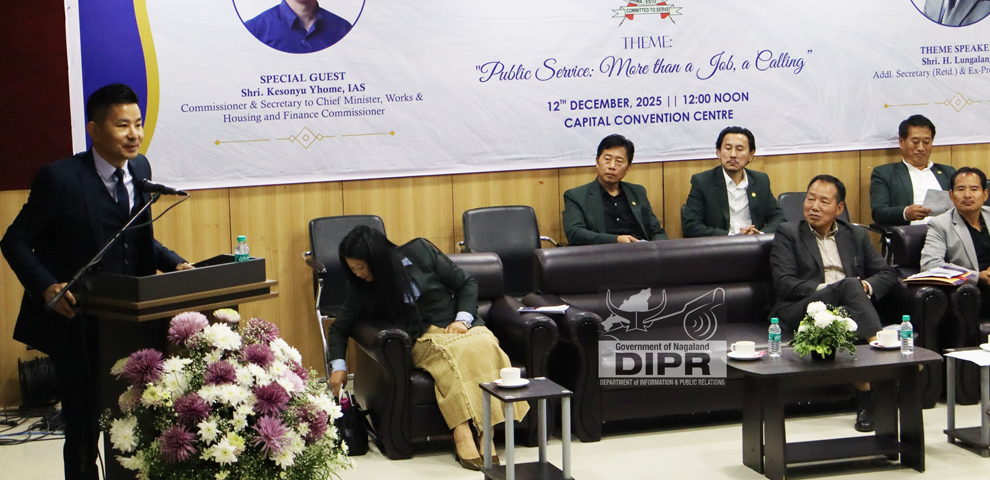
Speaking at the NSSA Triennial Conference 2025 at the Capital Convention Centre in Kohima, Yhome — who serves as Commissioner & Secretary to the Chief Minister, Works & Housing, and as Finance Commissioner — underscored the theme of the conference, “Public Service: More than a Job, a Calling.”
Describing the Nagaland Secretariat Service as indispensable to the State’s administrative functioning, Yhome said that while the Nagaland Civil Service forms the “backbone” of the bureaucracy, the NSSA is the “engine that keeps the State Administrative System running.”
“As long as the engine is up and running, the State machinery continues to function,” he said, emphasising the gravity of the responsibilities carried by NSS members. He added that the Secretariat cadre functions at the highest office of the State government, “working parallel to central services in delivering efficient governance.”
Yhome also called the NSSA the “institutional memory” of Nagaland, observing that while IAS and NCS officers come and go, continuity is maintained by Secretariat officials who remain embedded across departments.
Expressing concern over what he called a decline in work culture compared to earlier decades, Yhome reminded government employees that the privileges of job security must be matched with a higher level of duty, discipline, and sincerity.
He urged officials to prioritise solution-oriented thinking during meetings and administrative processes, instead of highlighting obstacles. With a significant portion of the State’s finances spent on salaries, he said government employees had a moral responsibility to deliver efficient and reliable service to the public.
He also encouraged NSSA members to deliberate on two critical challenges during their business session — restrictive land laws that hinder development and the need to strengthen revenue generation — noting that their administrative experience placed them in a strong position to offer meaningful recommendations.
Yhome raised concerns over the shrinking role of NSS officers in the policymaking process, calling it a worrying trend for Nagaland’s future governance.
He said the decline could be due to two reasons: either NSS officers are not being entrusted with responsibilities, or they have voluntarily stepped back. He stressed that policy formulation is not the exclusive domain of IAS or NCS officers but a “fundamental responsibility” of the Secretariat cadre.
“Do not expect all decisions to come from above,” he said, urging officials to put forward innovative ideas, fresh perspectives, and practical solutions. He added that the institutional experience of NSS officers gives them an important role in shaping policy continuity.
Addressing the gathering, retired Additional Secretary and former NSSA President H. Lungalang spoke about the unique privilege of NSS officers who remain posted in Kohima throughout their career — staying close to their families, an advantage not available to many others in public service.
He reminded officers of the effort that went into joining the service, and urged them to value their positions. Stressing work culture, he called on officers to be present at their desks so that citizens travelling long distances do not suffer due to absenteeism.
Lungalang encouraged members to reflect on their roles, emphasising that the chance to serve people is limited to one’s years in service. He warned that failure to deliver effectively could lead to regrets upon retirement. Concluding with a verse from Colossians 3:23–24, he urged officers to “work with sincerity as if serving God.”