Gorkha Union Mokokchung celebrates 50 years, traces century-long roots in Mokokchung
During the Golden Jubilee celebration of Gorkha Union Mokokchung held at Mokokchung Town Hall on Tuesday, the Register of Indigenous Inhabitants of Nagaland (RIIN) featured in the discussions, alongside reflections on the community’s long history in the district.
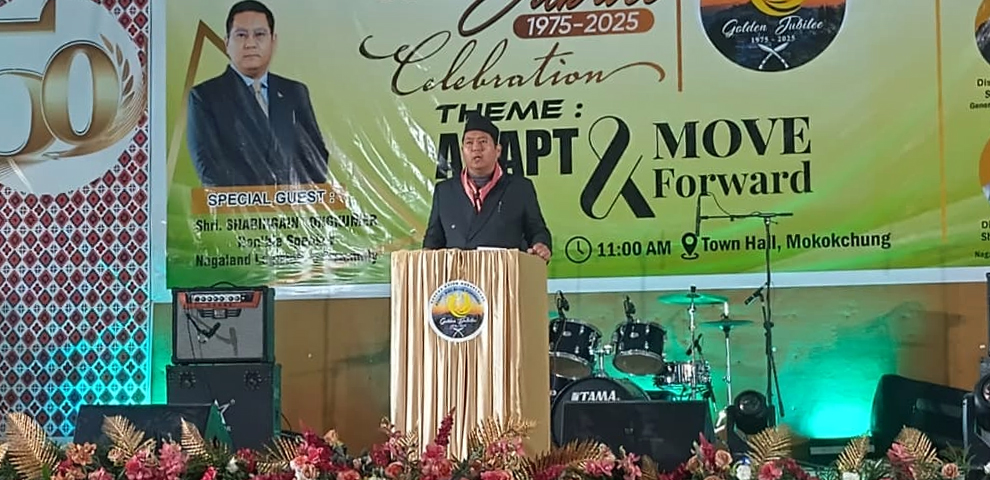
The jubilee marked 50 years of the Union, while speakers traced the Gorkha presence in Mokokchung back more than a century.
The program, held under the theme “Adapt and Move Forward”, was attended by NLA Speaker Sharingain Longkumer as the special guest and Deputy Commissioner Ajit Kumar Verma, IAS, as the guest of honour.
President of the Nagaland Gorkha Association, Nobin Pradhan, said the RIIN exercise would take away the term “indigenous” that had been made available to the Gorkhas, as as RIIN defines indigenous status on the basis of Naga blood lineage. However, he said the community continues to expect the same love and acceptance it had received from the Naga people over the years.
Pradhan also referred to assurances given by Minister of Power and Government Spokesperson KG Kenye at the 75th anniversary of the Gorkha Students’ Union, Kohima. He said Kenye had promised “special arrangements” for the Gorkha community and had spoken about finding ways to provide OBC status.
Highlighting political acceptance, Pradhan also recalled that during the previous election, no one had opposed the contestation of a Gorkha candidate on an NPF ticket, which he said reflected the trust and acceptance extended by the Naga people.
Addressing the gathering, Speaker Sharingain Longkumer said the history of the Gorkha community in Mokokchung extended far beyond the 50 years of the Union, stating that it has been “exactly 154 years” since the Gorkhas have been living in Mokokchung. He recalled that parts of Kumong, Arkong and Aongza were once considered “Faltu Line,” but with the arrival of the Gorkha community, these areas witnessed socio-economic upliftment.
“The Gorkhas came skilled in machinery and carpentry and helped in infrastructure development,” Longkumer said, adding that the community had contributed to education, sports and governance, and had become an integral part of government machinery.
However, he said the most important contribution was social networking, which helped build towns like Mokokchung, Zunheboto and Kohima. “This is how we have adapted with one another for 154 years,” he said.
On the RIIN issue, Longkumer said that whatever Minister KG Kenye had stated, he had his “full support” and that he would pursue the matter. “I give my full support to the aspirations of the Gorkha community,” he said.
Calling for unity, the Speaker said the Gorkha population in Mokokchung may have dwindled, “but not the spirit.” He added, “You are as much a part of the Land of Pioneers as we are.” Urging all community leaders and elders to come together, he said understanding “unity in diversity” was necessary to move forward.
Linking national goals with local development, Longkumer also spoke about Viksit Bharat 2047 and said he envisioned a Viksit Mokokchung 2047. He invited the Gorkha community to join hands with the ten MLAs of the district in areas such as social engagement, entrepreneurship, infrastructure and industry.
Earlier, speaking on the significance of the day, Sanjay Rai, Director (Retd), recalled the long journey of the Gorkha forefathers whose roots in Mokokchung date back to the 1800s. He said many were ex-servicemen who fought in the Second World War and later chose Mokokchung as their home. He added that the settlers were involved in farming, masonry and cattle rearing, gradually assimilating with the Ao community and building cordial relations.
Guest of honour Deputy Commissioner Ajit Kumar Verma described the jubilee of what he called “India’s most patriotic community” in the “Land of Pioneers” as profoundly symbolic. Recalling how he first learnt about the Gorkhas through a patriotic song by Lata Mangeshkar, Verma said the contribution of the Gorkhas to India and the Indian Army was historical and significant. He added that the strength of India lies in unity in diversity and urged Ao communities to ensure social safety, harmony and security for minority communities.
General Secretary of Ao Senden, Imtipokyim, recalled that the Government of Nagaland had recognised the Gorkhas prior to December 1940 and accorded them the status of non-Naga indigenous inhabitants.