
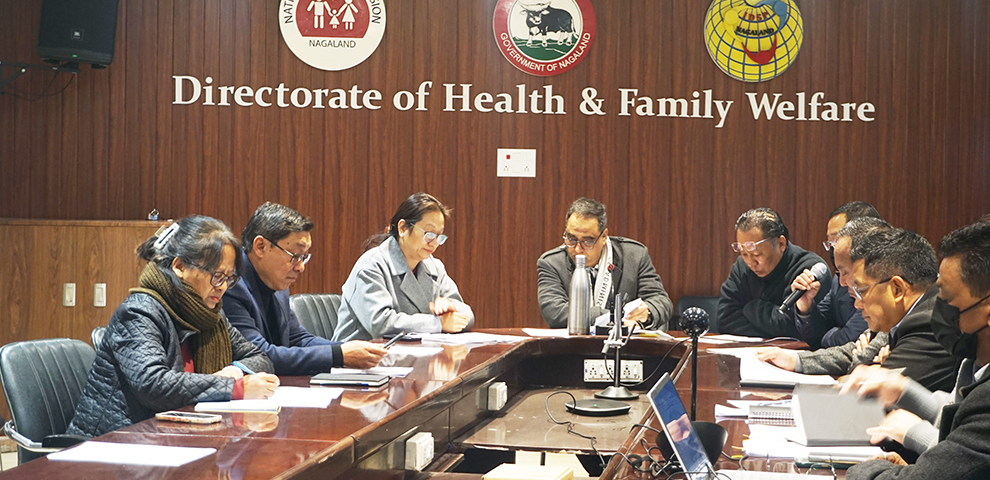
The mission was virtually launched by Commissioner & Secretary, Health & Family Welfare, Anoop Khinchi, IAS, from the IDSP Hall, Directorate of Health & Family Welfare (DoHFW), Kohima.
While launching the mission, Khinchi said that everyone involved should understand why NQAS certification of public health set-ups is important, adding that it is a framework to enhance quality patient care and build public confidence in the public health care system. He encouraged the state and district mentoring teams to work towards achieving certification of 50 per cent of public health facilities during the 100-day mission period and appealed to health personnel across districts to adhere to the prescribed timelines.
Principal Director, DoHFW, Dr Mereninla Senlem, said the Government of India has placed strong emphasis on quality health care through NQAS certification of public health units. She said quality could be sustained when internal systems within institutions are strengthened and ownership is taken by service providers, urging CMOs, medical superintendents and district programme officers to actively participate in the process.
Welcoming officers who joined both physically and virtually, Mission Director, National Health Mission, Dr. Keveduyi Theyo, said the 100-day mission was launched to improve health care quality and expedite NQAS certification of health facilities within a defined timeline.
Delivering the concluding remarks, Director (Health, ME & RS), Dr Sentimeren Aonok, said the mission should not be treated as a standalone programme, as it incorporates all activities concerning the health care delivery system. He said NQAS certification is important in ensuring safe and quality health care delivery in a clean and healthy environment, and requested district teams led by CMOs, medical superintendents and programme officers to ensure that standard operating procedures are followed.
As per Government of India guidelines, all public health facilities are required to be NQAS certified by December 2026. With the state missing the 50 per cent certification target by December 2025, the government has now adopted a mission-mode approach to accelerate implementation across districts.