Nagaland moves to fully digitised registration
A birth certificate will now serve as the sole legal document for admission to educational institutions, issuance of driving licences, inclusion in electoral rolls, Aadhaar enrolment, marriage registration and government employment for individuals born on or after October 1, 2023, following the implementation of the Registration of Births & Deaths (Amendment) Act, 2023 and its adaptation in Nagaland.
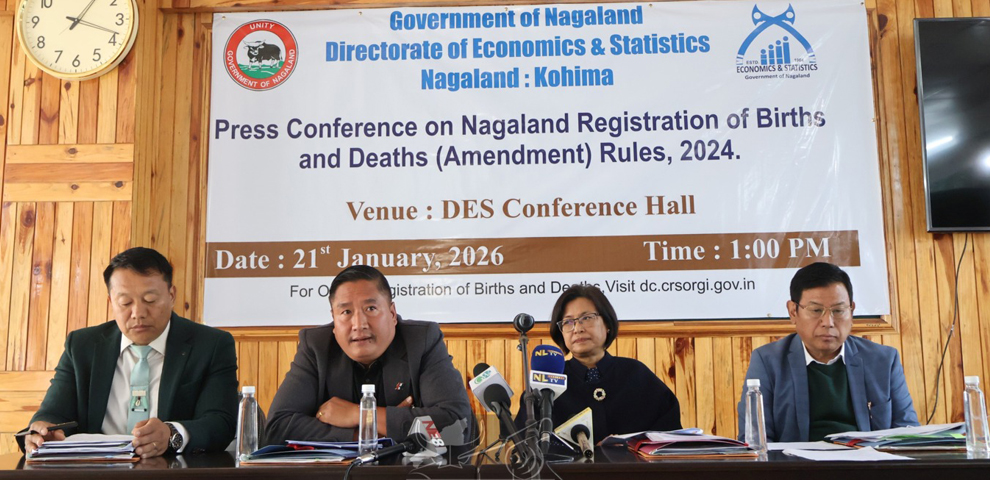
This was stated by Advisor for Economics & Statistics, IT&C and Evaluation, H Sethrongkyu Sangtam, during a press conference on the Nagaland Registration of Births & Deaths (Amendment) Rules, 2024, held at the Directorate of Economics & Statistics here on Tuesday.
“Birth and death are the two most important vital events that define the life of an individual and describe their legal existence,” Sangtam said, adding that the registration of these events forms the primary source of vital population data.
He informed that while the Registration of Births & Deaths Act, 1969 was amended at the national level in 2023, Nagaland adopted the changes in 2024 to meet local requirements through amendments to the Nagaland Registration of Births & Deaths Rules, 1999.
Sangtam disclosed that the State currently has 1,474 registration centres, of which 1,447 are located in rural areas and 27 in urban areas, as on December 31, 2024.
In rural areas, each recognised village has a registration unit manned by a Government Primary School or GMS teacher acting as the Registrar of Births & Deaths. Registration units have also been set up in PHCs and CHCs, where the nursing in-charge serves as the registrar.
In urban areas, registration units function from the Directorate of Economics & Statistics, offices of the District Registrars, and government district hospitals, where Nursing Superintendents register all vital events occurring in medical institutions.
Elaborating on the 2023 amendment, Sangtam said the Act has been in force across the country since October 1, 2023, and is also aimed at creating a national and state-level database of registered births and deaths. “It is the only document to prove the date and place of birth of a person born on or after October 1, 2023,” he added.
Secretary, Economics & Statistics, Akunu S Meyase, IAS, highlighted the registration procedures for birth and death events as mandated under Sections 8 and 9 of the Act, explaining the process applicable to both urban and rural areas.
Meanwhile, Director of Economics & Statistics, Neidilhou Angami, said the Registrar General of India (RGI) has developed a uniform Online Civil Registration System (CRS) under Sections 12 and 17 of the Act. Certificates issued through the system are accessible at dc.crsorgi.gov.in and carry unique registration numbers and QR codes, which can be verified at crsorgi.gov.in.
Angami noted that online registration of births and deaths in Nagaland was launched on April 19, 2022, and is currently implemented across all 11 district headquarters, including the Directorate. As of October 31, 2025, 889 registration units have been activated on the ORGI portal, with the remaining units to be brought online in phases.
He further informed that a revamped CRS portal, launched on May 13, 2024, now allows the general public to apply for birth and death certificates within 21 days of the event, with certificates delivered electronically to registered email IDs and mobile numbers. All manually issued certificates can also be digitised under the new system.