
First-ever village-level training sparks immediate action across nine districts
Farmers across Eastern Nagaland are taking beekeeping into their own hands after a series of intensive scientific training programs, marking a significant milestone in rural livelihood development. Covering Nokyan, Kusong, Sanglao, Pathso, Panso, Yakor, Shamator Headquarters, Sangphur, and Leankonger villages, the initiative brought practical apiculture knowledge directly to villages for the first time, except for Yakor Village, already known as a local “honey bee village.”
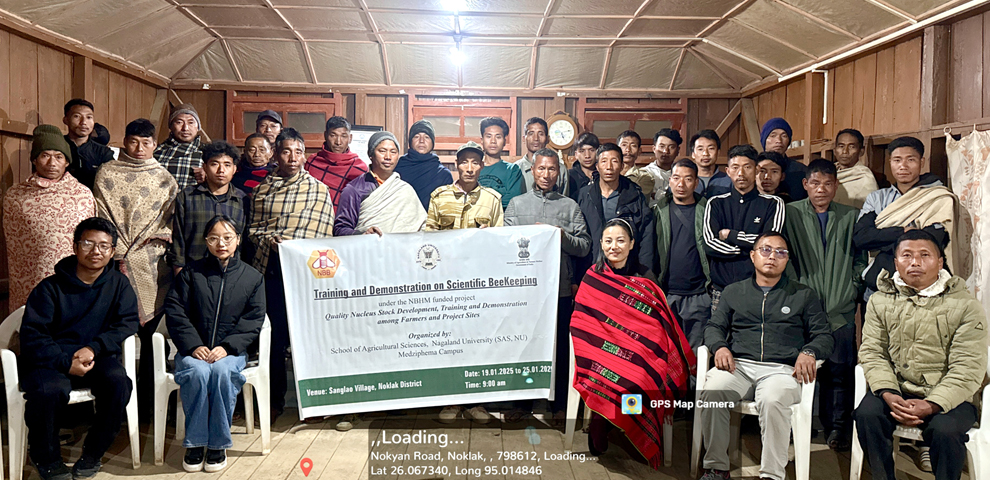
The programs, conducted between January 19 and 27, were implemented by the School of Agricultural Sciences, Nagaland University, Medziphema Campus, under the National Beekeeping and Honey Mission (NBHM), National Bee Board, Ministry of Agriculture and Farmers Welfare. The initiative targeted members of Farmer Producer Organisations (FPOs) supported by the Small Farmers’ Agribusiness Consortium (SFAC), with technical support from the Nagaland Honey Bee Mission and oversight by the District Agriculture and Horticulture Offices.
The training focused on hands-on demonstrations in colony inspection, seasonal management, disease identification, swarm control, hygienic honey harvesting, value addition, and crop pollination. Participants learned how scientific apiculture could improve oilseed crop productivity while enhancing the quality and market value of honey.
The immediate impact of the training was evident. In Kusong Village, ten farmers collectively pooled resources (Rs 500) to construct eight-frame bee boxes with brood and super chambers, applying newly acquired techniques. Across all participating villages, farmers began building bee boxes independently, forming cooperative groups, and preparing to integrate scientific beekeeping into their regular farming activities.
The program, led by Dr Mary N Odyuo, Associate Professor and Principal Investigator, and Dr Avinash Chauhan, Scientist and Co-Principal Investigator, emphasized capacity building, sustainable livelihoods, and the creation of local models for scientific beekeeping. Officials, including SDO (Civil) Bodi Kapfo, joined the program in Leankonger Village, underscoring local administration support.
By combining practical knowledge, institutional support, and farmer initiative, the program aims to strengthen rural livelihoods, improve oilseed productivity, and establish organized apiculture as a sustainable source of income. The success of these village-level trainings positions scientific beekeeping as a viable, scalable model for Eastern Nagaland.