

Where the Nagaland Foothills Road project stands today
Arenjungla Kichu
Mokokchung | 2 February
A 395 km stretch, one of the most ambitious road projects Nagaland has undertaken. A road that aims to connect the entire state, running from Tizit in Mon district to Khelma in Peren district, famously known as Nagaland Foothills Road. It has come a long way from a concept in the 1960s to actual groundwork carried out between 2013 and 2026. Yet, the unsettling question remains: 395 km, 13 years, and still some parts of the road have not seen earth cutting. Can the government under Chief Minister Neiphiu Rio make the Foothills Road motorable by 2027?
The project faced rejection for funding in 1974 and 1993 but gained renewed momentum in 2013 after sustained pressure from civil society organisations. In 2013, the Foothills Road was finally funded by the Planning Commission under Special Plan Assistance during the UPA government.
Initially, Rs 40 crore was sanctioned. In 2014, with the coming of the Modi-led BJP government, the Planning Commission was abolished and replaced by NITI Aayog, which affected the flow of funding. Despite this, the Nagaland government continued to invest in the project. In total, about Rs 100 crore had been invested before 2024, said Supu Jamir, Convenor of the Nagaland Foothills Road Coordination Committee (NFHRCC), a pressure group endorsed by the 14 tribal hohos to monitor construction.
“With that Rs 100 crore, the Doyang bridge came into being. It cost about Rs 29.5 crore. Earth cuttings and earthworks were done with the rest,” Jamir told MT.
Later, the project was announced to come under SASCI. Today, the Foothills Road is implemented under States for Capital Investment (SASCI), a loan-based mechanism with a 50-year repayment period, managed by the Finance Ministry. The SASCI allocation for 2024–25, considered Phase I, announced Rs 148.5 crore. With this funding, construction resumed, giving new life to the project. Significantly, with funding and monitoring by NFHRCC, the Nagaland Foothills Road project can indeed become a true reality. The only question is how soon.
Chenithung Humtsoe, General Secretary of NFHRCC, said discussions between the government and the committee suggested that the project could be completed by 2026, with some flexibility.
“When the situation was a little better, the government and NFHRCC sat down and discussed that by 2026, or at the most 2027, it should be black-topped,” Humtsoe said.
Supu Jamir echoed this optimism. He strongly believes that if the government is sincere, the Foothills Road can indeed be completed by 2027.
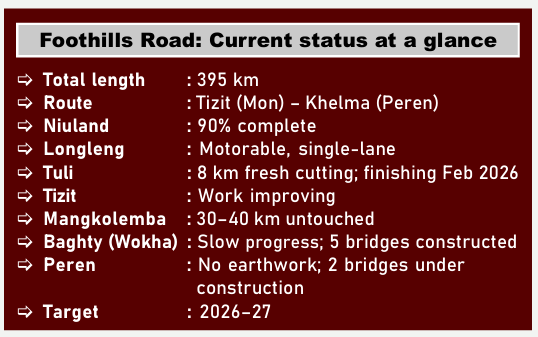
Currently, according to NFHRCC, in Niuland, the stretch is nearly 90 percent complete, and progress is “quite okay.”
In Longleng, the improved road has been completed and is pliable, though it remains a single-lane road. “The finishing is good,” Humtsoe said. In Tuli, an 8-kilometre fresh cutting was undertaken due to alignment changes, and the stretch is expected to be completed by the end of February. Work in Tizit, which started late, has shown improvement, and NFHRCC plans another monitoring visit soon. “We were told they were doing well,” Humtsoe said.
However, several stretches remain at early or slow stages. In Mangkolemba, 30 to 40 kilometres of the road have not yet been started. In the Baghty division under Wokha district, progress has been particularly slow. NFHRCC said they are satisfied only with the five bridges that have come up, constructed as galvanised double-lane modular steel bridges. Other than that, the earthworks are not satisfactory. Meanwhile, Peren district remains largely untouched, with only two bridges under construction. Like Mangkolemba, no earthwork has been started in Peren.
The work orders for several stretches have now expired. Therefore, NFHRCC believes it is time for the state government to release the work order for the second phase under SASCI.
“With the second phase work order released, we can look into Peren district, Mangkolemba under Mokokchung district, Champang area under Wokha division. The burning issue is we want to appeal to the state government to release the second phase work order,” Jamir said.
Admitting that funding has been a major challenge in the Foothills Road’s journey, Humtsoe also cited weather and accountability as factors slowing down the project.
“Last year the monsoon was not favourable, but I think accountability matters,” he said. “Contractors must take it seriously. It is a very limited fund, so it must be used judiciously and with a focus on quality.”
He also pointed out that the one-year contract period has already ended. “We are not very happy because the one-year contract is over,” he said, adding that contractors have sought extensions. On who should be held primarily responsible for the current pace and quality of work, Humtsoe said, “It will be the contractor firm supported by some politicians.”
Both Humtsoe and Jamir emphasised that the success of the Foothills Road cannot rest solely on NFHRCC.
“The public also need to pressure the government. This is a people’s road,” Humtsoe said. “Our tribal hohos can also play a huge role and not leave everything to NFHRCC alone.”
“This is a collective responsibility,” he added. “If this doesn’t work, it will be a collective failure.”
“The NFHRCC is literally helping the state government. We are 100 percent trying to cooperate with the state government. It is unfortunate that we are being treated like a stumbling block,” Jamir said.
Admitting that the state’s economy is in a very bad state, Jamir said, “Road is the mother of development. Once this road becomes operational, the burden of the government will lighten. Economic dynamics will change with this road becoming operational. We wish the general public and the hohos would give their voice at the right time and give very strong pressure to the government. The NFHRCC is the mouthpiece of the public.”
So far, NFHRCC expressed happiness over the support they have received from the tribal hohos, particularly the Ao Senden.
Over the years, the Foothills Road has also seen changes in its alignment and vision. Initially planned from Tizit to Khelma, adjustments were made to keep the road within Nagaland and avoid crossing into Assam. Later, plans to upgrade the road to two lanes and eventually to National Highway standards led to further revisions, including fresh cuttings in areas such as Tuli and debates over stretches like Baghty.
“There is a plan to upgrade it to a National Highway,” Humtsoe said, adding that the Ministry of Road Transport and Highways has, in principle, agreed to the proposal. Once upgraded, the road is expected to link with the Arunachal Frontier Highway at Tizit and an Assam–Manipur highway near Khelma.