

A Nagaland University study has highlighted soil erosion as an emerging environmental concern in the hilly regions of Northeast India, affecting land stability, agriculture and water resources.
The study notes that the issue is influenced by a combination of natural factors such as steep slopes and high rainfall, along with human activities including deforestation, shifting cultivation, mining and unplanned infrastructure development.
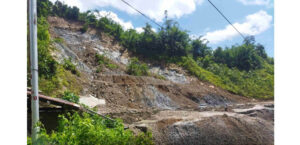
The research focused on the Siji watershed in the Gai River Basin in Assam, identified as one of the erosion-prone areas in the region. Using the Revised Universal Soil Loss Equation (RUSLE) integrated with Geographic Information System (GIS) modelling, the study assessed soil erosion patterns based on rainfall, soil characteristics, slope, land use and conservation practices.
Findings indicate that areas with dense forest cover and gentle slopes experience relatively low soil loss, while regions with steep terrain, agricultural activity, barren land and human disturbances such as road construction and mining are more vulnerable to erosion. The study also recorded higher erosion levels in specific zones, pointing to localized land degradation risks.
The research paper has been published in Discover Geoscience, a peer-reviewed journal under Springer Nature.
Explaining the approach, according to an update reveived here, Prof MS Rawat said integrated watershed management is necessary to reduce soil loss.
“We recommend an Integrated Watershed Management approach, including sustainable land use planning and measures such as contouring, terracing and vegetation cover to control erosion and improve water management,” he said.
The study highlights that watershed-based modelling helps identify erosion-prone areas at a micro level, allowing targeted interventions rather than uniform measures across larger regions.
The study also suggests that the framework can be adapted for other ecologically similar regions in India and beyond, and calls for further research on flood prediction modelling and environmental monitoring systems in view of increasing human pressure and climate variability.