

Legal questions over whether the “Nagaland Village and Area Councils Act, 1978” accurately reflects Ao customary governance came under sharp scrutiny at Ao Senden’s Shishatokden Sentong (seminar) held at Mokokchung Town Hall on Tuesday, May 12.
The discussion centred on Section 6 of the Act, particularly a proviso which states: “Provided further that village institutions which were traditionally established like the ‘Putu Menden’ in Ao area and recognized as Village Council shall continue to function as Village Council according to respective custom and usage.”
Participants raised concerns over what they described as an apparent contradiction between the statutory framework of Village Councils and the traditional institution of Putu Menden.
The key issue was tenure.
While Village Councils under state law generally function on a five-year term, Putu Menden in Ao customary practice may continue for much longer periods, in some cases extending to three decades depending on village-specific traditions.
This led to questions over whether Putu Menden and Village Council were being treated as the same institution under law despite operating differently in practice.
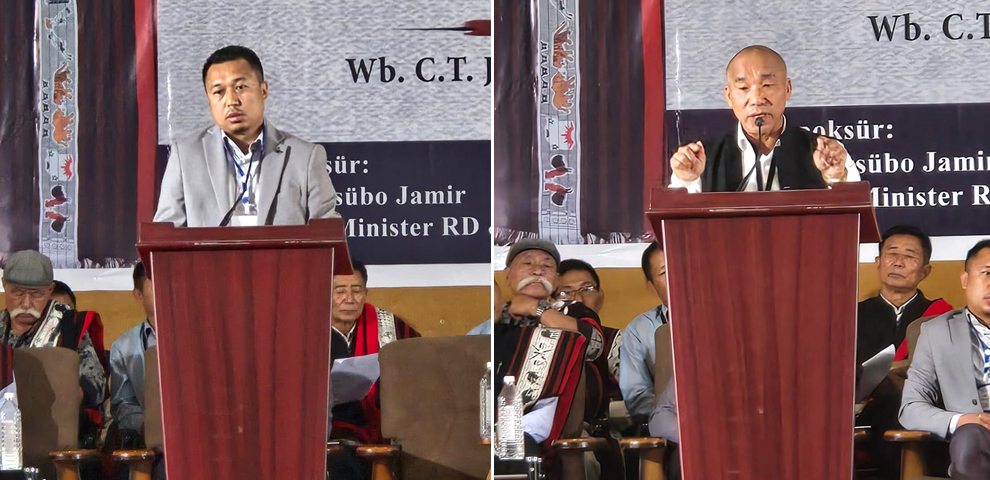
Advocate Sentiyanger Pongen clarified that the proviso must be interpreted narrowly and specifically within the context of tenure under Section 6.
According to Pongen, the clause focuses only on the tenure and explained that depending on the village, Putu Menden may have varying tenures, and during that period, Village Councils are elected from within the Putu structure.
Section 4 of the Act also came under discussion.
The section states: “A Village Council shall consist of members, chosen by villagers in accordance with the prevailing customary practices and usages, the same being approved by the State Government, provided that hereditary village Chiefs, GBs and Anghs shall be Ex-officio Members of such Council and shall have voting right.”
ALSO READ | Who owns Nagaland’s oil?
Participants questioned whether this provision fully aligns with Ao customary practice, pointing out that while Gaon Buras (GBs) may be part of Putu Menden, they do not traditionally exercise the same kind of voice within Putu Menden as the statutory provision may imply.
Responding to the concerns, Senior Advocate C T Jamir said “Since these laws were made in 1978, many were not knowledgeable enough,” Jamir said, suggesting that changes in legal understanding and customary interpretation now require “fine tuning” and that this can be initiated by legislators.