
Dimapur produces about 90 metric tonnes of garbage every day. The Dimapur Municipal Council (DMC), however, produces something far more renewable: CRISIS. Garbage, at least, has the decency to stay where it is dumped. Councillors? Not so much.
Ever since the birthing of the DMC, the Cock has ruled the roost — the first chairperson and all subsequent ones belonging to the NPF, a party that, despite many a culling, has retained the Cock (Rooster) as its symbol. Officially, the symbol represents vigilance and awakening — an iconic emblem in Nagaland politics representing regional political identity.
Unofficially, the DMC interpreted the symbol as: constant cock-fighting — a tradition faithfully practised since the council came into being in 2004. Over the past two decades, Dimapur has changed, the DMC and its councillors have changed, but cock-fighting has remained the council’s most consistent civic tradition. This was evident again in May 2026, when the chairman, considered the chief rooster, was challenged by a rival flock with a No-Confidence Motion. In most functioning democracies, that signals a crisis. In the DMC, it signals routine maintenance.
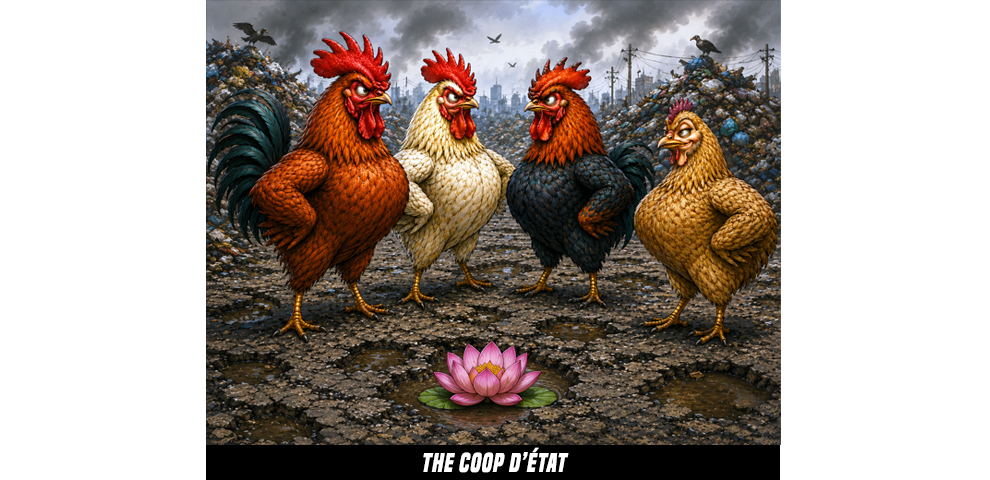
Of course, as of today, peace has returned to the DMC coop, the no-confidence motion has flown away, and the flock is once again crowing in harmonious agreement — pending future disagreements.
From Cock Symbol to Cocky Politics
To appreciate the beauty of this 2026 moment, one must revisit the DMC’s early days.
Back then, the municipal council resembled less an urban institution and more a live-action political derby, chiefly featuring three heavyweight roosters — all with allegiance to the NPF: Vikheho, Tovihoto, and Khekaho — moving against one another in recurring no-confidence episodes that gave the chairmanship all the stability of a plastic chair at a village feast.
The first No-Confidence Motion was moved in 2006. In less than four years since its founding in 2004, the DMC saw at least four chairmanship changes, with one cocky manoeuvre after another. It resembled a high-adrenaline game of musical chairs.
And then came Reservation. For years, urban local body elections in Nagaland remained frozen under the long shadow of the women’s reservation controversy. Entire elections collapsed. Protests erupted. Governments retreated.
The Coop Expands — And How
With the “historic” ULB elections in 2024, the DMC evolved — no, absolutely not in terms of governance. The cock-fight legacy lives on. The DMC coop simply became more gender-inclusive: hens arrived. The cock-fight acquired feathers of gender representation. And in a development so poetically Dimapur that even satire hesitates to improve upon it, the latest rebellion was led not by another rooster — but by a hen displaying the same political cockiness as the roosters.
Women finally entered municipal politics after decades of resistance and delay. Eight women won from reserved seats and one from a general seat. One expected gradual adjustment, cautious participation, perhaps symbolic inclusion. Instead, one ambitious hen looked at two decades of roosters fighting each other and apparently concluded: “I too would like to destabilise a chairman.”
The one woman councillor who won from an unreserved ward immediately entered the great DMC tradition — not participation, not observation, but straight to regime change. That, in its own chaotic way, is progress. What better example of gender equality could there be?
And yet, beneath the satire, something genuinely historic — a new dawn — seemed to be on the horizon. Because had the rebellion succeeded, Dimapur would have had its first woman chairperson — not through symbolic accommodation or polite political consensus, but through the exact same ruthless political mechanics long monopolised by men.
NPF-BJP Romance — To What End?
The political arithmetic of the DMC at the time added another layer of classic Nagaland absurdity.
Some NPF councillors joining hands with the Bharatiya Janata Party (BJP) to challenge the NPF’s own leadership would once have sounded ideologically dramatic. Today, it barely raises an eyebrow.
Nagaland politics long ago evolved beyond rigid ideological frameworks into something far more fluid: advanced survival choreography.
In Nagaland, political and party ideologies function more like optional decoration. And nowhere is this more visible than in DMC politics, where elections are fought with extraordinary financial enthusiasm just for the opportunity to spend the next five years attending emergency meetings about drainage, taxation disputes, and no-confidence motions.
The DMC’s health is determined not just by its leadership, but chiefly by revenue control. Revenue streams exist — but collection and remittance remain disputed. Resistance is strongest wherever revenue control is threatened. A municipal body created to govern a fast-growing city has instead become a theatre of factional politics, where enforcement is resisted, revenue is contested, and governance is episodic.
Dimapur, meanwhile, continued — and will in all likelihood continue — existing out of habit. While the camps calculated numbers and councillors rediscovered constitutional morality depending on current arithmetic, the city quietly carried on: flooding in parts, choking on waste, improvising infrastructure, and withering under collective indifference. Its residents now process alliance shifts the same way they process power cuts — annoyed, unsurprised, and already adapted.
A Modest Proposal
At this point, the DMC chairman’s chair may well be the most cursed piece of furniture in Nagaland — so much so that it deserves heritage status. Few objects in the state have witnessed more betrayal, more secret meetings, more absurd arithmetic, or more strategic holidays at resorts.
So then, why hide the drama? Perhaps Dimapur should stop apologising and start monetising it — the DMC drama, aptly packaged and marketed as Cock-a-doodle-Coup: A Heritage Political Tour.
Visitors would receive historical no-confidence timelines, live faction updates, and real-time viewing of councillors camping in resort retreats. A special premium package would additionally feature a contest: “Guess the Leader of the Next No-Confidence Alliance.”
Winners would receive a guided viewing of the heritage-tagged Chair of the DMC Chairperson, followed by an exclusive tour of the DMC dumping site at Sunrise Colony, Burma Camp.
No Joke, This
Dimapur is not just another town. It is Nagaland’s commercial nerve centre — the gateway through which goods, money, and migration flow into the state. But its primary urban authority, the Dimapur Municipal Council, has never quite matched the scale — or urgency — of the city it governs. Instead, over two decades, the DMC has evolved into something else entirely: a civic institution where power struggles routinely eclipse public service, and where governance is episodic, fragile, and frequently paralysed.
The story of the Dimapur Municipal Council is not just about one crisis or one chairman. It is about a deeper failure — a municipal institution that never fully transitioned from political battleground to civic authority.
For now, the coup appears to have been called off, the feathers smoothed, and harmony restored to the municipal coop — courtesy of the intervention of the NPF’s senior roosters. Yet the questions remain. Why did the big rooster entrusted with watching over the coop allow the squawking, clawing, and public display of feathers to escalate in the first place? Does he harbour favourites among the flock, or was this merely an elaborate exercise in pecking-order management? Whatever was hatched before May 20 appears to have worked, for the once-warring inmates of the coop are now crowing from the same perch again — if only in temporary harmony. The arrangement may have restored peace within the NPF coop, but it leaves another question hanging in the air: where does this newfound unity leave the six BJP councillors who briefly found themselves sharing grain with dissident roosters? And above all, the most intriguing question remains. The hen who came closest to rewriting DMC history has not disappeared into the nest. What exactly does she have tucked beneath her feathers, and can she prove fully capable of surviving — and perhaps one day mastering — the DMC’s legendary rooster politics?
(Kallol Dey is a senior journalist based in Dimapur who has spent years covering Nagaland politics, insurgency, elections, corruption, civic collapse, and the occasional road that survives monsoon. He believes the DMC should either be reformed immediately or officially recognised as Nagaland’s longest-running reality show.)
(The views expressed are those of the writer and not of the newspaper)