
India and Japan on Thursday expanded their Special Strategic and Global Partnership, signing a series of agreements on defence, economic security, artificial intelligence, semiconductors and critical technologies, while reaffirming cooperation aimed at strengthening connectivity and regional development, including in Northeast India.
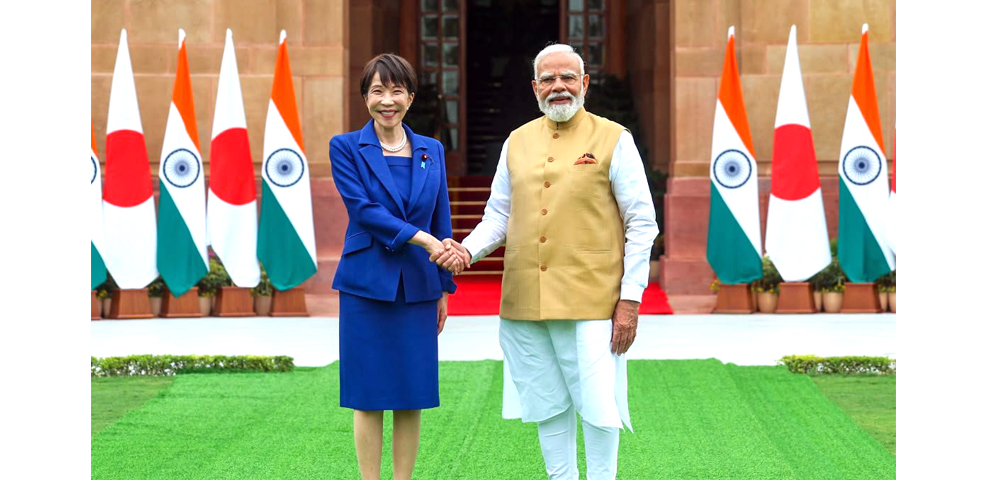
Prime Minister Narendra Modi and Japanese Prime Minister Sanae Takaichi held the 16th India-Japan Annual Summit at Hyderabad House, where the two sides signed a Memorandum of Cooperation (MoC) following delegation-level talks.
Among the key outcomes of the summit were a joint roadmap on economic security and agreements to strengthen cooperation in artificial intelligence, shipbuilding, semiconductors, biotechnology, biogas and other critical technologies. India and Japan also signed their first joint defence co-development agreement involving the Naval Radio Antenna “Unicorn”, marking a new milestone in bilateral defence cooperation.
Addressing the summit, Modi said India and Japan shared a common vision for a “free, prosperous and rules-based Indo-Pacific” and described technology cooperation as one of the strongest pillars of the future partnership. He said the two countries had also issued a joint statement on artificial intelligence and agreed to strengthen resilient supply chains in strategic sectors such as semiconductors, quantum technology and advanced materials.
The Prime Minister said around 120 new business agreements concluded over the past year were expected to bring more than US$10 billion in Japanese investments to India. He said both countries had set a target of attracting 10 trillion yen in Japanese investment and doubling the number of Japanese companies operating in India over the next decade.
The summit also saw the launch of the India-Japan Biogas Initiative, under which 1,000 biogas and organic fertiliser plants will be established across the country. Modi said the initiative would strengthen the GobarDhan scheme while promoting sustainability, rural livelihoods and clean energy.
Beyond the bilateral agreements, the summit highlighted the growing strategic importance of Northeast India within the India-Japan partnership.
According to diplomatic sources, discussions included the development of an industrial value chain connecting the Bay of Bengal with Northeast India, alongside continued cooperation under the India-Japan Act East Forum to improve connectivity and regional development.
The focus on the Northeast comes as the Centre seeks to strengthen the region’s role under the Act East Policy.
Union Commerce and Industry Minister Piyush Goyal has said Japan could play a crucial role in boosting infrastructure, industry and connectivity across the Northeast, describing the region as India’s gateway to ASEAN markets and a bridge for trade and economic engagement with Southeast Asia.
Japan has emerged as one of the Northeast’s key development partners through investments in infrastructure, connectivity, skills development and disaster resilience. Cooperation has also expanded into education, tourism, cultural exchanges and employment initiatives, with several northeastern states, including Nagaland, pursuing partnerships with Japanese institutions.
Although Prime Minister Takaichi’s visit did not include the Northeast, Thursday’s summit underscored the region’s growing importance in India-Japan relations as both countries deepen cooperation across trade, technology, investment and regional connectivity.