
Nagaland is turning to scientific research to strengthen its agarwood sector, with the State government signing an MoU with the Rain Forest Research Institute (RFRI), Jorhat, covering everything from planting material and farmer training to processing and export.
The Department of Environment, Forests and Climate Change (DEFCC) and RFRI signed the agreement at the Forest Office Complex, Dimapur, on Saturday.
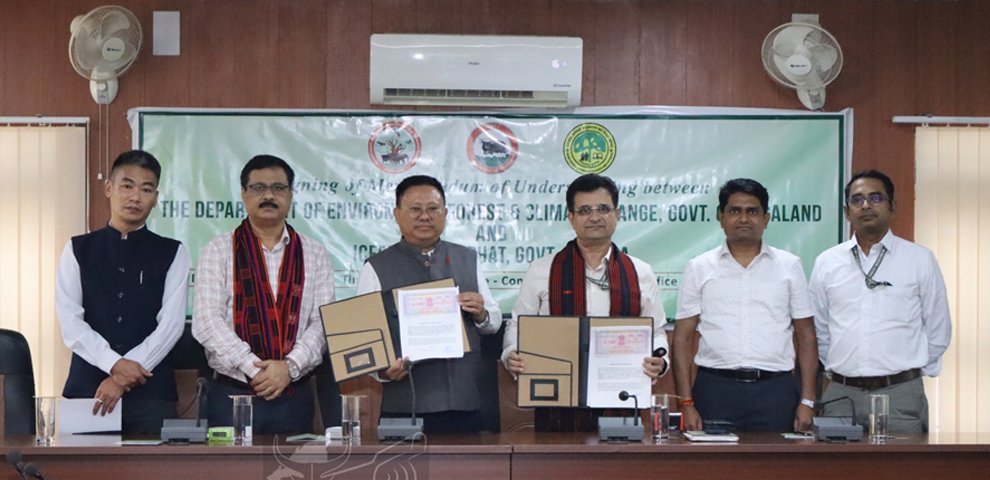
The partnership will provide for identification of suitable agarwood varieties, soil testing, quality saplings, farmer training and scientific harvesting protocols. It will also cover processing techniques, transportation and export management.
The move comes as Nagaland seeks to develop a sector that has long had a significant resource base but limited infrastructure and market support within the State.
Principal Secretary, DEFCC and Development Commissioner Y Kikheto Sema had estimated during discussions with RFRI scientists in March that Nagaland could have around 25 lakh agarwood trees.
Yet the State’s annual export quota stands at only 3,400 kg of agarwood chips or powder and 180 kg of agarwood oil, accounting for about 2.25 per cent and 2.55 per cent of the national quota respectively.
Sema had also pointed out that nearly 80 per cent of the national export quota was allocated to Assam, although Nagaland, Assam and Tripura have some of the country’s largest agarwood plantations.
The State has identified the lack of a dedicated policy, processing facilities and organised marketing as some of the constraints on the sector. Many growers have relied on traders from Assam to sell their produce, with farmers often receiving lower prices.
Nagaland now has a policy framework for the resource. The Nagaland Agarwood Policy, 2026 was formulated following consultations with RFRI in March and approved by the State Cabinet on May 6.
The MoU provides the technical partnership to support its implementation.
RFRI Director Dr Nitin Kulkarni said the institute would survey existing agarwood resources in Nagaland and assess their quality, while supporting plantation expansion and promoting agroforestry. Scientific technologies would also be applied to improve resin formation and the commercial value of agarwood.
Artificial inoculation is among the technologies being brought into the partnership.
Sema said RFRI’s Sashi Inoculation technology has a success rate of over 90 per cent in inducing artificial resin formation. He said it could provide farmers an alternative to unregulated private inoculation practices and access to more reliable and affordable technical support.
The agreement also extends to the stages after cultivation, including processing, transportation and export management.
Sema expressed hope that Nagaland could establish an agarwood processing facility similar to the unit in Golaghat, Assam, which he said was sanctioned in the Union Budget.
He said agarwood could generate 40–50 times higher returns than traditional jhum cultivation, potentially creating livelihood opportunities for farmers and unemployed youth.
The RFRI partnership will not be limited to agarwood. Kulkarni said it would also facilitate research and technology transfer involving other forest resources, including teak and bamboo.