
Nirendra Dev | New Delhi
At least 19 people have died in Nagaland over the past two days after allegedly consuming spurious liquor. Mokokchung district reported eight deaths, while Tuensang district reported 11 other casualties following the consumption of suspected illicit liquor.
The state Police have formed a Special Investigation Team (SIT) to investigate the deaths and trace the supply chain of suspected adulterated liquor in the state, where a prohibition law has been in place since 1990.
Recall time.
When Mumbai was still ‘Bombay’ and the popular tabloid ‘Mid-Day’ used to be published in brown and black.
The news clipping was my story published in 1990 in Mid-Day …. on Prohibition of Nagaland.
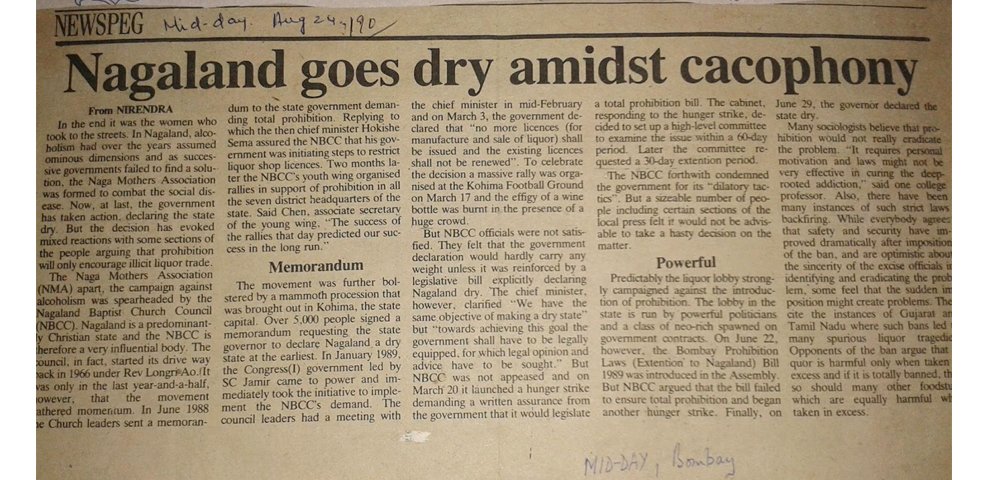
TIME CYCLE TOOK A TURN: YEARS LATER I LANDED IN Mumbai, the name was changed.
It was no longer Bombay……Mid-Day was a coloured tabloid….
AMIDST CACOPHONY now 19 deaths …. so sad … time to say ‘Om Shanti’ or Rest in Peace.
Something in life always has a story to share, a story from the heart!!
Dil Ki baat or Mann Ki ?
Essentially, Prohibition is simply a case of: — Reviving an idea whose time may have ‘long expired’.
In 2016, Bihar’s ‘su-sashan’ babu Nitish Kumar government tried with the experiment. We always thought he should have been more pragmatic before announcing prohibition as this cost several states earlier in terms of revenue and only helped bootleggers.
Many Naga politicians – used to say – Prohibition idea was a folly. Prohibition has either failed as in Nagaland or Manipur or had to be withdrawn as in Mizoram.
“We brought in the Nagaland Liquor Total Prohibition Act in 1989. I was part of the Congress party that brought the law.
But that was a mistake. We only helped the bootleggers of Assam and cash-starved Nagaland lost huge revenue,” added a Naga politician and a former minister in 2016.
“Mizoram was reeling under Prohibition for 18 years and one of our governors said: ‘Mizoram is the wettest dry state in the country.’ Not a comment to be proud of. Let’s not indulge in hypocrisy,” wrote Vanlalruata from Mizoram capital Aizawl on Facebook on the day prohibition was enforced in Bihar in 2016.
Christian-majority Mizoram declared prohibition under the influence of church bodies but lifted this in July 2014 after 18 years of struggling with its failure. In Nagaland’s case – the Prohibition law was enacted by the Congress Govt headed by SC Jamir under intense pressure from the Nagaland Baptist Church Council (NBCC) and the influential Naga Mothers’ Association (NMA).
ALSO READ | Tuensang: 9 deaths circumstantially linked to alcohol, cause yet to be scientifically established
In another northeastern state, Manipur, prohibition was brought in 1991 and for more reasons than one everyone seemed to believe in its limitations. There have been reports of bootlegging and also increase in drug abuse. In July 2014, Chief Minister Okram Ibobi Singh (of Congress) stated in the Manipur assembly that his government favoured exploring options of lifting prohibition. He also had suggested that the country liquor produced in Manipur by scheduled castes and tribes be sold in other states “for revenue”.
In Nagaland capital on March 17 (1989), a massive rally was organised and an effigy of a Wine bottle was burnt. This was certainly not enough — the NBCC wanted a legislative measure. The first bill made by the Jamir cabinet was rejected by the NBCC. Even a team of officials ‘got a chance’ to visit Mumbai as Maharashtra had tried with the idea long back.
‘Bombay State’ – now Maharashtra and parts of Gujarat – briefly imposed prohibition from 1948 to 1950 and again from 1958 to 1960.
Gujarat is quite a different story. Prohibition is as old as Independence and the fact that it is violated openly is also as old.
The fact of the matter is – the demand for Prohibition in Nagaland started in 1988 when Hokishe Sema was in power.
One rally was organised in 1988 by the NBCC youth wing. Later an office bearer had said — “The success of that day’s rally had predicted our success in the long run”.
ALSO READ | NBCC calls for ‘honest relook’ at NLTP Act after Tuensang deaths
Prohibition had been in force in what is now Tamil Nadu since pre-Independence days and was lifted in 1971. It was again briefly imposed in 1974 before being lifted.
Prohibition was imposed in Haryana in July 1996.
However, it remained in force only till March 31, 1998. One of the reasons is that neighbouring Punjab has one of the highest per capita consumption rates of liquor, so it was always easily available.
Bombay State – now Maharashtra and parts of Gujarat – briefly imposed prohibition from 1948 to 1950 and again from 1958 to 1960.
With Maharashtra and Gujarat created on May 1, 1960, today there is prohibition in only two of Maharashtra’s 36 districts – Wardha, and Ghadchiroli.
The prohibition in Chandrapur was lifted in 2021.
ALSO READ | Mokokchung resolves to tighten liquor enforcement; houses selling alcohol to be sealed
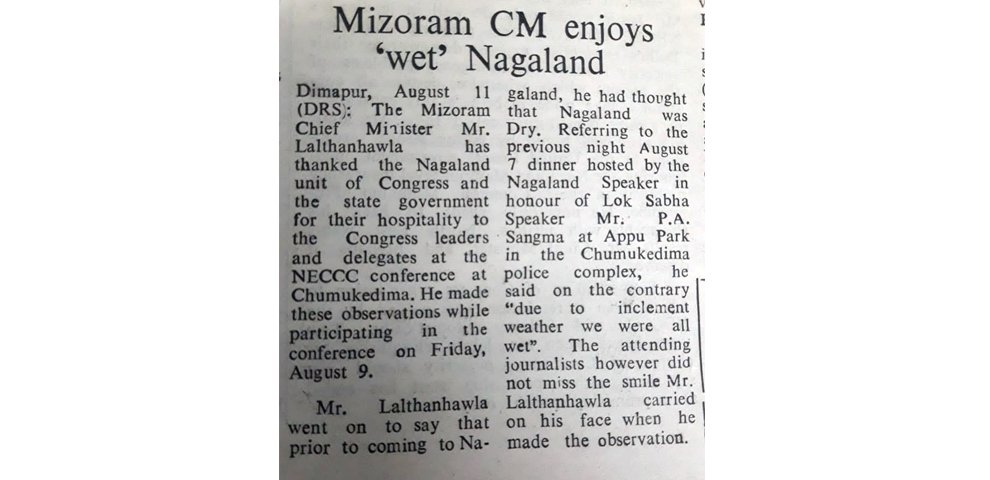
1996 story: When Mizo CM Lal Thanhawla enjoyed ‘wet Nagaland’
Nagaland hosted the North East Congress Coordination Committee (NECCC). SC Jamir took over as the chairman from Gegong Apang. Mizoram CM Lal Thanhawla and his wife visited Nagaland.
At Dimapur police training camp a grand party was organised in honour of PA Sangma – the then Lok Sabha Speaker, He had just taken over the role only a few months back.
“Due to inclement weather we were all wet,” Lal Thanhawla said at the meeting venue the next day.
The attending journalists did not miss the smile Lal Thanhawla carried on his face.
Newspaper clipping from ‘Daily Review’, Kohima:
(The views expressed are those of the writer and not of the newspaper)