
NABARD-funded facility to support sericulture training and livelihood opportunities
A training centre-cum-silk processing unit was inaugurated at Phusachodu village in Phek district on Monday, with the facility expected to support sericulture training and livelihood opportunities in the area.
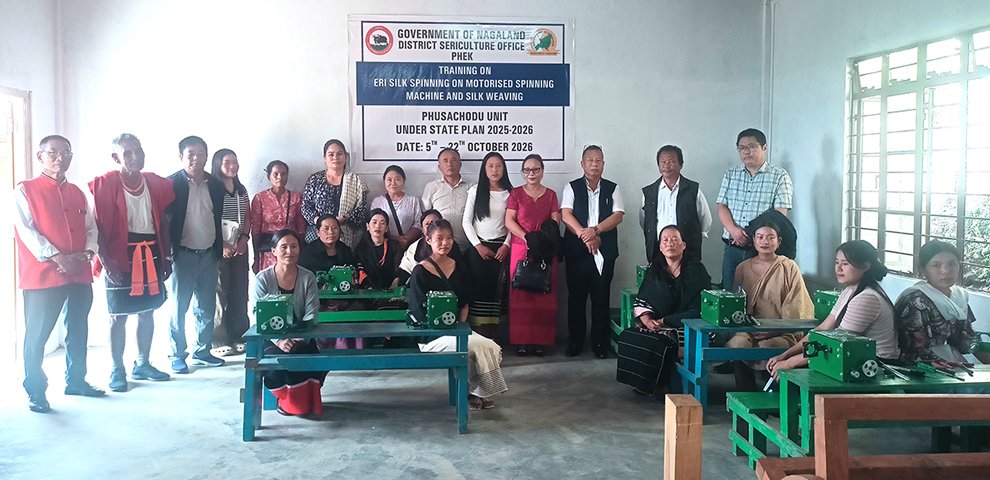
The facility was inaugurated by Zachivelu Khamo Dolie, Director of Sericulture, Government of Nagaland, in the presence of Kudecho Khamo, MLA and Advisor, CAWD. The project was financed by NABARD under the State Plan 2023-25.
Speaking at the program, Dolie said sericulture was largely a women-driven sector, while noting that men were also taking increasing interest in the activity. She assured that the department would provide training and handholding support to trainees to enable them to pursue sericulture as a livelihood.
Describing sericulture as a low-investment activity, Dolie said farmers could begin feeding silkworms about three months after establishing the plants. She said the activity could provide income three to four times a year if pursued consistently.
She said silk could fetch around Rs 3,000 per kg as a by-product and added that the department was considering enhancing the price, which could increase earnings for those engaged in the activity.
Dolie also highlighted the range of products that could be derived from sericulture and said that “nothing goes to waste”. She encouraged villagers to take greater interest in the activity and explore it as an alternative livelihood.
Kudecho Khamo described the establishment of the processing unit and the commencement of training for women as a benefit for Phusachodu. He said the centre should not be viewed merely as an asset created for the village, but as a facility where women could acquire skills and earn a livelihood.
He urged villagers to make proper use of the facility and develop a sense of ownership towards its maintenance and continued functioning.
Khamo also appreciated the cooperation of the village community and leadership in supporting developmental initiatives and called for collective participation in taking forward such programmes.
The programme was attended by village leaders, officials and community members.