
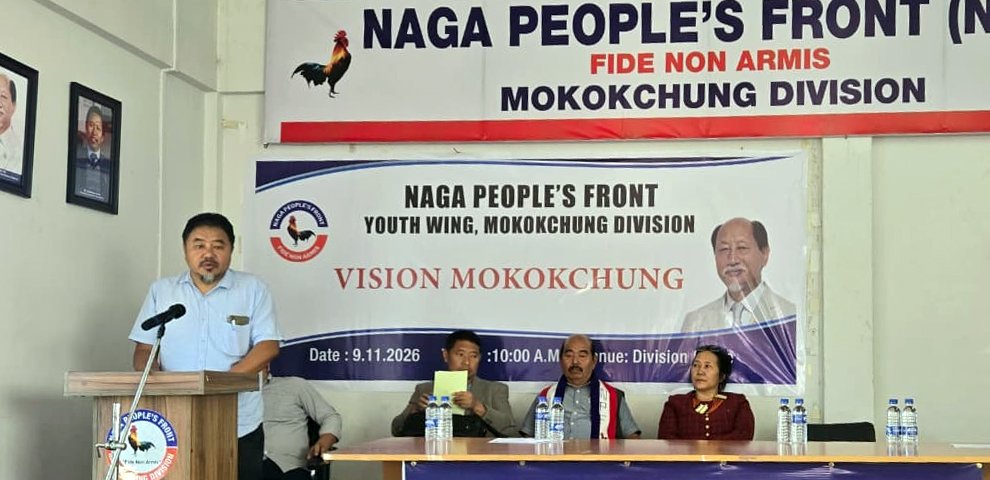
The need to rethink not only Mokokchung’s development priorities but also the attitudes and responsibilities of its people was highlighted during a panel discussion organized by the Naga People’s Front (NPF) Youth Wing, Mokokchung Division, under the theme “Vision Mokokchung” at the Division Office on November 9.
Speaking on the topic “Reimagining Mokokchung”, Mokokchung Municipal Council (MMC) Deputy Chairperson Lanuakum said that reimagining the district required innovation and a willingness to make better use of the resources and opportunities already available.
He observed that while discussions on development often centered on data, facts and figures, such efforts would have limited value “without population”.
He questioned whether the people of Mokokchung were themselves contributing towards making the district a livable place, stressing that development also depended on how people treated one another and participated in addressing common problems.
Pointing to everyday civic issues, he cited disputes between neighbors over rain gutters as an example of how even basic community cooperation had become difficult. He said that such attitudes needed to change if the district was serious about re-imagining its future.
Lanuakum also questioned the attitude towards people from outside the district, including non-locals and people from the Eastern Nagaland People’s Organization (ENPO) areas, who come to live in Mokokchung. He recalled that their forefathers had also traveled and settled in other people’s lands, and asked whether the present generation was creating an environment where others would feel welcome to come and live.
ALSO READ | What kind of Mokokchung does the next generation want?
He said the district needed to reflect on whether it was becoming a place where people from outside would want to settle, as well as a place where its own people would want to return.
Turning to infrastructure and public cooperation, he questioned how Mokokchung could speak of reimagining its future when basic emergency services and support remained difficult to access in times of need. He raised the examples of fire incidents where fire services could not reach affected areas and landslides where timely assistance could not reach those in need.
He also pointed to the contradiction in public demands for development, observing that while people wanted electricity and other facilities, they were often unwilling to allow electric poles to be installed on their land. He suggested that such resistance to common infrastructure highlighted the need for greater public cooperation.
On the role of research and public engagement in development, Lanuakum said that government initiatives should not simply be acknowledged or discussed without proper examination. Referring to projects and events such as Nagaki and the recently concluded Dr T Ao Trophy, he called for more research and analysis of such infrastructures and initiatives.
He said the media, including the media team within the party, had a role in examining developmental activities, assessing their impact and sharing findings with the government. He stressed that constructive criticism and informed analysis were necessary to help improve government initiatives.
Emphasising the need for a change in mindset, Lanuakum said society needed to “unlearn and relearn”, adding that this was necessary to rebuild, reconstruct and move forward.
MT