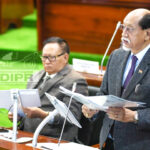
Nagaland’s Budget for 2026–27, with a total expenditure of Rs 22,127.33 crore, presents itself as a roadmap towards a “Developed Nagaland @ 2047.” At least that’s what the Chief Minister is saying. It is an aspirational document, forward-looking in language and intent. Yet, when placed against broader economic realities, the scale of the challenge becomes stark. The Brihanmumbai Municipal Corporation alone commands a budget of over Rs 80,000 crore, nearly four times that of the state of Nagaland! There are private corporations whose annual investments exceed Nagaland’s total budget outlay. These comparisons are not meant to diminish ambition, but to underline a hard truth. Nagaland remains fiscally constrained.
The question, then, is not whether the vision is valid, but whether the pathway is realistic. A state with limited internal revenue cannot rely indefinitely on central transfers and grants. The urgency must now shift towards building a stronger economic base. Revenue generation has to move beyond traditional streams. Sectors such as agri-processing, tourism, small-scale manufacturing, and digital services must be actively developed with clear policy support and accountability.
Equally important is fiscal discipline. High revenue expenditure, particularly on salaries, continues to restrict developmental spending. Rationalization, efficiency, and prioritization are no longer optional. Every rupee must produce measurable outcomes.
There is also a deeper structural concern. In an oppositionless political environment, the responsibility of scrutiny falls heavily on institutions, civil society, and the press. Yet, journalism itself struggles to sustain. In places like Mokokchung, it is increasingly difficult to pursue the profession as a viable livelihood. This is not merely an economic issue but a democratic one. Without a strong and independent press, accountability weakens.
The broader economic environment reflects a similar pattern. Outside government employment, opportunities for stable and honest income remain limited. This reality shapes public aspiration and reinforces dependence on the state.
Nagaland does not lack vision. What it needs is execution rooted in economic realism. Growth must be created, not assumed. Until then, the gap between aspiration and capacity will continue to define the state’s development journey.