
Three accused surrenders; NSCN-K (Khango–Vusshe) apologises, retracts statement
The Confederation of Nagaland Chamber of Commerce & Industry (CNCCI) has expressed serious concern over the “recent kidnapping and torture of a prominent businessman,” stating that the incident “demands immediate action, not mere condemnation or symbolic statements.”
In a strong statement, the CNCCI said it was “deeply shocked and disturbed by the continued inaction of the police,” despite the victim, identified as businessman Mr. Kiyeto Zhimo, having “publicly stated on a local news channel that he has repeatedly filed multiple FIRs in different police stations in the past.”
“When such serious complaints fail to result in timely action, it sends a dangerous message that criminals can operate with impunity,” the CNCCI stated, adding that this “reflects a serious breakdown of trust in the law-enforcement system and raises troubling questions about accountability.”
Terming the attempt to dilute the seriousness of the incident as “even more alarming,” the CNCCI said it was “impossible to understand how an act involving forcible breaking of a vehicle window, physical assault, abduction, blindfolding, and sustained physical and mental torture is not being openly acknowledged as kidnapping and extortion.”
“These are not isolated or accidental acts; they are deliberate, violent, and clearly intended to instill fear,” the statement read, asserting that “no explanation, justification, or narrative can convince the public otherwise.”
Reiterating its position, the CNCCI categorically stated that “kidnapping and extortion have nothing to do with the Naga National struggle.” Such acts, it said, are “anti-Naga and anti-people” and “directly undermine the values, principles, and sacrifices associated with the Naga cause.”
“What is being witnessed today is not political activity, but criminal intimidation and the collection of ‘hafta’ by gangs hiding behind ideology,” the CNCCI said, warning that such actions “tarnish the image of the Naga people and erode public confidence.”
Citing the “failure of the Nagaland Police to act despite repeated complaints,” the CNCCI strongly demanded that the case be handed over to the National Investigation Agency (NIA) so that “the entire network involved in kidnapping and extortion in Nagaland can be exposed and dealt with in a fair, impartial, and swift manner.”
The business body further stated “clearly and unambiguously” that the business community of Nagaland is not “livestock” to be “picked up, tortured, or intimidated at the whim of any group or individual.”
“Business owners are among the most respectable citizens of the state,” the CNCCI said, adding that they “contribute significantly to state revenue, keep the state economy running, and have been one of the most important backbones of the Naga National Movement.”
Issuing what it described as a “strong and final message” to the State Government and all Naga Political Groups (NPGs), the CNCCI said: “Enough is enough.” It cautioned that the business community “cannot and will not remain silent in the face of continued kidnapping, extortion, and intimidation.”
“If such activities are not immediately and decisively stopped, the CNCCI will mobilize the entire business community of Nagaland to stand united, protect its members, and defend its collective dignity and security,” the statement warned.
Meanwhile, the Western Chakhesang Hoho (WCH) also expressed its “strongest condemnation of the abduction and assault of Shri Kiyeto Zhimomi on January 19” and stated that it stands “in complete support and solidarity with the Western Sumi Hoho (WSH) on the 48-hour ultimatum to the NSCN-K (Khango–Hokato) group on this grave matter.”
Describing the incident as “despicable, barbaric, lawless and a direct assault on the conscience of Naga society,” the WCH said that such acts come at a time when “all Naga people earnestly long for lasting peace” and when “tireless efforts are being made by Naga civil societies to foster reconciliation and a permanent peaceful environment.”
“The use of threats, intimidation, abduction, and physical violence have no place in Naga culture and are alien to our customary values,” the WCH stated.
Calling the incident “a stark contradiction to the political movement we aspire to,” the WCH said the Naga political cause “must be inclusive, just, and respectful of human dignity,” and warned that “such criminal behaviour fundamentally undermines and destroys the very purpose of our collective struggle for self-determination.”
However, the WCH lauded the “timely and coordinated efforts of the district administration, police force, and civil society organizations in securing the rescue of the victim,” describing them as “commendable.”
It demanded an “immediate, thorough, and impartial investigation,” stating that “all perpetrators must be identified and brought to account through the swift delivery of justice.”
Three accused surrenders
Amid growing public outrage, three accused — Lovito Yeptho, Viniho Kiho and Hukhevi Yeptho — voluntarily appeared before the police on Thursday, as Nagaland Police intensified pressure and warned that “no ceasefire arrangement can be misused to shield criminal acts.”
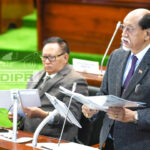
Addressing a press briefing at the Police Complex in Chümoukedima, DGP Nagaland Rupin Sharma said that upon receiving the complaint, police “immediately sprang into action” and rescued the victim through a combination of front-channel and back-channel policing.
Subsequent investigation revealed the involvement of specific individuals, prompting efforts to secure their arrest. When routine policing measures failed, the Dimapur Commissionerate, along with Nagaland Police, imposed an embargo on January 22 around the Ceasefire Supervisory Board (CSB) office of the NSCN-K (Khango–Vusshe) faction.
Sharma said police deliberately avoided confrontation, prolonging the embargo while engaging the faction in dialogue and urging it to surrender or hand over the accused.
He said statements made by the faction’s representatives during press briefings made it “evident that the abduction was carried out on instructions from senior members,” rendering denial “untenable.”
Sharma also disclosed that the Ceasefire Monitoring Group (CMG) had conveyed that the faction’s explanation was “unsatisfactory” and that ceasefire ground rules had been violated, reiterating that “no faction has the authority to take the law into its own hands.”
He maintained that ceasefire offices exist only to maintain peace and “cannot be used to summon, detain, abduct or threaten individuals,” adding that camps located in populated areas create fear and insecurity.
At least seven individuals have been identified so far, with further arrests not ruled out.
NSCN-K (Khango–Vusshe) apologises, retracts statement
Meanwhile, the NSCN-K (Khango–Vusshe) faction on Friday appealed to Sumi frontal organisations to reconsider their demand to shift the ceasefire monitoring cell from Thilixu village.
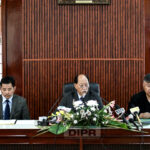
Addressing the media at the Ceasefire Supervisory Board office, MIP kilonser Hokashe Muru tendered an apology “on behalf of the group” to all Sumi frontal organisations for the physical assault of Zhimomi.
On the demand for surrender and arrest, Muru claimed that the main accused named in the FIR had been “discharged” from party membership for breach of discipline, sharing a discharge order dated January 23.
The faction also retracted its earlier statement alleging mediation by Sumi frontal organisations over an extortion amount of Rs 30 lakh. “We retract our statement,” Muru said, terming it a misinterpretation.
On the demand to shift the ceasefire office, he said the group had requested reconsideration, citing “technical implications” and procedural requirements involving the Government of India and the Ceasefire Monitoring Group.