
The Department of Political Science, Asufii Christian Institute (ACI), Punanamei, Mao, undertook an academic field visit to Khonoma village in Nagaland as part of its experiential learning programme. Located about 20 kilometres from Kohima, Khonoma is known for its historical, political, and cultural significance.
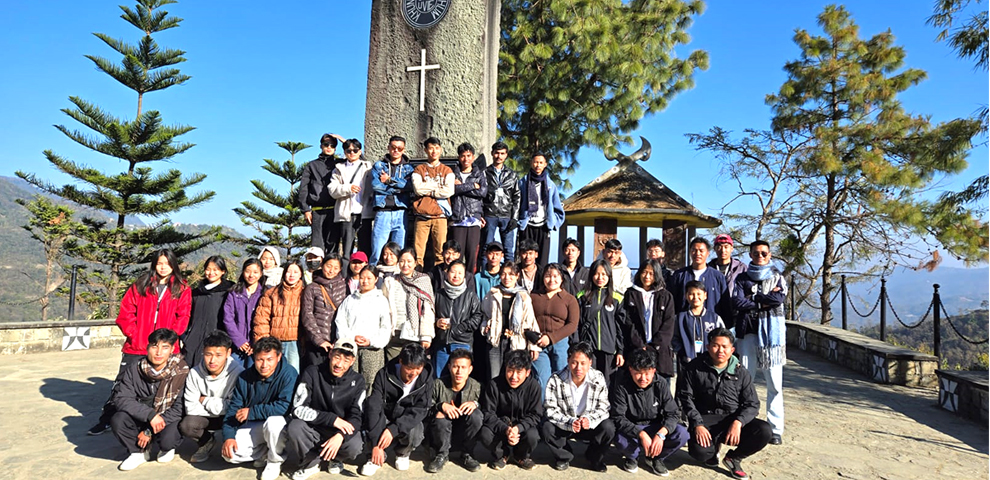
The visit was led by Dr. Soreiphy K, Head of the Department of Political Science, ACI, and accompanied by Dr. Adani Kollo, Dean of Students, Chovoni Cheng, faculty member, and 44 students. The academic tour was guided by a local resident, Ketu, who shared historical and political insights on Khonoma and highlighted its importance as a political community rather than merely a heritage village. He explained that Khonoma, locally known as Khwunomia, derives its name from Khwuno, a plant abundantly found in the area, and Mia, meaning dwellers, reflecting the close relationship between identity, territory, and ecology.
Students were introduced to Khonoma’s pre-colonial system of self-governance, where the village functioned as an autonomous political unit with defined territorial boundaries protected by the Kharu, a traditional wooden gate symbolising sovereignty and collective security. The present stone structure replacing the original Kharu was cited as an example of continuity in indigenous political symbolism.
The visit also focused on Khonoma’s resistance to British colonial expansion, particularly the Anglo-Khonoma War of 1879–1880, regarded as the final armed resistance of the Angami Nagas in the Naga Hills. Participants learned about Khonoma’s internal governance system organised into three major khel units, namely Thevo-ma, Merhu-ma, and Semo-ma, which historically regulated social conduct, defence, and collective decision-making.
The role of traditional morungs, or bachelors’ dormitories, was discussed as centres of political socialisation and leadership training. The visit further examined Khonoma’s contemporary identity as Asia’s first green village, focusing on community-led conservation practices. Field visits to Dzuleke village and the Heunambe cave and waterfall reinforced discussions on ecological governance and indigenous stewardship.