

Species named after late researcher Limaakum’s son and daughter
Limaaakum, the late Nagaland field researcher, continues to leave his mark on science. Nearly two years after his passing in June 2024, two new species of freshwater fish he collected from tributaries of the Brahmaputra River have been formally described in a peer-reviewed journal Zootaxa, adding to a series of discoveries that have already brought him recognition in Nagaland’s scientific community.
The authors of the study also acknowledged the vital role of his family in supporting the research.
This is not Limaakum’s first contribution to ichthyology in Nagaland. He has been recognized twice previously in this newspaper for earlier discoveries. (Read here and here)
The current research, conducted by Jayasimhhan Praveenraj and Balaji Vijayakrishnan, introduces Glyptothorax sentimereni from the Dikhu River and Oreichthys elianae from the Tsurang River. Both species are distinguished by unique physical traits, including fin structures, scale patterns, and body proportions, adding to Nagaland’s rich but historically underexplored freshwater fauna.
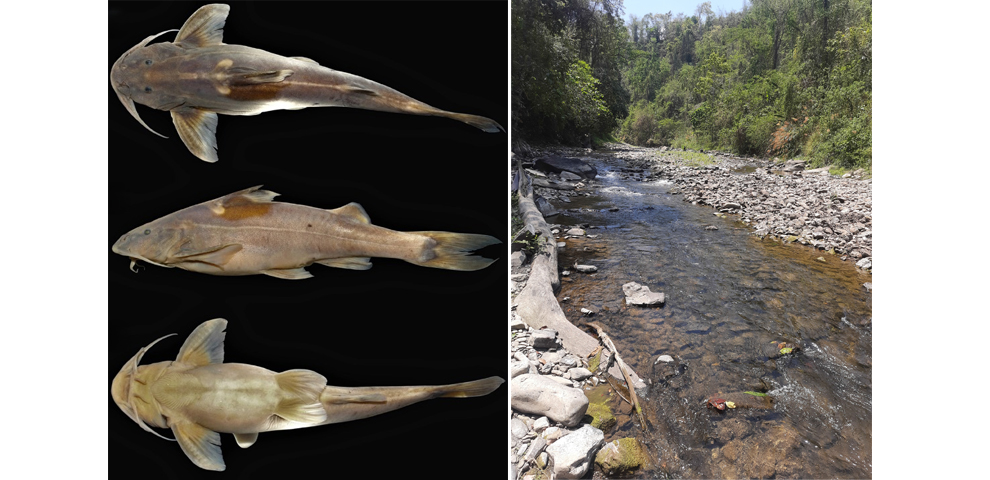
Glyptothorax sentimereni, a rheophilic torrent catfish from the Dikhu River, is described as “the loach of the catfish world,” with flattened heads, adhesive chest pads, and a grip built for fast-flowing rocky streams. Its distinctive rhomboidal thoracic adhesive apparatus sets it apart from all close relatives. The species is named after Sentimeren, son of Limaakum, fulfilling one of the researcher’s last wishes to see this fish scientifically described.
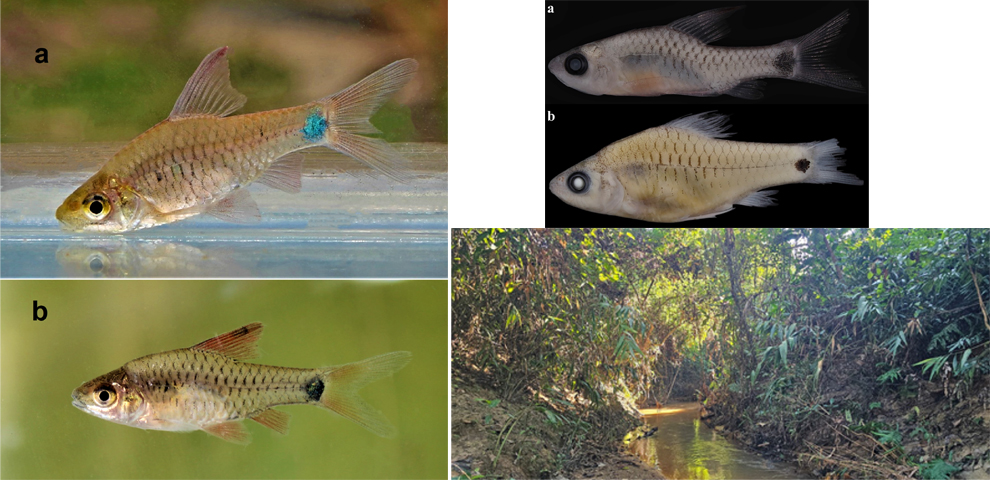
The second species, Oreichthys elianae, is a tiny 25 mm cyprinid likely to captivate aquarium enthusiasts. The deep-bodied, laterally compressed fish boasts red fins, a wine-red dorsal tip, and an iridescent turquoise-blue oval spot at the base of the tail, though it loses its coloration immediately under stress – a sign of its environmental sensitivity. It is named after Eliana, Limaakum’s daughter.
Speaking to Mokokchung Times, Limaakum’s wife, Dr A Watinaro, said: ‘I want people to remember his consistent hard work, his patience and persistence in adding new knowledge to science. He had identified a few new species but could not finish those.”
She added: “Lima always wanted young scholars to pursue new knowledge. I hope this discovery will ignite a flame to uncover what the natural world has in store for us.”
Nagaland’s rivers, shaped by tectonic activity, drainage shifts, and geological history, harbor numerous species yet to be scientifically described. Despite the State’s global biodiversity significance, freshwater fish have been poorly studied since the 1930s.
Early surveys by Hora & Mukerji (1935) and Hora (1936) focused primarily on the Manipur Valley and the Naga Hills, describing only a handful of species. Since then, systematic ichthyological surveys in Nagaland have been scarce.
Sitting between two global biodiversity hotspots – the Eastern Himalaya and Indo-Burma ranges – Nagaland is home to over 400 freshwater fish species in Northeast India, with many more still waiting to be discovered.