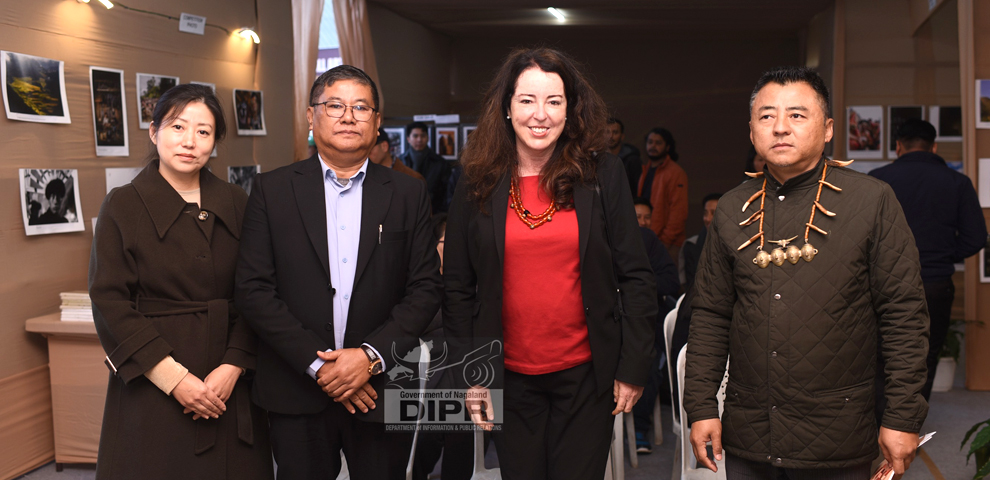

Hornbill Festival showcases Nagaland’s Cultural Diversity on Day 2
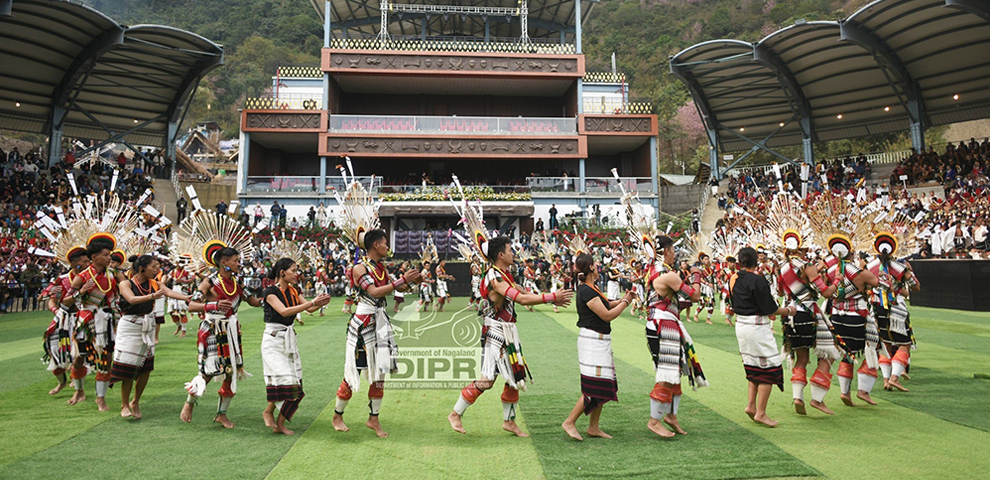
The second day of the Hornbill Festival at the Naga Heritage Village in Kisama featured a vibrant showcase of traditional dances and cultural performances, drawing dignitaries and visitors from India and abroad.
The cultural show was hosted by Nagaland Deputy Chief Minister TR Zeliang, with G Ikuto Zhimomi, Advisor for Land Resources, serving as co-host. Among the special guests were France’s Ambassador to India, Thierry Mathou, and Chief Justice of the Gauhati High Court, Justice Ashutosh Kumar.
Performances throughout the day represented the diversity of Nagaland’s tribes, each bringing their distinct traditions, histories and ceremonial practices to the festival’s main arena.
The Angami troupe opened with Phita, a folk dance performed during festive seasons alongside traditional chants. The Ao troupe followed with Nokinketer, a warrior dance symbolising bravery and martial spirit.
The Chakhesang troupe presented Lika/Thücüikhü, a horn-blowing performance reserved for festivals, and Khridikhuhi, an observance linked to the Mass Curse Day ritual that reinforces peace and social order in the village community.
Performances by other tribes included:
· Chang: Bu Sen Oneed
· Garo: Wangala Dance, a post-harvest thanksgiving ritual
· Khiamniungan: Jamhang, a song performed during the feast of merit
· Kachari: Bima Thanai, a traditional game played between two symbolic teams
· Konyak: Shim Shut Boa, a song highlighting the hardships of women preparing for marriage
· Kuki: Jangcha Lam, inspired by the warrior Jangcha
· Lotha: Kongtsu Kongyaa, a ritual test of warriors during headhunting traditions
· Phom: Yapo Louh-Po, an enactment of a headhunting expedition accompanied by log drums
· Pochury: Hapie Hapie, a precursor dance to the Feast of Merit
· Rengma: Tufu Kethyu, depicting traditional cotton spinning
· Sangtam: Shiru Kyucho Khi, a song performed to honour distinguished guests
· Sumi: Imuno Pi Sujo, celebrating fraternity, unity and goodwill
· Tikhir: Tsonglak Tsin, a dance symbolizing the sanctification of weapons used in war and hunting
· Yimkhiung: Hi Chu Khun, illustrating traditional grain pounding
· Zeliang: Matha-Bu Lin, performed during the Chaga Gadi festival to encourage youth to display their culture
The expansive line-up underscored the Hornbill Festival’s reputation as one of India’s most culturally diverse celebrations and a major tourism draw for the Northeast.
7th MykiFest launched in Kohima to celebrate women’s talents and entrepreneurship
The 7th edition of MykiFest, an initiative of the Department of Women Resource Development, commenced on Tuesday at the Directorate of Women Resource Development premises in Kohima. The festival, held alongside the Hornbill Festival, aims to provide a platform to recognize, promote, and celebrate the skills and achievements of women across the state.
Speaking at the launch, Secretary of Women Resource Development Zhothisa Dawhuo, IAS, emphasized that MykiFest is intended to break barriers and highlight the strengths and potential of women. “This festival is about showcasing talent, recognizing potential, and empowering every woman to contribute toward building a better society,” he said. Dawhuo also recalled that the Myki brand was created to provide women with a platform to display their skills and creativity and assured continued departmental support for initiatives that uplift women across Nagaland.
Director of Women Resource Development, Vilone Sakhrie, in his opening remarks, described the festival as a celebration of women’s achievements and an appreciation of their contributions to everyday life. He expressed gratitude to participants and attendees for their engagement in the event.
The festival officially began with the inauguration of micro-stalls by Secretary Dawhuo, featuring products from the apparel and accessories program, the Food Processing and Resource Centre, and creations by trainees from Myki training centres in Kohima and Dimapur.
This year’s edition also highlights women entrepreneurs, local musicians, singers, and authors, underlining the festival’s focus on women-led creativity and enterprise. Officials announced that future editions of MykiFest will be expanded at Kisama to showcase a wider range of products and talents from across the state.
Toyota Hornbill Music Festival 2025 launched at Kisama
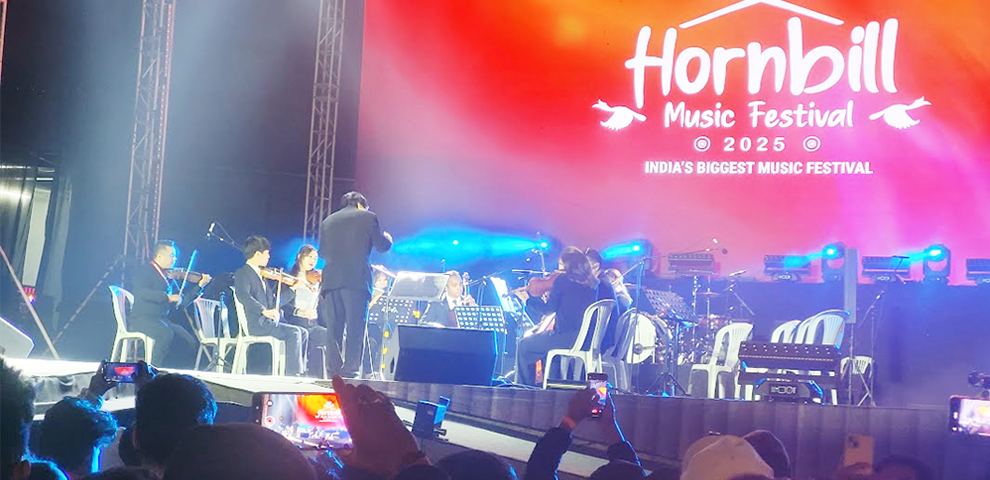
Kohima, 2 December: The Toyota Hornbill Music Festival 2025, billed as India’s biggest music festival, was formally launched today at the Naga Heritage Village, Kisama, in the presence of Nagaland’s Tourism and Higher Education Minister Temjen Imna Along, senior officials from Toyota, and representatives of the Task Force for Music and Arts (TaFMA). The festival was officially unveiled by Tadashi Asazuma, Deputy Managing Director, Toyota Kirloskar Motor Pvt Ltd, and Taisukhe Aoyama, Deputy Managing Director, Toyota Tsusho India Pvt Limited, who jointly beat a ceremonial gong.
Speaking at the launch, Y. Vikheho Swu, Managing Director of Okusa Toyota, Nagaland, said the Hornbill Festival has grown into one of India’s most distinguished cultural events, while the Toyota Hornbill Music Festival has become a premier platform showcasing exceptional musical talent from across the region. “As of today, its growth and stature have brought international bands into our stage,” he said.
Swu credited TaFMA, led by Chairman Theja Meru, for transforming Nagaland’s artistic landscape by developing platforms for musicians, creating professional ecosystems and promoting excellence. Their efforts, he said, have helped position the state as a thriving centre for contemporary and indigenous music.
He expressed gratitude to Nagaland Chief Minister Dr. Neiphiu Rio, describing him as the visionary architect of the Hornbill Festival. Swu said the festival has become a “dynamic culture, institutions that continues to inspire admiration across the world,” adding that Dr. Rio’s leadership has laid a foundation that not only preserves heritage but also elevates contemporary artistic expression. He also acknowledged Abu Metha, Advisor to the Chief Minister, for his role in advancing the festival.
Swu thanked the Department of Tourism and Minister Temjen Imna Along for consistently enhancing the festival’s reach and global appeal. “At Toyota, we firmly believe that music is powerful vehicle for connection and transformation. It is this belief that underpins our pride in partnering as the official partner of the Hornbill Festival 2025. Our association reflects our longstanding commitment to the people of Nagaland and our aspiration to contribute meaningfully to the cultural and creative advancement of the region,” he said. He added that the partnership reflects Toyota’s core values of trust, innovation and service to society.
The launch event also featured remarks by TaFMA Chairman Theja Meru and Sudeep Santram Dalvi, Chief Communication Officer of Toyota Kirloskar Motor Pvt Ltd. Performances followed, featuring Rumac from Scotland, Drum Tao and the Japan Junior Orchestra from Japan and Agniva from France.
December 3 line-up:
Novo (Assam), BoINN – Friends of the Mary Wallopers (Ireland), Mongdoll (South Korea), Trance Effect (Nagaland).
Hornbill Festival records 40,518 visitors in first two days
The first two days of the Hornbill Festival 2025 recorded 40,518 visitors at the Naga Heritage Village, Kisama. This included 363 foreign tourists and 5,314 domestic tourists on Day 1, and 341 foreign tourists and 4,893 domestic tourists on Day 2.
The number of local visitors from Nagaland stood at 16,831 on Day 1 and 12,776 on Day 2. The total number of visitors at the Naga Heritage Village was 22,508 on December 1 and 18,010 on December 2, combining for a total of 40,518 visitors, according to Toka E. Tuccumi, Joint Director, Department of Tourism, Government of Nagaland.