

The Centre’s decision to replace the Mahatma Gandhi National Rural Employment Guarantee Act (MGNREGA) with the Viksit Bharat–Guarantee for Rozgar and Ajeevika Mission (Gramin) Act, 2025 has triggered a political divide in Nagaland, with the Congress launching a state-wide protest and the Bharatiya Janata Party (BJP) defending the proposed legislation as a corrective reform.
The Nagaland Pradesh Congress Committee (NPCC) formally announced the protest on Thursday at Congress Bhavan, Kohima, describing the new law as the repeal of a rights-based rural employment programme. Party leaders accused the Centre of undermining a scheme that has provided livelihood support to rural households since 2005.
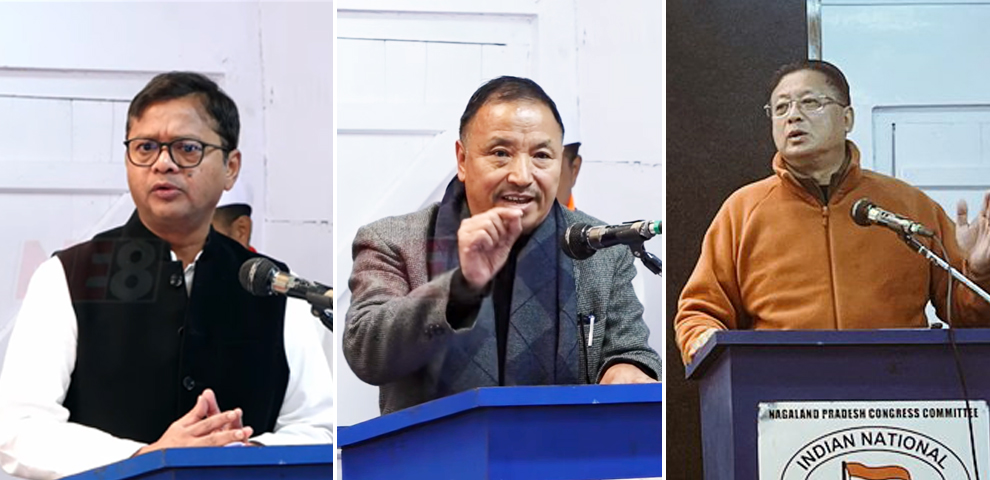
Speaking at the launch, MP and Parliamentary Standing Committee chair Saptagiri Sankar Ulaka alleged that the Modi-led government has been systematically weakening MGNREGA since 2014, citing delays in wage payments and material cost disbursements.
“Material costs of around INR 103 crore have been pending in Nagaland for nearly nine months, while wages totaling approximately INR 30 lakh remain unpaid for a year,” Ulaka said, calling it a failure of governance under the NDPP-BJP state government.
Ulaka also drew attention to wage rates, saying Nagaland continues to have one of the lowest MGNREGA wages in the country at INR 241 per day. He said wages have not been revised for more than a decade and that the scheme has suffered from chronic underfunding. According to him, a significant portion of the annual allocation is used to clear old liabilities, while demand for work is increasingly being restricted.
Emphasising that MGNREGA guarantees employment as a legal right, Ulaka said the renaming and restructuring of the scheme amounts to an attack on Gram Panchayats and rural livelihoods, and warned that the changes could render the programme ineffective.
NPCC president and Lok Sabha MP S Supongmeren Jamir said the scheme was introduced during the tenure of former Prime Minister Manmohan Singh and Congress leader Sonia Gandhi with the objective of providing assured livelihood support in rural areas.
Jamir said the Congress had opposed the changes during the last parliamentary session but alleged that the government went ahead and passed the legislation despite objections. “Until MGNREGA is restored in its original form, the Congress will continue to oppose this move and fight for those who depend on it,” he said.
Questioning the BJP’s current stance, Jamir said the party had previously acknowledged the importance of MGNREGA but was now attempting to discredit it by citing misuse. Responding to claims of misappropriation of around INR 193 crore, he said the government was “misrepresenting facts” and creating confusion by turning a guaranteed employment scheme into what he described as a budget-driven program.
NPCC working president C Apok Jamir said the new law effectively removes the guarantee of 100 days of work for rural households. He alleged that the move was politically motivated and said the focus on renaming the scheme distracted from its real consequences. He further claimed that the new framework shifts control from the states to the Centre, diluting the rights-based nature of the original Act.
The NPCC said the 45-day protest would include demonstrations, rural outreach programmes, press conferences, submission of memoranda and rallies across the country.
Meanwhile, the Nagaland unit of the BJP earlier had defended the proposed Viksit Bharat–Guarantee for Rozgar and Ajeevika Mission (Gramin) Bill, saying it aims to fix long-standing flaws in the implementation of MGNREGA.
Addressing a press conference in Dimapur, state BJP leaders said that while MGNREGA guarantees 100 days of employment per rural household, only a small fraction of beneficiaries were able to complete the full entitlement in the 2024–25 financial year.
State BJP general secretary Sunep C Jamir said that according to figures cited by the party, only 7.6 per cent of households across the country accessed the full 100 days of work, leaving over 93 per cent without complete coverage.
He said the proposed Bill seeks to realign rural employment policy with the Viksit Bharat 2047 vision by restructuring how work is planned, monitored and funded. The BJP also pointed to alleged misappropriation of around INR 193 crore under the existing system as a sign of weak oversight.
According to Jamir, the new framework proposes increasing guaranteed employment from 100 to 125 days and introducing technology-driven monitoring mechanisms, including artificial intelligence-based oversight and geospatial tracking, to improve transparency and reduce delays.
He added that the revised system includes measures aimed at greater inclusivity, including provisions for persons with disabilities.
The press conference formed part of the BJP’s nationwide outreach programme to build awareness around the proposed Bill. BJP Dimapur district president V Shekishe Achumi, state general secretary Manai Konyak and BJP Media Cell convenor Nini Cheng were present.
Explaining the broader rationale behind the Bill, Jamir said the new framework reflects changes in rural India since 2005, including digital expansion, direct benefit transfers and infrastructure growth. He cited Census 2011 data indicating that nearly 69 per cent of India’s population resides in rural areas.
He said the proposed model shifts away from a purely demand-driven system to a structured approach focused on water security, rural infrastructure, livelihood creation and climate resilience.
On accountability, Jamir said responsibility under the proposed law would rest with state governments through a normative budgeting system, adding that delays in implementation or fund release would be the responsibility of the state concerned.
State BJP general secretary Manai Konyak said the Bill is intended to prioritise underprivileged rural communities and urged those who are not eligible to refrain from availing benefits meant for the needy.