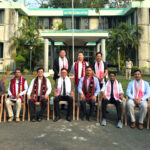

The Konyak Baptist Bumeinok Bangjüm (KBBB) has reaffirmed its firm stand on the Nagaland Liquor Total Prohibition (NLTP) Act, stating that the legislation emerged from years of “prayers, fasting, discussions and commitment” by Naga Christians and not from a sudden policy decision.
In a press statement, KBBB said the Act was the outcome of the “spirited efforts of our fore-parents who envisioned a better Nagaland for the generations to come.”
The KBBB maintained that liquor consumption has devastating effects on family, public health, and community safety.
“Having experienced how it was like to see the rise in broken families or to have lived in one; how it was like to have become alcoholics themselves or to see their close ones become a victim to alcoholism; how it was like to imagine the dark future of Nagaland with students dropping out of schools and colleges; how it was like to see the rising social problems, moral and spiritual decay due to alcoholism; It sure was their love for their own people that prompted this course of action,” KBBB said.
The KBBB argued that any assessment of the NLTP Act as a failure or success depends on “the lens one uses in analyzing the facets of the past, present and future altogether,” adding that the Act cannot be judged when it has been “put in cold storage.”
“Failure or success should be determined by how the Act is implemented. One cannot really determine the result when the Act itself is put in cold storage,” the KBBB said. It stated that the core issue was not prohibition but gaps in implementation and enforcement. “Let us remind ourselves that the Act is a means to achieve the goal and not an end in and of itself,” it stated.
The KBBB reminded Naga Christians that the Act “is not just any other agreement on a paper but a Covenant that was made between God and the Churches under Nagaland Baptist Church Council.”
The KBBB rejected arguments that lifting prohibition would reduce the sale of spurious liquor or help generate revenue, saying such claims “do not stand any ground.”
It also criticized suggestions that liquor prohibition has pushed youth toward drug use, calling the link “fallacious and misleading.” The KBBB urged collective efforts to provide healthier recreational alternatives instead of blaming the Church and considering the lifting of prohibition.
The KBBB appealed to its members and the larger Naga community to priorities healthy life of individuals and families and a sober society because “the potential harms of lifting the Act whether partially or fully outweighs any perceived benefits.”