
Nagaland on Monday expanded its food-processing infrastructure network with the inauguration of four facilities across the state, including incubation centres in Dimapur, Chümoukedima and Tuensang, and a modern aggregation centre in Mokokchung.
Chief Minister Dr Neiphiu Rio inaugurated the Incubation Centre for Food Processing at the State Industrial Area, Toluvi, Dimapur, and virtually launched three other projects – the Incubation Centre for Entrepreneurs and Infrastructure Development at the Industrial Growth Centre, Ganeshnagar, Chümoukedima; the Incubation Centre for Food Processing at Tuensang; and the Modern Aggregation Centre at Longnak, Mokokchung.
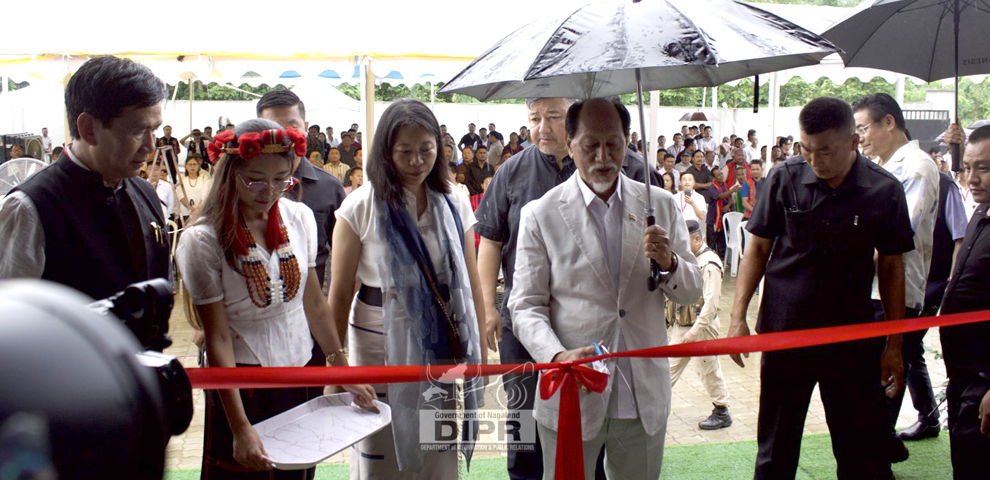
The projects were constructed under the Special Assistance to States for Capital Investment (SASCI-V 2024–25) and PM Gati Shakti schemes and are aimed at strengthening value addition, food processing and market linkages for local agricultural produce.
Addressing the program, Rio said the facilities could play a significant role in generating employment, encouraging entrepreneurship and reducing the state’s dependence on imported goods.
Noting that nearly 70 per cent of Nagaland’s population depends on agriculture and allied activities for their livelihood, he said food processing and small-scale industries represent some of the most viable avenues for industrial development in the state.
“Nagaland is largely a consumer state, with most commodities and products imported from outside,” Rio said, expressing hope that investments in food processing and value-added products would help strengthen local production and move the state towards greater self-reliance.
The Chief Minister said the newly inaugurated facilities would support entrepreneurs, create market opportunities for farmers and help convert local produce into marketable products. He also stressed the need for proper management and maintenance of the infrastructure to ensure long-term benefits for producers and farming communities.
Calling on young people to explore opportunities beyond government employment, Rio said entrepreneurship, micro, small and medium enterprises (MSMEs) and the private sector offered significant avenues for livelihood generation. He noted that unemployment among educated youth remained a challenge and emphasised the importance of skill development and vocational training.
Advisor for School Education and SCERT and Food Processing, Achumbemo Kikon, said the department would pursue what he described as the “Six P’s” vision for the food processing sector – Production, Processing, Preservation, Packaging, Pricing and Patenting.
He said strengthening food processing across the state could improve farmers’ incomes, generate employment and promote sustainable economic growth.
Advisor for Industries and Commerce, Hekani Jakhalu, said the department envisions establishing similar food-processing ecosystems across all districts, tailored to local agricultural strengths and resources.
She said the objective was not merely to create infrastructure but to develop complete value chains linking farmers, processors and markets.
Jakhalu noted that infrastructure alone would not guarantee success and stressed the importance of reliable raw material supply, skilled manpower, working capital, packaging, branding and strong market linkages.
The inauguration marked one of the state’s largest recent efforts to expand food-processing infrastructure, with facilities now established across multiple districts as part of a broader push to strengthen local production and value addition.