

Domestic violence accounts for over 30% of cases; Women Helpline 181 attends to 3,568 cases and information-seeking calls
Nagaland’s One Stop Centres have handled 2,121 cases of gender-based violence since the first centre was established in the state in 2016, while Women Helpline 181 has attended to 3,568 cases involving gender-based violence and information-seeking calls up to October 2026.
The figures were shared by Secretary, Social Welfare, Limawabang Jamir, IAS, during the state-level observation of the International Day for the Elimination of Violence against Women at the Capital Convention Centre, Kohima, on Wednesday. It was also informed that more than 30% of cases reported to the One Stop Centres involved domestic violence.
The figures highlight the demand for support services for women in the state, although the number of cases handled by these institutions does not represent the full extent of gender-based violence, particularly as many incidents remain unreported.
Addressing the gathering, MLA and Advisor for Industries and Commerce Hekani Jakhalu Kense said Nagaland needed to establish a culture of zero tolerance towards violence against women, pointing to the normalisation of harassment, abuse and domestic violence as major challenges.
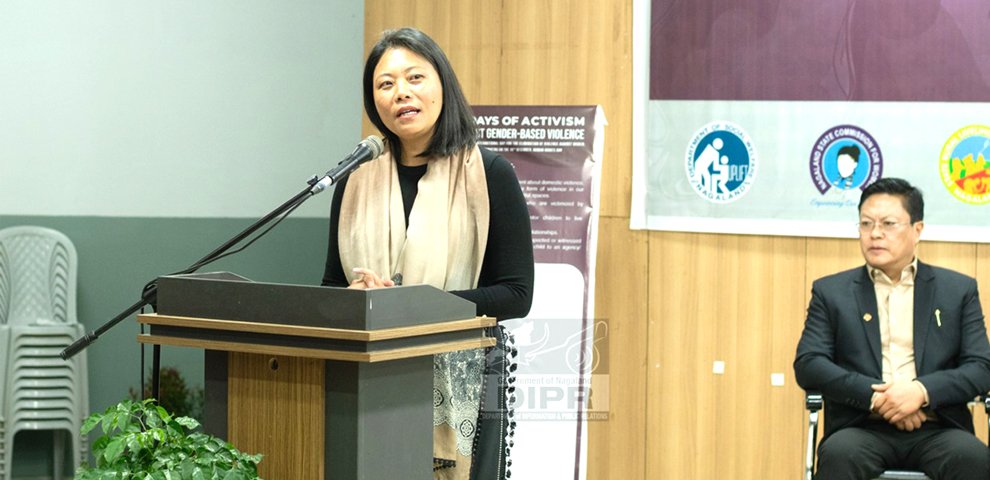
She said that while statistics might suggest Nagaland was among the safer places for women, such figures did not necessarily reflect the ground reality. Domestic violence, she observed, often remained hidden behind closed doors, with victims reluctant to report abuse due to fear of social ostracisation, retaliation and the expectation that family matters should remain private.
Jakhalu also pointed to patriarchal structures that pressure women to endure abusive relationships in the name of family honour. Divorce remains stigmatised, she said, while women who leave abusive marriages are often shamed rather than supported. Economic dependence, concerns about children and fear of social backlash further prevent many from leaving abusive situations.
She also criticised the tendency to question victims rather than hold perpetrators accountable, noting that survivors often face questions about why they did not report abuse or leave the relationship.
Citing the World Health Organization and UN Women, Jakhalu said one in every three women experiences violence during her lifetime. Applying this global estimate to Nagaland’s estimated population of 20 lakh, she said the number could translate to approximately three lakh women over their lifetime. The estimate, however, was an extrapolation from the global figure and not a state-specific survey.
She called for sustained action beyond annual observances, saying the responsibility to address violence against women rested not only with the government but also with churches, civil society organisations, families and individuals. She urged religious institutions to avoid remaining silent or prioritising family unity at the cost of women’s well-being.
In his keynote address, Jamir highlighted initiatives under Mission Shakti, including the Hub for Empowerment of Women, Beti Bachao Beti Padhao, One Stop Centres and Women Helpline 181. Marking 10 years of service by the One Stop Centres in Dimapur and Kohima and Women Helpline 181, he appreciated the teams for their work in supporting women.
He also urged students to contribute towards preventing gender-based violence through peer-led initiatives, digital safety awareness and reporting mechanisms, while encouraging survivors to seek assistance through available services.
Chairperson of the Nagaland State Commission for Women, W Nginyeih Konyak, called for awareness to be translated into tangible action in homes, educational institutions and communities. She urged students to stand against cyberbullying, harmful stereotypes and peer pressure, and encouraged women to know their legal rights, pursue financial independence and seek support through institutional mechanisms.
Konyak further stressed the need for stronger coordination among the Commission, Social Welfare Department, Mission Shakti, One Stop Centres, law enforcement agencies, District Legal Services Authorities and Nagaland State Rural Livelihoods Mission to ensure a survivor-centred approach that upholds confidentiality, dignity and timely justice.
The programme also saw the launch of three additional Gender Resource Centres under NSRLM in the Rural Development blocks of Dhansiripar, Jalukie and Shamator, alongside the fifth edition of Nayi Chetna under the Deendayal Antyodaya Yojana–National Rural Livelihoods Mission.
The 16 Days of Activism against Gender-Based Violence and Nayi Chetna 5.0 were also launched during the programme, which featured the release of an awareness video and a special anniversary edition of the Sakhi One Stop Centres and Women Helpline 181 newsletter.