

Nagaland wants a modern fish market, but the bigger question is why the state still cannot produce enough fish for itself
Speaking at the Regional Review Meeting for the Northeast in Aizawl on May 25, Fisheries & Aquatic Resources Advisor Pangjung Jamir said Nagaland plans to establish a “state-of-the-art” wholesale fish market by 2027.
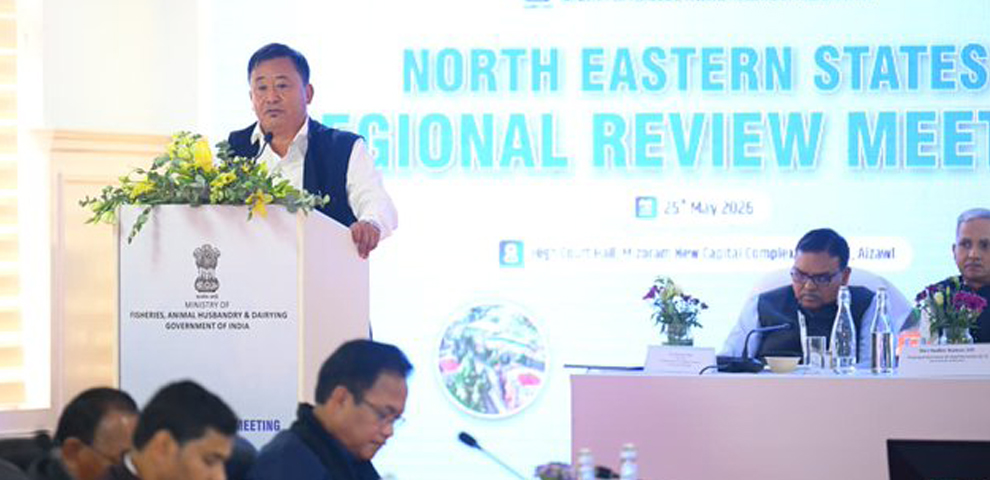
Jamir said “adequate financial support” is essential for accelerating fisheries development in Nagaland and the wider Northeast region. He pointed out that unit costs under the PMMSY scheme have not been revised for the last 11 years and stressed the need for timely revision to reflect current implementation realities.
The Advisor also stressed the importance of introducing integrated aquaculture models such as paddy-cum-fish cultivation under the scheme, saying it could significantly improve farmers’ income opportunities.
He further highlighted the tourism potential of the region and proposed promoting fisheries eco-tourism across the Northeast.
Jamir also called for strengthening transportation and connectivity in hilly areas, inclusion of administrative costs for effective monitoring, and enhancement of the subsidy pattern to 90:10 considering the geographical challenges of the region, instead of the existing 60:40 support structure.
The proposals come at a time when Nagaland’s fisheries economy continues to face structural limitations.
According to the Annual Administrative Report 2024–25 of the Department of Fisheries & Aquatic Resources, Nagaland currently produces only 11,158.9 metric tonnes of fish annually. The department itself noted that production would need to be “doubled” for the state to achieve self-sufficiency.
The figures suggest that a substantial portion of fish consumed in Nagaland continues to come from outside the state through interstate trade routes linked to Assam and larger aquaculture-producing states such as Andhra Pradesh and West Bengal.
Fisheries experts and government reports have repeatedly pointed to structural challenges limiting large-scale aquaculture expansion in Nagaland, including difficult terrain, high transportation costs, fragmented fish farming practices, limited cold-chain infrastructure and dependence on imported feed and fish seed. Compared to major aquaculture-producing states in the plains, commercial fish production in Nagaland remains relatively small-scale and cost-intensive.
Departmental data also shows that most fish production in Nagaland still comes from ponds and tanks, which account for over 9,481 MT annually. Paddy-cum-fish cultivation contributes around 1,389 MT.
Doyang Reservoir, often projected as a major fisheries resource for the state, contributes around 277.8 MT annually despite spanning 2,258 hectares.
This aligns with findings from research conducted by the Indian Council of Agricultural Research–Central Inland Fisheries Research Institute (ICAR-CIFRI), which described Doyang as a fisheries resource with significant untapped potential while also noting that nearly 80–90% of fish catches there come from stocked species rather than naturally sustaining populations.
The Advisor’s demand for revised PMMSY unit costs also points to wider concerns regarding fisheries economics in hill states where transportation, feed supply, pond construction and cold-chain logistics are significantly more expensive than in the plains.
His push for a 90:10 subsidy structure instead of the existing 60:40 pattern further indicates that Nagaland views fisheries development in the Northeast as structurally disadvantaged under current funding arrangements.
The department’s report further noted that per capita fish consumption in Nagaland stands at 7.16 kg, below the 11 kg nutritional benchmark referenced in the report.
The proposed wholesale fish market may therefore represent more than infrastructure expansion alone. It also reflects the growing commercialisation of Nagaland’s fish economy at a time when the state remains dependent on external supply chains to meet local demand.