Nagaland Minister for Horticulture and Women Resource Development, Salhoutuonuo Kruse, on Thursday said agricultural policies designed for the plains cannot adequately address the realities of hill states, while calling for greater Centre investment and region-specific interventions for the Northeast.
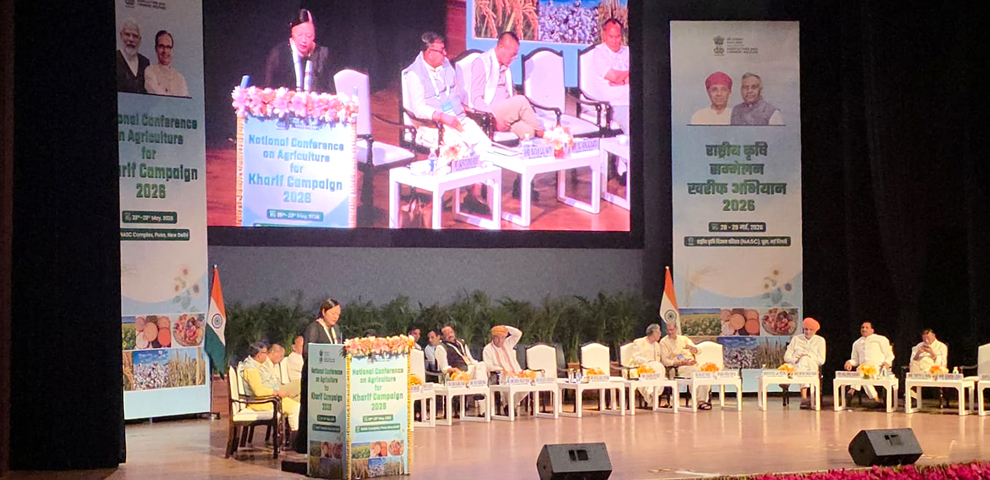
Speaking at the National Conference on Agriculture for Kharif Campaign 2026 held at NASC Complex Pusa, New Delhi, Kruse stressed the need for hill-specific agricultural policies, climate-resilient technologies and improved infrastructure to unlock the agricultural and horticultural potential of Nagaland and the Northeast region.
She said climate change has become a serious concern for farmers in Nagaland, with unpredictable rainfall, soil erosion and landslides increasingly affecting cultivation in the state.
Kruse also highlighted the challenges faced by farmers due to poor infrastructure, stating that despite increased production, lack of cold storage facilities, weak aggregation systems and limited market access continue to result in high post-harvest losses.
Calling for greater investment in storage, processing, branding and market linkages, especially for products from the Northeast, the Minister maintained that uniform policies framed for the plains often fail to reflect the realities of hill agriculture.
She further stated that jhum cultivation remains deeply connected to the identity and culture of the people and said any transition towards more sustainable farming systems must be gradual, community-driven and supported through scientific and financial assistance.
Highlighting the state’s traditional farming practices, Kruse remarked, “Nagaland doesn’t need to go organic – it already is.”
She said Nagaland possesses unique strengths including rich biodiversity, traditional chemical-free farming practices, GI-tagged products and favourable agro-climatic conditions, adding that products such as Naga Mircha, kiwi, pineapple and large cardamom have strong market potential.
“With the right support, Nagaland can position itself as a premium horticulture hub for niche and export-oriented products,” she said.
Kruse also described the Northeast as a region capable of leading an “Evergreen Revolution” rooted in sustainability and traditional agricultural knowledge.
She expressed confidence that stronger Centre-State collaboration and strategic investments in the Northeast could help reduce regional imbalance and create resilient rural economies.