
The Government of Nagaland on Wednesday took a major step towards strengthening water security, climate resilience and rural livelihoods across the State with the signing of key Memoranda of Agreement (MoAs) under the World Bank–supported ELEMENT Project, covering 225 villages in 16 districts.
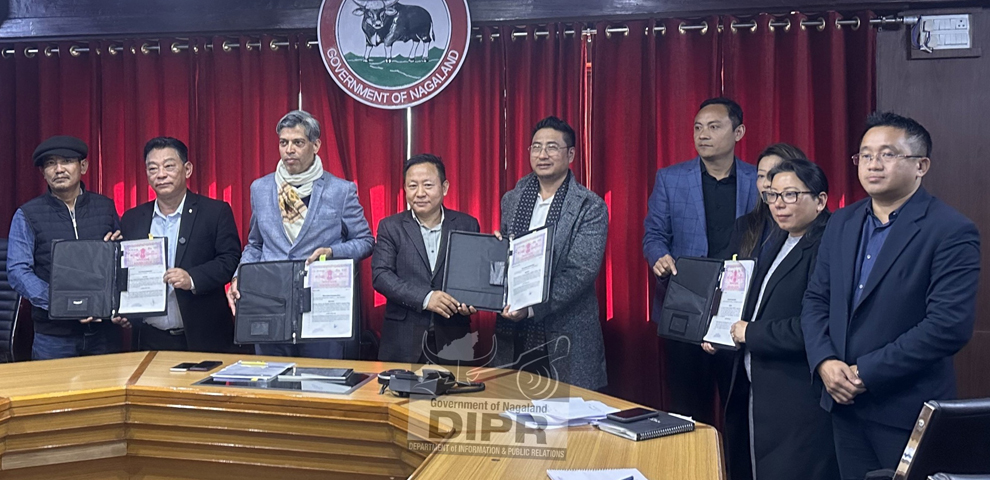
The MoAs were signed with the Department of Land Resources (DoLR) and the Nagaland Environmental Protection and Economic Development Society (NEPED) at the Chief Secretary’s Conference Hall, Nagaland Civil Secretariat, Kohima.
Delivering the keynote address, Additional Chief Secretary & APC and Mission Director, ELEMENT, V. Shashank Shekhar, IAS, said that collaboration with State and Central departments and agencies forms a core part of the project’s implementation strategy. He said the signing of the MoAs marked the beginning of strengthened and expanded partnerships under the project.
He informed that the ELEMENT Project is jointly supported by the State Government, the Government of India and the World Bank. While the World Bank has extended a loan for the project, the responsibility of repayment rests jointly with the State Government and the Government of India. He said the overall objective of the project is to improve the quality of life of the common people.
Speaking on the MoA with the Department of Land Resources, Shashank Shekhar highlighted the importance of springshed development, stating that water is fundamental to life and civilization.
He cautioned that unchecked extraction of water without adequate replenishment could lead to severe water scarcity and said the collaboration with DoLR aims to strengthen water resource rejuvenation and sustainability in the State.
Under the MoA, DoLR has been designated as the State Technical Partner for Springshed Development and Coffee Development. The initial engagement is for one year, with provision for annual renewal based on performance. The department will provide technical support in resource mapping, spatial analysis, preparation of Detailed Technical Reports, implementation planning, monitoring and capacity building. Key interventions include spring rejuvenation, sustainable coffee plantation planning and installation of Customized Automatic Weather Stations.
On the partnership with NEPED, he said research and development plays a critical role in economic growth. NEPED, through its Centre of Excellence for Renewable Energy Studies (CERES), has been engaged as a State Technical Partner for research, innovation and technology development for a period of 18 months, extendable based on performance. The collaboration focuses on indigenous, low-energy technologies aimed at improving livelihoods, generating employment and strengthening the local economy.
The ELEMENT Project, implemented through the Society for Climate Resilient Agriculture in Nagaland (SoCRAN), seeks to restore degraded landscapes, build climate resilience and improve livelihoods across 225 villages in 16 districts over a five-year period ending in 2030. The total project cost stands at Rs 574.63 crore.
Short speeches were delivered by Hukato N, Additional Director, Land Resources Department, and Kovi Meyase, NCS, Team Leader, NEPED, reaffirming their commitment to effective implementation of the project objectives. The vote of thanks was delivered by Limanenla, Joint Secretary, Agriculture Department.