

Media, officials undergo training in Dimapur
Against the backdrop of over 1,600 reported fire incidents in the past decade, a two-day Disaster Management Training for First Responders began on Wednesday at Hotel Saramati, Dimapur, with a focus on strengthening emergency response, legal awareness, and responsible crisis reporting.
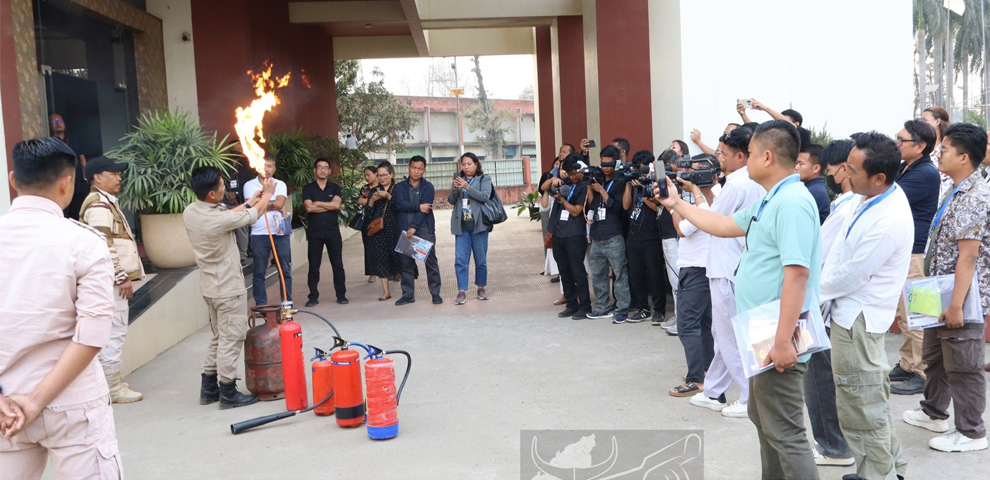
Organised by the Directorate of Information and Public Relations, the training brought together journalists and media personnel on Day 1, while Day 2 will include in-service officials and staff of the Information and Public Relations Department.
Statistical data shared during the program revealed that between 2016–17 and January 2026, Nagaland recorded 1,078 residential fire incidents and 556 forest or wildfire cases. Additionally, 818 fire safety mock drills were conducted across the state between 2023 and 2025, covering schools, churches, markets, hotels, hospitals, banks, petrol pumps and industrial establishments.
Addressing media personnel, Keren Rose, Assistant Manager, Media and Public Relations, Nagaland State Disaster Management Authority, described the media as a critical partner in disaster governance.
She said responsible journalism during emergencies can save lives by ensuring timely and verified dissemination of information. She stressed that inaccurate or sensational reporting may create panic and obstruct rescue efforts.
Highlighting ethical considerations, she urged journalists to verify information from official sources, fact-check casualty figures, protect victims’ identities, and avoid spreading unverified social media content. She also advised reporters to focus on resilience and recovery, in addition to destruction, and to remain sensitive to affected communities.
Rose also explained the disaster management framework under the National Disaster Management Act, 2005, outlining the roles of the National Disaster Management Authority, Nagaland State Disaster Management Authority, District Disaster Management Authorities, and response forces including the National Disaster Response Force and State Disaster Response Force. She said understanding this structure enables accurate and coordinated reporting during crises.
The second session was conducted by Kenny Khing, Fire Prevention and Audit Officer, Fire and Emergency Services. Speaking on fire safety and provisions of the Nagaland Fire and Emergency Service Act, 2021, he highlighted legal requirements and penalties related to fire safety compliance.
Under Section 23(3) of the Act, multistoried buildings above 15 metres and special buildings such as educational institutions, hospitals, assembly buildings, business establishments, industrial and hazardous occupancies must obtain a Fire Safety Certificate. Mixed occupancies exceeding 500 square metres are also required to secure certification.
He stated that obstruction of firefighting operations may attract imprisonment up to three months or a fine up to Rs 10,000, or both. Hoax calls are also punishable under the Act. Fire service personnel responding to emergencies have the right of way and are empowered to remove obstructions and break into premises if necessary during rescue operations.
Explaining the science of fire, Khing elaborated on the Fire Triangle comprising fuel, oxygen and heat, and the Fire Tetrahedron, which adds chemical chain reaction. He said removal of any one element can extinguish a fire.
Participants were briefed on fire classifications and appropriate extinguisher usage, as well as LPG and electrical hazards. Citizens were advised to ventilate areas during LPG leaks, switch off regulators, avoid electrical switches, and contact fire services immediately.
Highlighting operational challenges, Khing cited delayed communication, traffic congestion, narrow colony roads, non-compliance with building bylaws, rapid urbanisation, and use of flammable construction materials. Recurring forest fires and limited resources were also flagged as concerns.
Earlier, Deputy Director IPR Seiwatho S Nyusou said this was the first disaster management training organised by the Directorate and assured that more such programmes would follow with wider inter-departmental participation. He stressed that preparedness is essential as disasters often strike without warning.
The program concluded with a hands-on demonstration on fire extinguisher use and basic emergency response techniques.
Representatives from Fire and Emergency Services, Police and other departments attended the training.