
As nationwide protests led by the Indian National Congress continue over the replacement of the Mahatma Gandhi National Rural Employment Guarantee Act (MGNREGA), the District Congress Committee (DCC) Mokokchung on Friday held a press conference to sensitize the public on what it described as the “basic differences” between the former rural employment scheme and the newly enacted Viksit Bharat Guarantee for Rozgar and Ajeevika Mission (Gramin) Act.
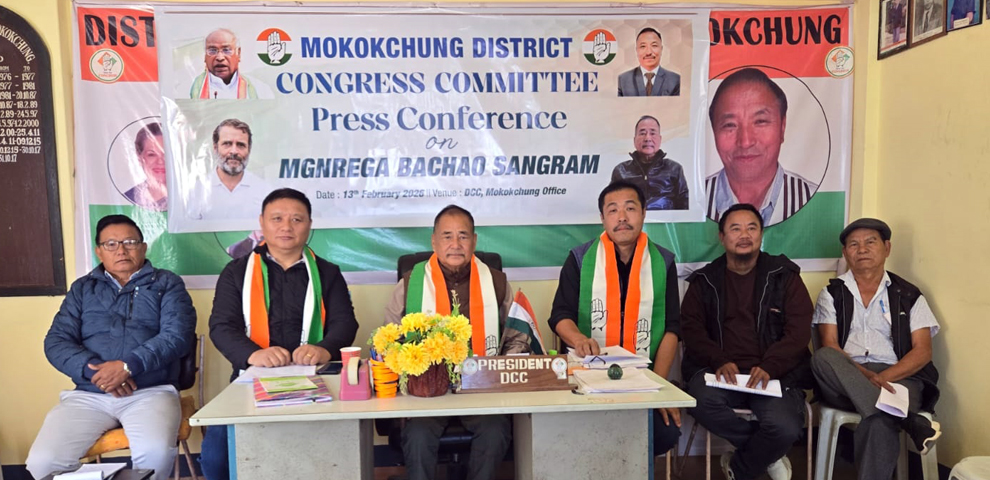
The press meet was led by DCC president Watimongba Aier along with general secretary Temsu Imchen, Aotemsu, vice presidents L Yanger, I Temsu Jamir and Nukshi Ozukum.
The new legislation, passed by Parliament in December 2025 amid opposition protests, repeals the MGNREGA Act of 2005 and introduces a revised framework for rural employment programs. Addressing the media, DCC leaders described the change as a major shift in how rural work will be planned and distributed.
Calling the move an “assault on poor rural households,” the committee said many villagers remain unaware of how the new system could affect their rights and livelihoods. The leaders stressed the need for immediate awareness campaigns across villages in Mokokchung district.
According to the DCC, one of the key differences lies in the nature of employment itself. Under MGNREGA, they said, rural families had a legal guarantee to demand work, which had to be provided within a stipulated period.
They alleged that under the new framework, “work will no longer be a right, but instead a ‘revdi’ to be handed out as the government decides”.
“The Modi Government will pick and choose which Village Council will get work,” the congress workers said.
The committee also expressed concern over wages and working conditions. It claimed that the earlier system ensured notified minimum wages with periodic revisions, while the new mechanism may reduce certainty around wage levels and work availability.
“Work will not be permitted during the harvest season, so the power of workers to demand better wages from other employers will be reduced. They will be forced to accept any work they can get, with no minimum wage,” they said.
Another major issue raised during the press conference was the role of local governance. The DCC argued that village councils previously played a central role in planning and executing development projects, whereas in the new structure, they said, “under the Modi Govt’s changes, all decisions will be made by remote-control from Delhi.”
“Development projects will be restricted to a few categories, with key planning decisions taken by the Modi Govt. The Gram Panchayat will lose its authority and become merely an implementing agency of the Modi Government’s orders. Contractors will be brought in, and workers will be diverted into becoming labor supply for contractor projects. There will be no MGNREGA mates or Rozgar Sahayaks to support local work,” they claimed.
Financial implications for state governments were also highlighted. The leaders stated that while MGNREGA provided full central funding for wages with open-ended allocations based on actual demand, relieving states exchequer of heavy burdens, the new Act imposes a schematic entitlement, limited by fixed, normative budget cap and statutory guarantee of 125 workday and shifts to a 60:40 Centre-state funding ratio (90:10 for north-eastern states).
DCC vice president I Temsu Jamir remarked, “The people are being misled by the VB-G RAM G Act’s claim of increasing workdays to 125, which is merely a statutory limit rather than the full, unconditional guarantee of 100 days under the original MGNREGA.”
The committee further noted that MGNREGA had served as a critical safety net for rural workers for nearly two decades, particularly during the COVID-19 crisis when millions returned to villages and depended on rural employment schemes for survival.
Announcing its next steps, the DCC Mokokchung said it will soon begin village-level sensitization drives to educate citizens about the policy changes and mobilize public opinion. The awareness effort forms part of the broader ‘MGNREGA Bachao Sangram,’ a 45-day nationwide campaign involving press conferences, grassroots outreach programs, sit-ins, and rallies.