

Policy gaps, weak logistics and limited market access continue to hold back Nagaland’s farming economy
Arenjungla Kichu
Mokokchung | 8 February
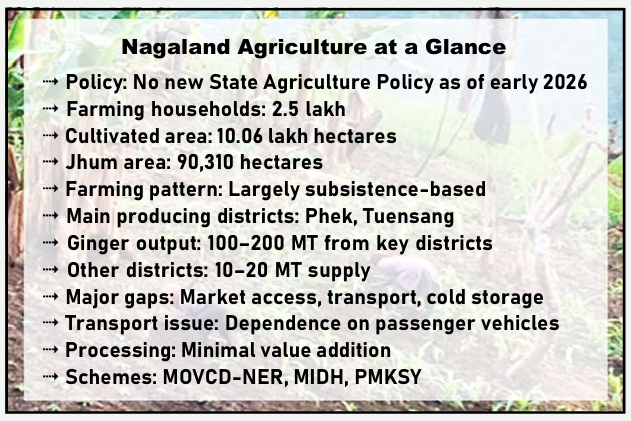
Despite decades of government schemes, organic branding initiatives and a large farming population, Nagaland’s agriculture sector continues to remain largely subsistence-driven, struggling to evolve into a sustainable economic engine due to structural policy gaps, weak market systems and failing logistics infrastructure.
In 2025, Nagaland Advisor for Agriculture Mhathung Yanthan announced that a comprehensive State Agriculture Policy focusing on productivity, post-harvest infrastructure, market linkages and farmer welfare was in the pipeline. Yet as of early 2026, the state continues to operate without a formal agriculture policy framework.
Administrative and programme reports for 2023–24 show that Nagaland has approximately 2,50,360 farming households cultivating around 10,06,204 hectares of land, with nearly 90,310 hectares under jhum cultivation. Despite this large agricultural base, commercial-scale production remains limited and fragmented.
Speaking to MT, Ariba Anar, State Coordinator of the North Eastern Regional Agricultural Marketing Corporation (NERAMAC), a CPSE under the Ministry of DoNER, said large-scale market production is concentrated in only a few districts.
“Large production quantity is done mainly in two districts – Phek and Tuensang,” Anar said. “Phek supplies approximately over 100 metric tonnes of ginger to Assam, while Tuensang supplies around 100–200 metric tonnes. Other districts supply only about 10–20 metric tonnes.”
According to him, most farmers continue to produce primarily for household consumption rather than commercial markets.
“It does not mean there are no farmers. Farming is happening across the state, but much of it is survival-based rather than business-oriented,” he said.
Anar said past policy failures have had long-term consequences on farmer trust and production patterns.
“Four to five years ago, farmers were encouraged to plant ginger with buy-back assurances. When the government did not purchase the produce, farmers were forced to sell independently,” he said. “Some buyers even offered one rupee per kilo. Severe losses were incurred, and many farmers stopped large-scale ginger cultivation.”
The incident highlights the vulnerability of farmers operating without stable market guarantees or institutional support mechanisms.
Across districts, Anar said farmers consistently identified transportation as their most urgent requirement.
“They need transport access to markets in towns and urban areas,” he said. “In some villages, women have to hire an entire passenger sumo filled with produce just to reach the market.”
Without structured logistics networks, farmers often depend on passenger trucks or informal transport arrangements, significantly reducing profitability.
Cold storage infrastructure remains another major gap.
“Many farm products especially green leaves and chillies spoil within two days because cold storage facilities are not available,” he said. He added that targeted transport subsidies and logistics support could significantly reduce post-harvest losses and expand market access.
Anar also identified the absence of processing infrastructure as a major barrier to value addition.
“If farmers produce 20–30 truckloads of ginger, it may not be possible to sell it fresh. But dehydrated ginger would have access to wider markets,” he said.
He proposed an integrated model linking farmers, educated unemployed youth operating processing units and private investors to create new value chains within the state’s agricultural economy.
Currently, most farmers sell raw ginger, vegetables and chillies through local traders or Assam-based intermediaries, resulting in minimal value addition and low returns.
Nagaland currently implements several major agricultural schemes, including the Mission Organic Value Chain Development for North Eastern Region (MOVCD-NER), Mission for Integrated Development of Horticulture (MIDH) and Pradhan Mantri Krishi Sinchayee Yojana (PMKSY).
Under MOVCD-NER, organic clusters, certification programs and value chain initiatives have been introduced to strengthen production and branding. However, field observations suggest that implementation gaps including limited aggregation centers, insufficient processing units and fragmented transport networks continue to prevent farmers from capturing higher market value.
Observers say that without integrated reforms linking production, logistics, processing infrastructure and market systems, Nagaland’s agriculture sector may continue to sustain livelihoods without driving wider economic transformation.