

Deforestation, environmental pressures, and shift to hybrid varieties put local banana germplasm at risk
Nagaland is home to a treasure trove of wild bananas, but increasing environmental pressures and changes in farming practices are putting some local varieties at risk, according to a new study by Nagaland University researchers.
The study, titled “Exploring the Genetic Diversity of Musa sikkimensis Land Races in Nagaland, India” and published in the peer-reviewed journal Flora and Fauna, examined the genetic diversity of Musa sikkimensis, commonly called the Darjeeling or Sikkim banana. While not widely cultivated for fruit, the species is a vital genetic resource, offering traits such as disease resistance, stress tolerance, and adaptability – critical for future banana breeding and climate-resilient agriculture.
Researchers found that local banana germplasm shows strong adaptive potential across diverse environments. However, deforestation, environmental pressures, and a growing shift among farmers toward hybrid and tissue-cultured varieties could accelerate the loss of these traditional genotypes.
Researchers noted that wild banana species could support the development of high-yielding, disease-resistant varieties and new value-added products such as fibre-based materials and health beverages. The study also highlights the significant ethnobotanical value of wild bananas among indigenous communities in Nagaland. Different plant parts are traditionally used for food, fibre, medicine and cultural practices, with reported medicinal properties including treatment for dysentery, ulcers, diabetes and microbial infections.
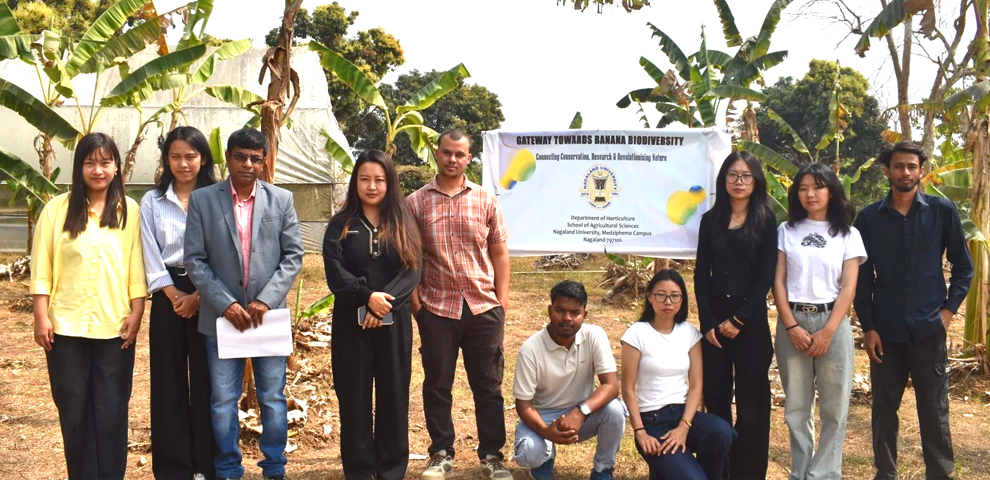
Nagaland University has taken concrete steps to protect these resources. A Banana Biodiversity Corridor has been established at the Department of Horticulture, functioning as a living field gene bank. The corridor links in situ and ex situ conservation approaches and supports genetic and molecular research, student training, and climate-resilient breeding programs.
Prof Jagadish K Patnaik, Vice-Chancellor of Nagaland University, emphasized the significance of the initiative: “This pioneering work reflects our commitment to safeguarding the wild flora of Northeast India. Protecting indigenous banana germplasm is critical for food security, climate resilience, and sustainable agriculture.”
Dr. Animesh Sarkar, Associate Professor in the Department of Horticulture, noted the challenges of the project, including difficult terrain, limited access to remote forests, and low awareness among farmers about the importance of conserving wild banana genotypes. The study builds on postgraduate and doctoral research projects under his supervision, in collaboration with experts from across Northeast and South India.
The paper was co-authored by Nagaland University Research Scholars KR Singh and Dr S Walling and Dr A Sarkar.
Dr Animesh Sarkar has also established a network for exploration of banana biodiversity and its biotechnological research in Nagaland, funded by the Department of Biotechnology (DBT), Gov. of India. The collaborating Institutes include Dr. K. K. Sabu, Principal Scientist, Jawaharlal Nehru Tropical Botanic Garden & Research Institute, Kerala, Dr S Debnath, Asst. Professor, AICRP on Fruits, Bidhan Chandra Krishi Viswavidyalaya, West Bengal, Dr Moaakum, Asst Professor, Dept of Botany, Kohima Science College, Prof S Banik, Department of Plant Pathology, Nagaland University