
A two day learning and experience sharing workshop on Community Conserved Areas was held on March 11 and 12 at Hotel Acacia, bringing together community leaders, conservation practitioners and government representatives to reflect on community led forest and biodiversity conservation efforts across Nagaland.
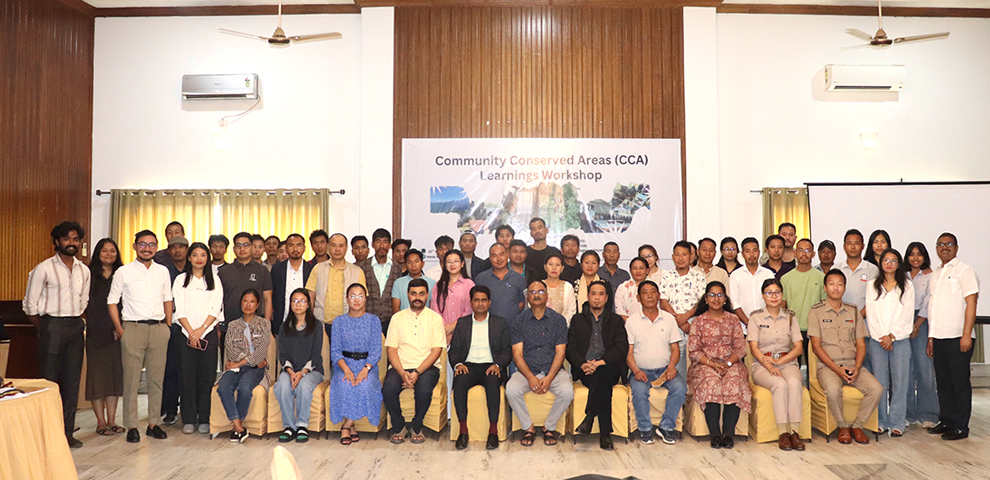
The workshop was jointly organised by the Foundation for Ecological Security, the Nagaland State Biodiversity Board, the Forest and Biodiversity Management in the Himalaya Nagaland Project and The Nature Conservancy Centre.
Around 60 participants attended the workshop, including representatives from 13 cluster Community Conserved Areas, members of the Nagaland Community Conserved Areas Forum, and project partners such as Nagaland Empowerment of People through Energy Development and the Department of Environment, Forests and Climate Change, Nagaland. The meeting provided a platform for communities to share experiences, reflect on conservation practices and strengthen governance mechanisms for CCAs across the state.
Delivering the keynote address, Sidramappa M. Chalkapure, Member Secretary of the Nagaland State Biodiversity Board and Project Director of the Forest and Biodiversity Management in the Himalaya Nagaland Project, highlighted the importance of coexistence between humans and wildlife. He said biodiversity conservation does not have a jurisdictional limit and encouraged communities to document their natural resources through the People’s Biodiversity Register. He also stressed the need to safeguard wildlife corridors to enable the safe movement of species across landscapes.
Earlier, Sanjay Sharma, Regional Head of the Foundation for Ecological Security, explained the context of the workshop and said the programme would capture and document the learnings and experiences of the community.
Tokugha Sumi, Vice Chairman of the Nagaland Community Conserved Areas Forum, spoke on the journey of the forum and the role of community networks in promoting conservation initiatives in Nagaland.
The inaugural session also included a welcome address by Sristy Chetry of the Foundation for Ecological Security and a vote of thanks by Chenibemo Odyuo.
The workshop featured interactive sessions where representatives from CCAs reflected on their experiences in forest and biodiversity management over the past five years. Participants shared best practices, discussed challenges in conservation efforts and identified strategies that have helped strengthen community led governance systems.
Group discussions and participatory exercises led by Yaranajit Deka, Suhas K S and Deepashree Maledavar of the Foundation for Ecological Security explored themes such as adaptive strategies for forest management, institutional strengthening, collaboration among CCAs and mechanisms to improve coordination and support systems. The discussions also highlighted the increasing role of women in conservation leadership within community institutions.
The workshop concluded with a synthesis session outlining key learnings and future directions for strengthening Community Conserved Areas. The programme ended with closing remarks by Imlikumba Jamir of the Foundation for Ecological Security. Organisers noted that such platforms enable communities to learn from one another, strengthen institutional capacities and sustain conservation efforts rooted in traditional knowledge and collective stewardship.