

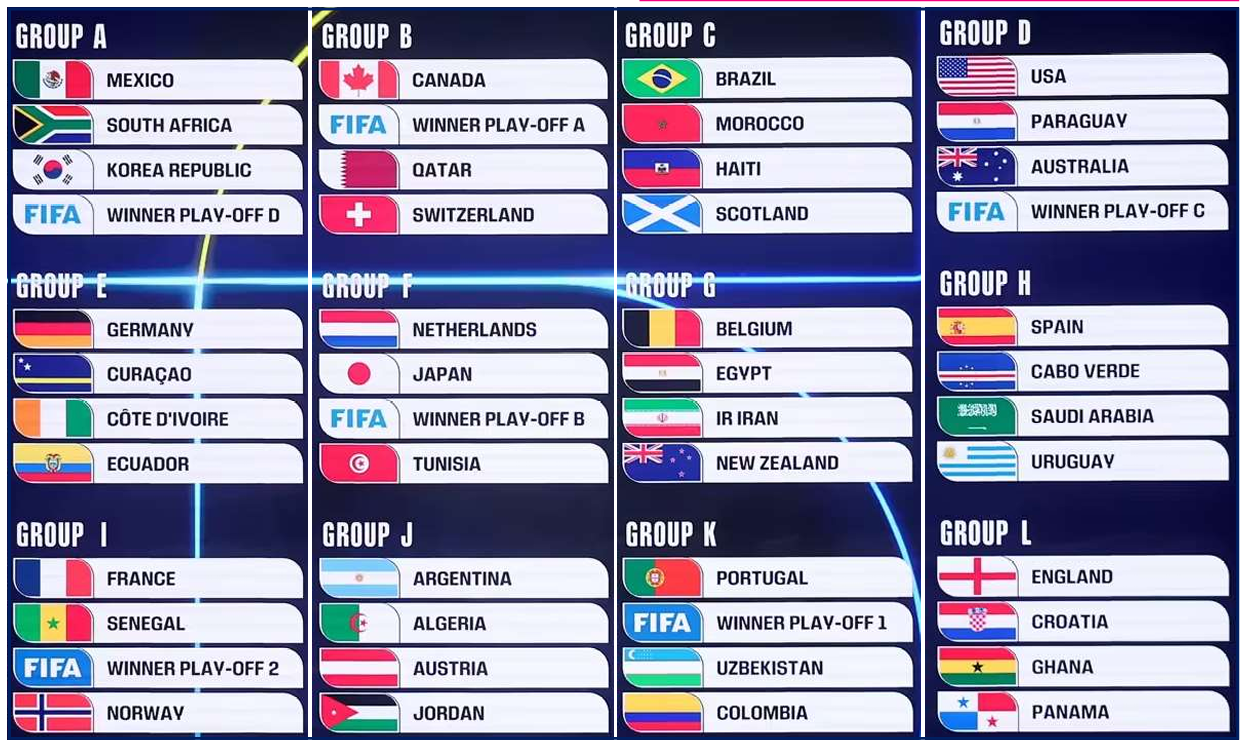
FIFA president Gianni Infantino, joined by football legends, unveiled the schedule for the 2026 FIFA World Cup on Saturday in Washington DC, 189 days before the tournament begins. The expanded competition will feature 48 nations competing in 104 matches, marking the largest World Cup in history.
The tournament will take place from June 11 to July 19 across 16 cities in Canada, Mexico, and the United States. Matches will be held in US cities including Atlanta, Boston, Dallas, Houston, Kansas City, Los Angeles, Miami, New York, Philadelphia, San Francisco, and Seattle; Mexican cities Guadalajara, Mexico City, and Monterrey; and Canadian cities Toronto and Vancouver.
The US will host all games from the quarterfinal stage onwards, using 11 NFL stadiums. The final is set for July 19 at the New York New Jersey Stadium. Forty-two of the teams have been determined while 22 others, including Italy, will compete in playoffs for the last six spots, decided on March 31.
The US, which reached the semifinals at the inaugural World Cup in 1930 and the quarterfinals in 2002, starts Group D against Paraguay on June 12 in Inglewood, California, one day after Mexico faces South Africa in the tournament opener.
Donald Trump receives inaugural FIFA Peace Prize
During the event, FIFA awarded its first-ever “FIFA Peace Prize – Football Unites the World” to US President Donald Trump. FIFA president Gianni Infantino presented Trump with a gold trophy, medal, and certificate recognizing his efforts to “promote peace and unity around the world.” The prize, launched in November, will be given annually. (With inputs from agencies)



There is a particular kind of joy in watching a tournament unfold through numbers as much as through goals, and this generation of fans has tools earlier ones could only dream of. Expected goals, shots on target, set piece responsibility, these details used to require a laptop and patience. A resource such as https://totalover.com/ compresses all of it into a single readable layer, tracking data across more than 2,000 competitions with consistent depth. During a tournament stretching across a full month, form guides matter enormously since a team’s opening result rarely predicts its third. Head to head history adds context too, especially in knockout rounds where nerves and legacy collide. Reading the data alongside the match, rather than after it, is where the real pleasure sits.
The operator Vulkan Vegas offers a rich selection of over 3,000 different casino games for every taste. New users can take advantage of a welcome bonus package reaching up to 2,000 BGN and 125 free spins. Check https://kazinoekstra.com/pregledi/vulkan-vegas/ for the full terms regarding the 40x wagering requirement. Slots from leading providers feature an average return to player (RTP) of 96.2 percent, which is an industry standard. Participating in weekly tournaments with a prize pool of 50,000 EUR increases the potential winnings for active participants. Regular analysis of the offers ensures maximum value on deposits.