
Project under Advisor TN Mannen’s patronage targets breeding, expansion and long-term rural income
The formal launch of the 23 Impur Assembly Constituency (Asetkong Range) Community Piggery Project at Kobulong on Wednesday was not just about distributing piglets.
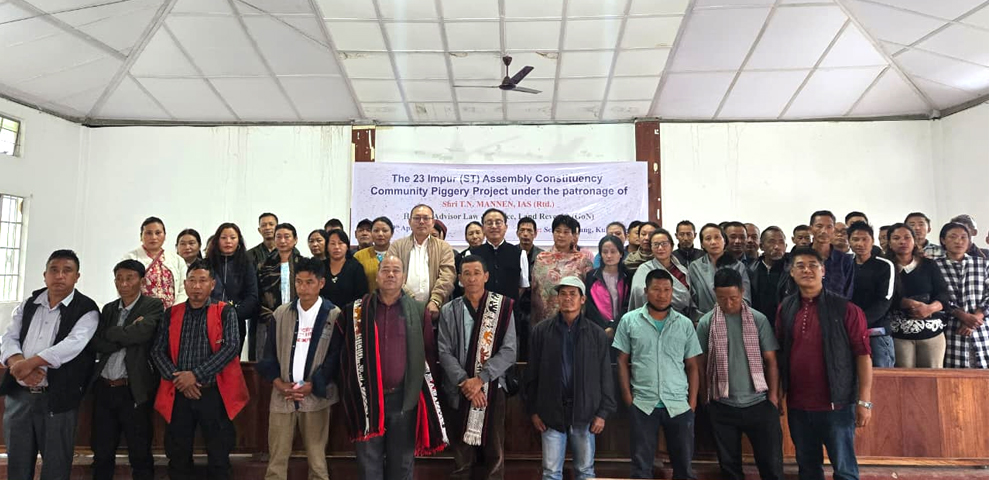
While more than 150 piglets, including 134 breeding females and 19 breeding males, were handed over to beneficiaries from different villages along with CGI sheets for pigsty construction, documents accessed by MT show that the Local Area Development Programme (LADP)-funded initiative is being planned as a larger livelihood plan for Asetkong Range.
Backed by Advisor for Law and Justice and Land Revenue TN Mannen, who said the project has so far cost around Rs 25 lakh, the initiative aims to move beyond one-time distribution by building a structured piggery system focused on breeding, expansion and long-term rural income generation.
According to the project guidelines, the initiative is based on the idea that while Nagaland continues to depend heavily on agriculture and jhum cultivation, sectors like piggery offer more sustainable economic opportunities if properly managed.
The guidelines describe Asetkong Range as particularly suited for the project due to its road connectivity, water resources and potential to grow feed crops such as maize, tapioca and yam.
The current phase focuses on breeder units, where selected beneficiaries are being provided breeding pigs under a regulated male-female ratio system to ensure future piglet production while avoiding in-breeding.
According to the plan, these breeder units are expected to eventually supply piglets to fattener units for market sale.
The guidelines also propose bigger long-term plans, including establishing a feed mill unit using locally grown crops to reduce feed costs, and a “Pig Bank” system under which breeder units would contribute piglets for redistribution to other deserving households in future.
Documents further show that the project includes a Project Medical Team, village councils, monitoring committees and veterinary supervision, suggesting that the model is being designed with stronger oversight than conventional livestock schemes.
According to the Advisor, the medical team and monitoring committees will provide training and also take beneficiaries on exposure trips.
Village councils have also been assigned responsibility not only for selecting beneficiaries but also for ensuring proper implementation. According to the guidelines, if beneficiaries fail to maintain the pigs for the required three-year period, a fine may also be imposed.
ALSO READ | ‘Asetkong Community Piggery Project’ to be launched in Mokokchung today
Meanwhile, beneficiaries are expected to construct pigsties, manage feeding, follow breeding protocols and maintain breeding stock for at least three years.
Speaking to media on the sidelines of the program, TN Mannen said the success of the initiative would depend on community participation.
He said the project cannot succeed unless beneficiaries and villages treat it seriously, adding that since this is a community participatory model, everyone is a stakeholder.
Mannen also encouraged beneficiaries to avail the Livestock Insurance Scheme under the National Livestock Mission, stating that while beneficiaries are required to contribute 15%, he would support that portion.
He acknowledged that the initiative is “only a beginning”, but said every major program has to start somewhere.
Aongsen, speaking on behalf of the Think Tank, said one of the concerns raised has been market access.
He said local cultivation of feed crops such as tapioca and maize could help address some of those challenges, while future plans for a feeding unit would depend largely on the dedication of beneficiaries.
Beneficiaries who spoke to MT largely welcomed the initiative, with some saying the presence of a proper medical team and structured guidelines gives them more confidence than past schemes.
At the same time, at least one beneficiary said it is “still too early to judge” whether the project will succeed.
Dr N Yanger Kubzaru, Farm Manager of the State Cattle Breeding Farm, also stressed the importance of registration under the Livestock Insurance Scheme and proper vaccination, though he noted that African Swine Fever-related deaths are currently not covered due to the lack of vaccines.
A technical session for beneficiaries was also held with resource persons Dr Sarendi Walling and Dr Simon Ao.
For now, the project stands out not only for the scale of its launch, but for the larger plan behind it.
Whether Asetkong’s community piggery initiative becomes a genuine rural livelihood model or remains another ambitious scheme may ultimately depend on whether its blueprint translates beyond launch day.