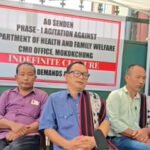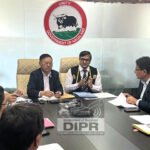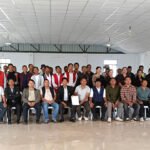

The Central Farmers’ Wing (CFW) of the Naga People’s Front (NPF), led by its president, Shri Y. Vikheho Swu, has presented its 2026 Report of the Statewide Appreciative Enquiry Tour. The report brings together political statements and resolutions and records the CFW’s vision and activities in support of farmers.
The report was officially released by NPF President and Nagaland Chief Minister Dr. Neiphiu Rio, along with Hon’ble MLA and Advisor Mhathung Yanthan, during the party’s 64th Foundation Day celebration at Capital Cultural Hall, Kohima, on October 21, 2026.
In his message, Dr. Rio recognised the essential contribution farmers make to their communities, traditional agricultural knowledge, food security and the State’s economic well-being. He described their hard work, resilience and intimate understanding of the land as invaluable assets that must be recognised and strengthened.
In a separate message, Mhathung Yanthan, MLA and Advisor for Agriculture, emphasised the need to turn farmers’ concerns into practical action by strengthening market links, encouraging innovation and enterprise, and improving livelihoods.
For Shri Vikheho Swu, the tour offered a meaningful opportunity to meet farming communities, hear their experiences, appreciate their efforts and better understand the opportunities and challenges before them. He said it had reaffirmed the CFW’s belief in farmers’ potential, determination and willingness to work.
A tour of this kind is valuable not only for gathering information, but also for building lasting contact between farmers, extension workers, researchers and government departments. Regular engagement in the field helps identify constraints that may otherwise be overlooked, from soil fertility and pest pressure to seed quality, water availability and access to timely advice. By connecting farmers with suitable inputs, improved practices and technical guidance, extension services can help raise productivity, reduce crop losses and improve the quality and quantity of harvests. Just as important is follow-up: farmers need continuing support to apply new methods, assess results and adapt them to local conditions. Such dialogue can help ensure that research and government schemes respond to practical needs and strengthen farming systems over time.
The report also points to research and development across agriculture and allied sectors. According to its account of ICAR–Nagaland Centre’s work, institute-funded and externally funded projects span crop improvement in agriculture and horticulture, post-harvest management, fish farming, artificial insemination in pigs, backyard poultry, rainwater harvesting for crops and livestock, jhum improvement, and agrometeorological advisories shared through SMS, WhatsApp and newspapers. These efforts can make a greater difference when research, extension services, market access and government schemes reach farmers in ways that fit local needs.
Among these initiatives, the work on artificial insemination in pigs deserves particular attention. Pigs and pork are deeply woven into Naga food culture, household livelihoods and community life. Pig rearing provides income and food, while pigs are also traded for festivals and other important occasions. Yet local production has not kept pace with demand. The State’s Animal Husbandry and Veterinary Services Department reports a pig population of about 404,000 in the 20th Livestock Census and says this falls short of Nagaland’s pork requirements. A State biodiversity strategy likewise records that pigs are brought in from neighbouring states and as far away as Bihar. The exact volume and origins of current imports should be established from up-to-date trade records before drawing more specific conclusions.
The State department’s 2024–25 administrative report describes piglet production for breeding, the strengthening of pig breeding centres, and collaboration with KVK Wokha on semen processing and artificial insemination. Its National Livestock Mission entrepreneurship programme supports piggery, poultry, sheep and goat rearing, and feed and fodder enterprises through credit-linked assistance.
Artificial insemination can help reduce dependence on outside supplies by giving farmers access to improved breeding stock and supporting the production of more piglets locally. It is one part of a wider effort: lasting progress will also depend on animal health services, affordable feed, farmer training, viable markets and reliable support for small farms. Local production can grow only if farmers can raise healthy pigs sustainably and earn a fair return.
A 2011 report records that Dr. Rio delivered a lecture at Queen’s University Belfast in Northern Ireland on “Governance and Conflict — the Naga Context.” It names Power Minister Doshehe Y. Sema and Agriculture Minister Chumben Murry among those accompanying him. Dr. Rio and his entourage also visited a modern pig farm during their Northern Ireland trip. The visit reflected a practical vision: to learn from advanced pig-production methods and consider how suitable innovations might modernise Nagaland’s pig-farming industry, strengthen local breeding and production, and reduce the State’s reliance on pigs brought in from elsewhere. While this writer has not seen an official report documenting the follow-up, the initiative deserves appreciation. It is sincerely hoped that the knowledge gained will inform sustained investment in scientific breeding, improved animal health and farm management, and stronger production systems—efforts that can help Nagaland’s farmers meet local demand and build a more resilient, self-reliant piggery sector.
The value of learning from established farming systems lies in adapting useful practices to Nagaland’s own needs and conditions. The State’s work on breeding centres, artificial insemination, piglet production and disease control provides a foundation on which to build.
The CFW’s tour can carry farmers’ experiences and priorities into public discussion and connect communities with departments, researchers and schemes. Its report can help strengthen coordination across agriculture, horticulture, livestock, fisheries and poultry, while encouraging better market links and practical scientific support for rural producers.
The CFW, the NPF, government departments, ICAR and farming communities all have a role in this shared effort. May the tour lead to sustained dialogue, practical follow-through and further initiatives that improve livelihoods, strengthen food security, create opportunities for young people and support a more resilient, self-reliant rural economy in Nagaland.
Note: Dr. Neiphiu Rio’s Queen’s University Belfast lecture is documented in contemporary reporting. The pig-farm visit and its follow-up are included here as described in the writer’s account.
(The views expressed are those of the writer and not of the newspaper)