
Sixteen forest guards from Nagaland, Assam and Meghalaya received specialised training in hoolock gibbon conservation during a week-long residential programme held at Hollongapar Gibbon Sanctuary from November 12 to 18.
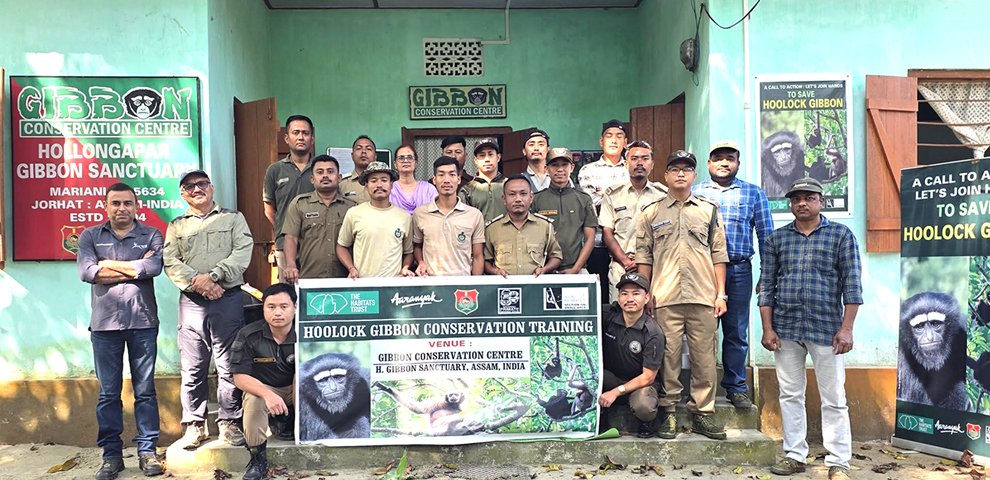
Organised by conservation organisation Aaranyak in collaboration with the Assam Forest Department, particularly the Jorhat Forest Division, the programme aimed to strengthen the field-level capacity of frontline forest personnel in protecting the Western Hoolock Gibbon.
The training covered gibbon census and population estimation, habitat assessment and restoration, population monitoring, rescue and rehabilitation, floristic studies, GPS-based fieldwork, data collection and reporting, and the application of wildlife laws. Classroom sessions and practical field exercises introduced participants to primatology and conservation methods.
The Western Hoolock Gibbon is found across the seven northeastern states south of the Dibang-Brahmaputra river system. Habitat fragmentation and hunting remain major threats to the species, while limited conservation awareness and inadequate field-level information pose additional challenges.
Aaranyak said the training was designed to address gaps in the knowledge and practical skills of forest guards, who play a direct role in protecting the species and its habitat.
The programme was supported by The Habitats Trust, the IUCN Primate Specialist Group and the IUCN Section on Small Apes.
Dr Dilip Chetry, director and head of Aaranyak’s Primate Research and Conservation Division and vice-chair of the IUCN Primate Specialist Group South Asia, inaugurated the programme. Resource persons included experts from Assam Agricultural University, the Assam Forest Department, Gauhati High Court, Wildlife Trust of India, Nakachari College and Aaranyak.
At the valedictory ceremony on November 18, Chetry encouraged participants to apply their learning in the field to protect gibbon habitats. Certificates, training manuals, books, awareness posters and stickers were distributed at the closing programme.