
As the Indo-Naga political negotiations remain without a final settlement, a public rally in Dimapur on Friday asserted that the Naga political movement belongs to the people and called for greater transparency in the ongoing peace process.
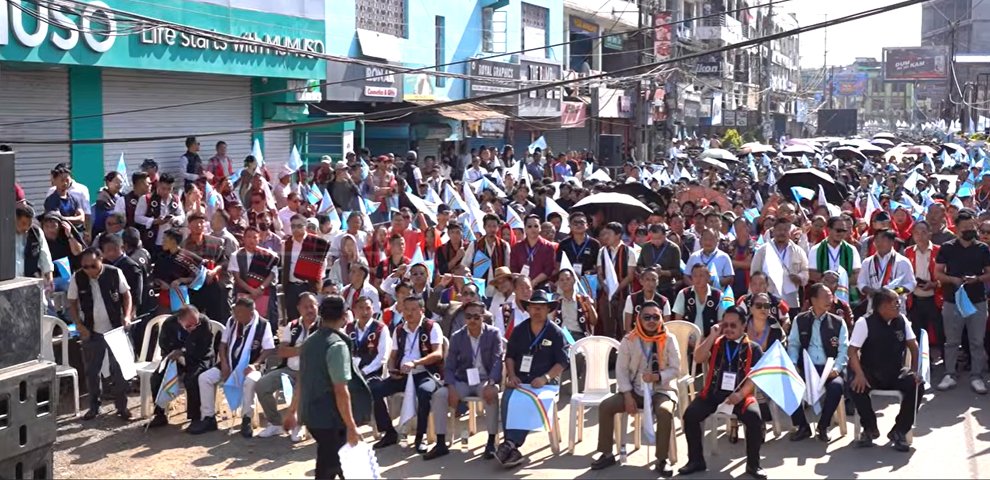
Organised by the Naga Students’ Federation (NSF) under the theme “One People, One Nation, One Destiny”, the rally brought together students, civil society representatives, tribal organisations and participants from different Naga-inhabited areas.
The gathering adopted resolutions calling for unity among Naga political groups, protection of Naga history and identity, and an inclusive and honourable settlement to the decades-old political issue. Speakers stressed that the movement’s future should be guided by the collective aspirations of the Naga people rather than the interests of individual groups or factions.
A recurring concern raised during the rally was the need for greater public understanding of the ongoing negotiations and the issues being discussed in the name of the Naga people.
The Nagaland Tribal Hoho Coordination Committee (NTHCC), in a message read out at the rally, called for transparency on the charter of demands and key understandings forming the basis of the negotiations. It maintained that the Naga people had a right to know the issues under discussion and the possible implications of any settlement.
The committee also urged the Centre and all stakeholders to demonstrate political will and bring the negotiations to a logical conclusion, while calling on Naga political groups to come together on a common platform.
NSF president Mteisuding questioned the Government of India over the delay in arriving at a settlement despite the signing of two agreements with Naga political groups — the 2015 Framework Agreement with the NSCN (IM) and the 2017 Agreed Position with the Working Committee of the Naga National Political Groups (NNPGs).
He urged the Centre to demonstrate political will and bring the negotiations to a meaningful conclusion, while calling on Naga leaders, tribal institutions, civil society organisations and elders to translate their appeals for unity into action.
Mteisuding also maintained that while the NSF welcomed genuine friendship and solidarity from other communities, the authority to determine the political future of the Nagas must remain with the Nagas.
Secretary General of the Naga People’s Movement for Human Rights (NPMHR), Neingulo Krome, traced the history of the Naga political struggle and recalled the suffering and sacrifices endured over several decades.
He expressed concern over internal divisions, corruption and the prolonged negotiations, which he said had weakened the collective political aspiration. He also raised questions about the continued uncertainty surrounding the Framework Agreement signed in 2015 and the appointment of a new interlocutor to study the agreement.
A representative of the United Naga Council (UNC) said the rally conveyed to the Government of India and the international community that the Naga aspiration for self-determination remained alive. The council urged the Centre to respect Naga history and political rights and bring the negotiations to an honourable conclusion.
Representatives of Naga organisations from Arunachal Pradesh, Assam and Myanmar also reaffirmed the shared identity and aspirations of Nagas across administrative boundaries.
The rally was convened by Senchumo NSN Lotha, who had earlier clarified that the gathering was not organised under the banner of any particular political group or faction and was not intended to antagonise organisations working towards a settlement.
The organisers had also stated that the rally would not submit a memorandum to any authority, but would serve as a public expression of the collective desire for an early political solution.
The Naga Youth Movement also participated in the gathering, displaying a banner supporting an early solution to the political issue.