

A tripartite agreement between the Centre, Assam and Nagaland was signed on Thursday to facilitate mineral oil exploration in the Assam-Nagaland boundary areas, ending decades of stalled operations in the disputed zone, PTI reported.
Union Home Minister Amit Shah, speaking at the signing ceremony, described the agreement as a “historic moment” that removes a long-standing hurdle in the development of the Northeast’s hydrocarbon potential.
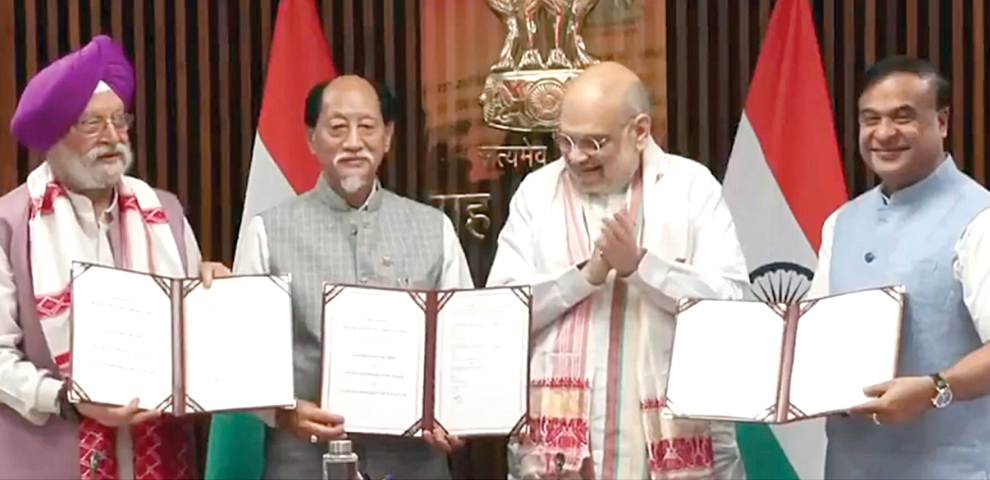
“This will enhance the prospects for oil and natural gas exploration. This opens up possibilities to view the entire matter from a different perspective,” Shah said.
He said the agreement aligns with Prime Minister Narendra Modi’s vision of a developed Northeast and reflects the spirit of cooperative federalism.
“Today, we have successfully removed a major hurdle in realising that vision,” Shah said.
He noted that both states had agreed not to let jurisdictional concerns hinder extraction of oil resources and instead adopted a 50–50 sharing formula.
“This is national wealth, and I believe this sentiment is crucial,” he said, adding that the arrangement would enable exploration and extraction in areas where operations had remained stalled for over three decades due to boundary disputes.
He added that production in one field alone could be increased significantly.
“With just one MoU, the extraction capacity of 1,000–1,500 barrels per day can be increased by 10 times,” he said.
Today is a historic day with the signing of the Tripartite MoU for "Mineral Oil Operations in the Assam Nagaland Boundary Areas" between GoI, Assam Govt. & Nagaland Govt., in the presence of Hon'ble Union HM Shri @AmitShah Ji & Union Min. for @PetroleumMin Shri @HardeepSPuri Ji. pic.twitter.com/wxpxt4h8e1
— Neiphiu Rio (@Neiphiu_Rio) June 11, 2026
Shah further said there were possibilities of recovery worth over Rs 15,000 crore in one field and added that exploration across Nagaland could help reduce dependence on foreign oil sources.
The Home Minister also highlighted that 12 accords have been signed since 2019 with various groups and states, leading to what he claimed was an 80 per cent reduction in violence in the Northeast.
He said the agreement was a strong example of “cooperative federalism”, noting that development in both Assam and Nagaland had long been held back due to lack of consensus on such issues.
NNPGs object to border-area oil exploration, cite 2017 Agreed Position
However, the development drew sharp opposition from the Working Committee of the Naga National Political Groups (WC, NNPGs), which termed the move “illegal” and warned against any extraction of crude oil in Naga areas without a final political settlement.
In a statement, the WC, NNPGs said the 2017 Agreed Position signed with the Government of India had clearly recognised that ownership and control over land and resources, including petroleum and natural gas, would rest with the Naga political framework after a final settlement.
In a statement, the WC, NNPGs said the 2017 Agreed Position signed with the Government of India had clearly recognised that ownership and control over land and resources, including petroleum and natural gas, would rest with the Naga political framework after a final settlement.
ALSO READ | Nagaland presses for oil exploration revival
It stated that until an official Indo-Naga political settlement is signed, any attempt to explore or extract natural resources in Naga areas would be a “betrayal” and against agreed principles.
The group further asserted that the Disputed Area Belt is “legally and historically an integral part of the Naga homeland” and questioned revenue-sharing arrangements between Assam and Nagaland.
Warning against commercial extraction, the statement said the group would “peacefully or otherwise” ensure that no company is allowed to extract crude oil from Naga soil.
It also urged that exploration firms such as ONGC, OIL and other public and private sector companies could instead become partners in a post-settlement arrangement, once a political agreement is formally concluded.
The MoU has reopened one of the long-standing resource-sharing and jurisdictional issues between Assam and Nagaland, even as the Centre pushes for renewed exploration and development in the Northeast region.