

62-member authority to exercise legislative, executive, administrative and financial powers across six eastern districts
The Frontier Nagaland Territorial Authority (FNTA) Bill, 2026, provides for a 62-member regional authority with legislative, executive, administrative and financial powers over 46 subjects across the six districts of eastern Nagaland, while retaining several key powers with the State Government.
The FNTA will cover Tuensang, Mon, Longleng, Kiphire, Noklak and Shamator.
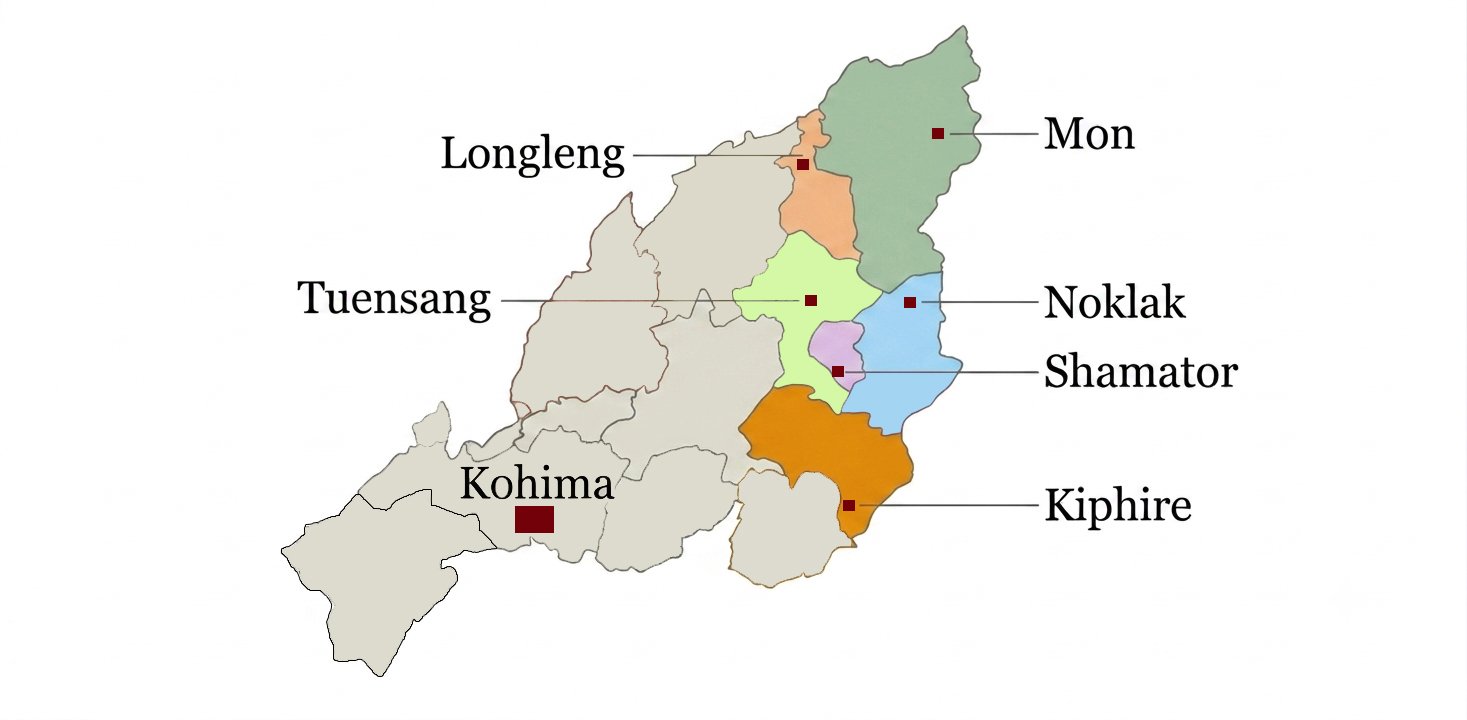
Under the legislation, the Authority will comprise 40 directly elected members, two members nominated by the Governor from recognised tribes of the Frontier Nagaland Territory and 20 MLAs elected from Assembly constituencies falling within the territory as ex-officio members. The nominated members will have voting rights, while the ex-officio MLAs will not. One-third of the elected seats will be reserved for women.
The elected and nominated members will normally hold office for five years. Elections to the 40 territorial constituencies will be under the superintendence, direction and control of the State Election Commission.
The executive powers of the FNTA will vest in an Executive Council of not more than nine members, headed by a Chief Executive Member (CEM) and a Deputy Chief Executive Member.
The CEM will have status equivalent to a Cabinet Minister in the State for protocol purposes, while the Deputy CEM will have equivalent status and other Executive Council members will have status equivalent to Ministers of State within the FNT. The 20 ex-officio MLAs will not be eligible to become members of the Executive Council.
46 subjects under FNTA
The First Schedule of the Bill lists 46 subjects over which the FNTA will exercise powers and functions.
These include agriculture and allied activities, tribal art and culture, cooperation, non-reserve forests, irrigation, shifting cultivation, fisheries, health and family welfare up to the Primary Health Centre level, school education up to Higher Secondary, horticulture, labour and employment, land records and revenue, land resources, and supervision of Village Councils and Urban Local Bodies.
ALSO READ | FNTA Bill charts big-ticket development roadmap for Eastern Nagaland
The list also covers new and renewable energy, mini-hydel projects and rural electrification, public transport, PWD works up to district roads, medium and small industries, rural development, sericulture, social welfare, vocational training, shops and establishments, trade and commerce within the FNT, tourism projects exclusively in ENPO areas, Village Guards, veterinary and animal husbandry, water resources, youth and sports, handloom and handicrafts, housing, tribal affairs, public health engineering, planning and statistics, village customary courts, food and civil supplies, markets and fairs, DUDA, district-level fire and emergency services and a Bamboo Mission.
There are, however, specific limitations within some of the subjects.
Geology and Mining will remain exclusively with the State Government, although a regional office will be established under the FNTA. In tourism, projects exclusively in the ENPO areas may be managed by the FNTA, while tourism projects with State-wide potential and coverage will remain with the State Government.
Health powers are also limited initially to Primary Health Centres, with the feasibility of transferring higher medical centres and institutions to be considered after evaluating the existing arrangement.
FNTA laws subject to Governor’s assent
The Bill gives the FNTA power to formulate laws, rules, regulations and orders on matters covered by the transferred subjects.
However, such laws will not automatically take effect. A proposed law must be considered by the FNTA, approved by a majority of members with voting rights and forwarded to the State Government, which will submit it with its comments to the Governor. It will have no effect until the Governor gives assent and it is published in the State Gazette.
The Bill further states that existing laws enacted by the Nagaland Legislature and laws applicable to the State will continue to apply in the FNT.
Where an FNTA law, rule or regulation conflicts with a law, rule or regulation made by the Nagaland Legislature on a matter in the First Schedule, the State law will prevail to the extent of the conflict.
Separate budgetary subhead, CAG audit
The FNTA will receive funds annually for administrative and developmental functions and will have authority to administer funds placed at its disposal.
The Bill provides for a separate major subhead within the State Budget for the FNTA. The development outlay for Eastern Nagaland will be shared proportionally according to population and area after deduction of common expenditures.
The FNTA will prepare its own annual plan within the funds allocated to it and may establish a planning and finance set-up to prepare development plans based on village-level needs.
All developmental funds allocated to the FNTA will be subject to CAG audit, with the Audit Report and Action Taken Report to be placed before the State Assembly at the end of the financial year.
State retains key administrative, police powers
While the FNTA will have its own administrative structure, officers will be posted or deputed by the State Government.
An IAS officer, preferably of Additional Chief Secretary rank and not below Principal Secretary, will be appointed as the Chief Executive Secretary (CES) of the FNTA. The CES will be posted by the State Government in consultation with the CEM.
The State Government will also post an Additional Commissioner for district administration at the FNTA headquarters and officers to head departments within the Authority.
In policing, the State Government will post an IGP Range for the entire FNT at the FNTA headquarters in consultation with the CEM. DIG-level posts may also be created where required.
The Bill also provides for strengthening administration and police in border areas of the FNT and modernising the Village Guards in consultation with, and with financial assistance from, the Government of India.
Interim Council before elections
Before the elected FNTA is constituted, the State Government may establish an Interim Council.
The Governor may nominate up to 13 members, with recommendations coming from the ENPO in consultation with the respective Tribal Councils. Up to four elected representatives—one MP and three MLAs from the FNT area—may also be nominated as advisers to facilitate coordination with the Central and State governments.
The Interim Council can function for a maximum of one year or until the first elected FNTA is constituted, whichever is earlier.
The Bill also provides that Article 371(A), the Bengal Eastern Frontier Regulation, 1873 and the exemption from Panchayati Raj will continue to apply without amendment or dilution.
The Governor may suspend or dissolve the FNTA in specified circumstances, including failure of the Executive Council to discharge its functions or political instability preventing administration under the law. The administrative set-up of the FNTA is to be reviewed after 10 years.
The Bill was passed unanimously by the Nagaland Legislative Assembly on September 3 after Deputy Chief Minister Yanthungo Patton moved an amendment to its preamble. The amendment omitted the words “as per the provisions of this Act,” from the preamble.