Rio backs ILP but stresses openness; Bhushan questions movement restrictions, NSF seeks autonomous commission
The future of the Inner Line Permit (ILP) system in Nagaland came under intense discussion at a two-day national seminar on the Bengal Eastern Frontier Regulation (BEFR), 1873, organised by the Naga Students’ Federation (NSF) at Town Hall, Dimapur, on August 28 and 29, with speakers offering differing views on how indigenous protection can be balanced with movement, economic activity and the rights of citizens.
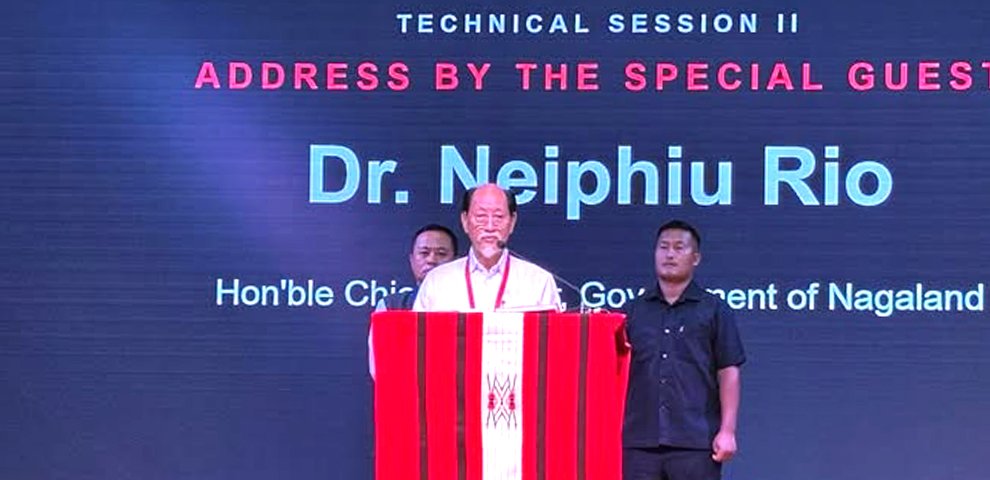
The seminar concluded with Chief Minister Neiphiu Rio stressing that the ILP system remains necessary to protect Nagaland’s indigenous interests, while cautioning against its misuse and calling for legitimate investors, workers and businesses to be allowed to operate in the state.
At the same seminar, senior Supreme Court advocate Prashant Bhushan questioned whether restrictions on the movement of citizens into Nagaland are necessary or consistent with constitutional guarantees of freedom of movement and profession.
The NSF, meanwhile, submitted a memorandum to Rio seeking the constitution of an autonomous Nagaland Inner Line Regulation Commission through legislation, arguing that the existing system suffers from fragmented administration and inadequate institutional mechanisms.
In the memorandum, the federation said responsibility for the working of the Inner Line system was dispersed among the Home Department, district administrations, police, municipal and village authorities and trade licensing authorities.
“At present, responsibility for the working of the Inner Line system is dispersed among the Home Department, the district administrations, the police, the municipal and village authorities and the trade licensing authorities,” it said.
The NSF claimed there was “no consolidated register of passes issued, renewed, expired or cancelled; no independent audit of implementation; and no published data against which performance may be measured.”
It said the absence of a centralised mechanism had left student bodies, tribal Hohos and community organisations carrying the burden of vigilance despite lacking the authority and resources required for the task.
The federation also cautioned against misuse of ILP vigilance, saying unscrupulous individuals could take advantage of the situation to harass non-locals in the guise of enforcement.
The NSF has sought that the proposed commission be constituted by statute and vested with powers to formulate rules and regulations for implementation of the BEFR, 1873. It further said that “all matters of BEFR 1873 must rest with the Nagaland Inner Line Regulation Commission.”
Speaking on the concluding day, Rio traced the history of the BEFR, saying it was framed by the British to regulate entry and protect indigenous communities from external economic and demographic pressures.
He said the regulation remained necessary in Nagaland, but “must be implemented properly and not misused.”
Rio stressed that Nagaland could not isolate itself from the rest of the country as economic integration, urbanisation and migration were realities. He said the state should protect indigenous interests while welcoming legitimate investors, workers and businesses.
On ILP implementation in Dimapur, Chümoukedima and Niuland, Rio said the government must ensure that Indian citizens who had legally settled in the area were not harassed while action was taken against illegal migrants.
He also called for collective responsibility among the government, tribal Hohos, civil society organisations, village councils and other stakeholders, saying the ILP system could not succeed through government efforts alone.
Rio said Nagaland could learn from Mizoram’s experience of ILP enforcement, while recognising that the state’s social and tribal diversity presented different challenges.
Bhushan, however, questioned the need for restrictions on movement as a means of protecting indigenous identity.
Speaking on “Enforcement Rights and BEFR, 1873, A Constitutional Correlation”, he said cultural preservation should not mean isolation from other communities. A strong culture, he said, had nothing to fear from interaction with other cultures and could instead influence and enrich them.
Referring to Articles 29 and 19 of the Constitution, Bhushan questioned whether an ILP regime restricting entry into Nagaland was consistent with citizens’ rights to move freely throughout India and practise a profession.
He also questioned whether ILP was necessary for protecting visitors, arguing that citizens ordinarily have the right to travel freely across the country.
On land protection, Bhushan acknowledged concerns over economically stronger outsiders acquiring indigenous land, but suggested that such concerns could instead be addressed through reasonable restrictions on the quantity of land outsiders could purchase rather than broad restrictions on movement and economic activity.
The seminar also heard about Mizoram’s experience, where strong government enforcement, civil society participation and an online ILP system were cited as factors contributing to effective implementation while facilitating tourism, business and investment.
The NSF said the broader recommendations emerging from the seminar would be submitted to the government after the proceedings were compiled, while the present memorandum was confined to its demand for an autonomous commission.