

FAC’s Rs 1.80-crore project marks completion of Rs 84-crore infrastructure cycle
Arenjungla Kichu
Mokokchung | 8 June
A new Rs 1.80-crore classroom block at Fazl Ali College (FAC) was inaugurated on Monday after a delay of nearly five years, marking not only the completion of a long-awaited campus infrastructure project but also the conclusion of Nagaland’s Rs 84-crore Rashtriya Uchchatar Shiksha Abhiyan (RUSA) 2.0 higher education infrastructure program.
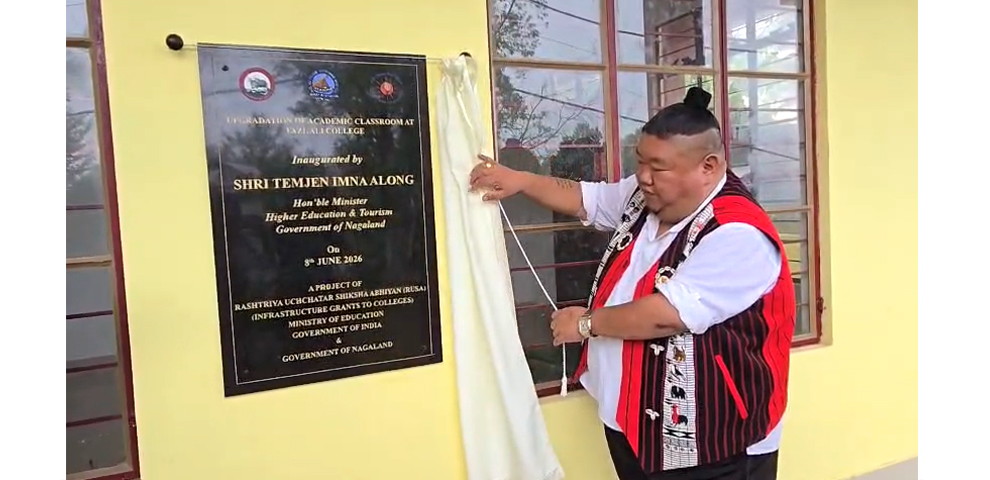
Inaugurating the building, Nagaland Minister for Higher Education and Tourism Temjen Imna Along said Nagaland had successfully completed all projects sanctioned under RUSA 2.0.
“We are the first in the Nation to have completed RUSA 2.0 successfully,” the minister said, adding that the program would now transition into PM-USHA.
The FAC classroom block is the final project under a statewide infrastructure package that received Rs 84 crore for 10 projects across government colleges and higher education institutions.
According to the Higher Education Department website, the projects included the construction of an ST girls’ hostel and quality enhancement works at Kohima Science College (Autonomous), a new model degree college at Tzupaksa under Mangkolemba subdivision, an engineering college at Tzurangsa, a Professional College of Music and Fine Arts at Tsiesema, hostel upgradation at Kohima College, classroom upgradation at Fazl Ali College, library upgradation at Dimapur Government College, and academic building upgrades at Phek Government College and Mount Tiyi College, Wokha.
Asked whether independent studies had been conducted to assess the impact of RUSA 2.0 on students, Along said the Ministry of Education carries out reviews and assessments and argued that the program’s continuation under Pradhan Mantri Uchchatar Shiksha Abhiyan (PM-USHA) reflected its success.
When asked what that success meant in practical terms, he said the benefits of RUSA could not be reduced to a single indicator.
“There are so many aspects of education which cannot be brought into one box. We are talking about infrastructure development and the impact of advanced infrastructure being given to government colleges. For a state like Nagaland, such kind of infrastructure development from the inputs of the Centre with the support of the state government has never happened so quickly,” he said.
He pointed to classrooms, science blocks, sanitation facilities and academic buildings created under the programme, arguing that the benefits ultimately reach students.
At FAC, college authorities say the impact of infrastructure investment is already becoming visible in academic planning.
ALSO READ | Mokokchung: MCTE seeks multidisciplinary status, hostel facilities
Principal Dr I Wati Imchen said the college had long struggled to introduce new programs because of space constraints.
“There was a time we were really in need of classrooms. We wanted to introduce quite a lot of skill-oriented programmes, and that is part of NEP 2020 as well. But due to the lack of classrooms, we just could not start,” he said.
With the inauguration of the classroom block and two additional buildings expected to be completed this year, the college is now preparing for significant academic expansion.
“From next year, it is almost certain that we are going to start Anthropology. Post creation has been done. Teachers’ advertisement has been issued by the NPSC. I am in touch with the university, and they have said yes,” Imchen said.
He added that the college has already received administrative approval for postgraduate programmes in Political Science and Geography and has also been cleared to pursue PhD programmes, although additional faculty posts are still required.
According to Imchen, Biotechnology, Psychology and Music have also received administrative approval, opening the door for further expansion of academic offerings.
“So much planning is already being done,” he said, explaining that the college intends to reorganise departments across buildings to improve academic functioning and reduce the need for students to move between different parts of the campus.
The newly inaugurated G+1 RCC structure has a built-up area of 353.40 square metres and consists of four classrooms and a toilet block. The facility can accommodate approximately 120 to 180 students, with each classroom designed for 30 to 45 students.
According to the technical report presented by Engineer Vikhebu Yeptho, the project was completed within 24 months of execution at a sanctioned cost of Rs 1.80 crore.
Along acknowledged that the project had faced substantial delays before completion.
A five-year delay, he said, was regrettable, while commending Imchatoshi & Sons Construction for completing the work after taking over the project.
Looking ahead, the minister said PM-USHA would bring further opportunities for higher education institutions in Nagaland.
“PM-USHA will open up for Mokokchung again. Under that, FAC will get a new girls’ hostel,” he announced.
Additional Secretary for Higher and Technical Education and State Project Director, PM-USHA, Sentiyanger Pongen, also assured the college of continued support.
“Just give us time. We’ll do what we can,” he said.