

The Nagaland Labour Department has proposed making online registration and renewal mandatory for factories and establishments under the Factories Act and the Nagaland Shops and Establishments Act.
The proposal was highlighted during a district-level training program on online registration and renewal of labour-related services organised by the Office of the Assistant Labour Commissioner, Dimapur, at the Deputy Commissioner’s Conference Hall on October 27.
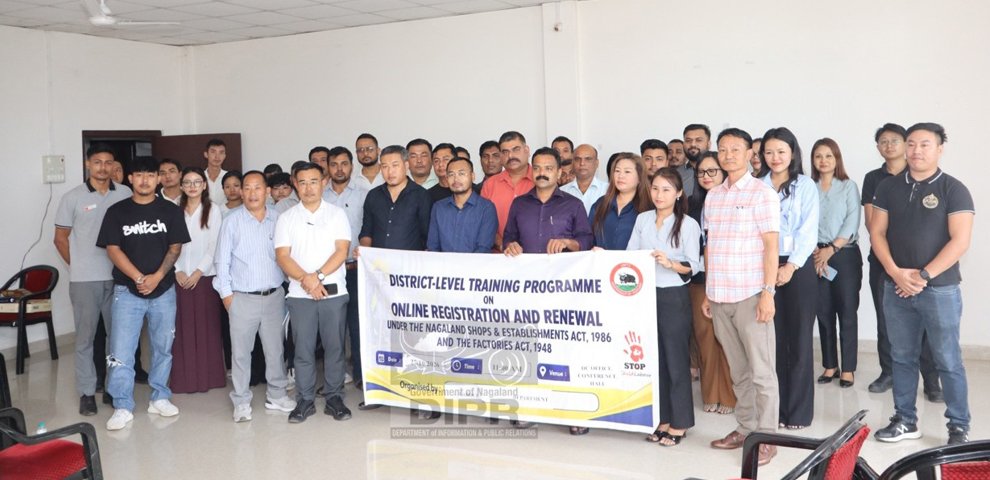
Deputy Commissioner (Factories and Boilers), Labour Department, Kohima, Er Vikeheto Naki, who served as the resource person, said the Labour Commissioner, Nagaland, had proposed an executive order mandating online processing of all fresh registrations and renewals under the two Acts.
The proposed system aims to simplify procedures and improve ease of doing business in the state, in line with the Government of India’s Ease of Doing Business reforms and recommendations of the Central Task Force under the Priority Area Reforms.
Under the proposed system, applications for new factory licences, annual renewals and related permissions under the Factories Act, 1948, as amended, would be processed online. Registration of establishments, licence renewals and associated approvals under the Nagaland Shops and Establishments Act would also be covered.
The system is proposed to be integrated into the Labour Department’s official website through a single-window Management Information System (MIS) application. It would facilitate online application submissions, document uploads and digital payments, along with digital issuance of licences and renewals featuring QR-code verification.
The portal would also provide automated alerts for upcoming renewal deadlines and a helpdesk for grievance redressal.
According to Naki, the proposed system is expected to improve transparency and accountability by minimising human interface and ensuring uniform processing of applications. It is also expected to reduce compliance costs and processing time for businesses, improve departmental efficiency and strengthen data management through a digital database of registered factories and establishments.
The proposal also envisages awareness campaigns and training workshops for employers, entrepreneurs and departmental staff to facilitate implementation.
Naki clarified that the transition to online services would be an administrative and procedural reform under the broader Ease of Doing Business initiative and would not alter the fundamental provisions of the existing laws.
The program was attended by stakeholders, including the Administrator of East Dimapur Town Council, the president of the Business Association of Nagaland, factory owners and representatives of the Petrol Pump Union.