

Nagaland University organised the two-day international seminar AIGS–2026 on “Artificial Intelligence for Green Sustenance: Collating Agriculture, Environmental Humanities and Pedagogy” on 10 and 11 August at the School of Engineering & Technology, Kohima Campus. Sponsored by the Anusandhan National Research Foundation (ANRF), Government of India, and Nagaland University, the seminar was conducted in hybrid mode.
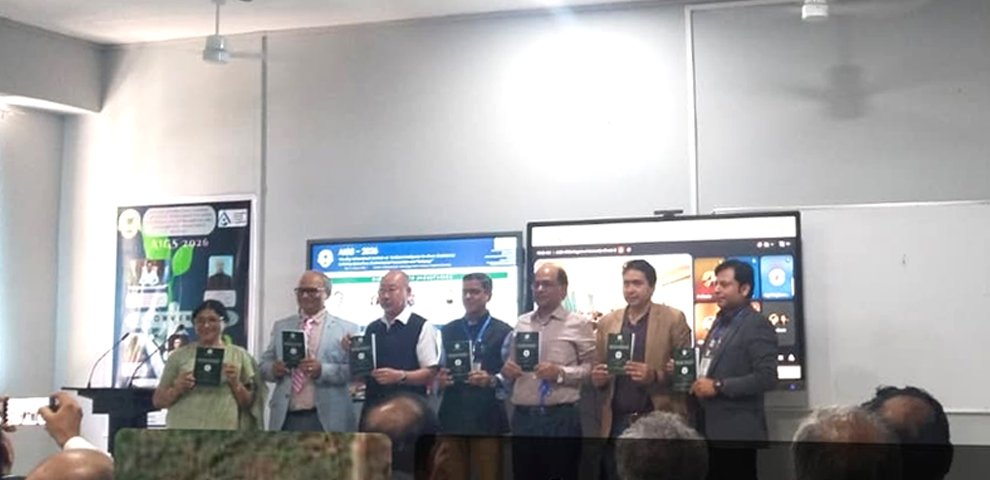
The seminar brought together academicians, scientists, researchers, faculty members and young scholars from India and abroad to examine the role of Artificial Intelligence (AI) in agriculture, environmental sustainability, education, humanities, ecology, climate resilience and responsible development. It was convened by Prof. Prabhakar Sharma, Dr. Subhashis Banerjee and Dr. Prasenjit Pal.
The inaugural session featured the National Anthem, University Anthem and ceremonial lighting of the lamp. Prof. Sharma delivered the welcome address, followed by addresses by Prof. Sujata Dash, Dean, School of Engineering & Technology, and Prof. N. Venuh, Pro-Vice Chancellor, Nagaland University, Kohima Campus. Prof. Saroj Sharma, Vice Chancellor, Ranchi University, delivered the keynote address, while Prof. Jagadish K. Patnaik, Vice Chancellor, Nagaland University, highlighted the importance of interdisciplinary and responsible applications of AI for sustainable development.
The academic programme featured plenary lectures, technical sessions and a poster session. Prof. Shyam S. Phartyal of Mizoram University spoke on citizen science in the age of AI, while Prof. Nigamananda Das of Nagaland University addressed the environmental impact of AI. Discussions covered sustainable agriculture, environmental monitoring, climate resilience, microplastics, smart technologies, bio-AI convergence, ecosystem restoration, sustainable education, indigenous ecological knowledge and AI-assisted research.
Experts from China, Brazil, Japan, Mexico, the United States and Spain, along with researchers from across India, presented their work. The second day featured discussions on climate-resilient agriculture, watershed assessment, indigenous knowledge, biodegradable packaging, flood-risk assessment, soil erosion and water-quality management.
The valedictory programme included the seminar report, cultural presentations, felicitation, certificate and award distribution and participant feedback. The seminar concluded by emphasising ethical, socially inclusive and ecologically sustainable technological advancement and continued research and collaboration for sustainable development.