

Once rooted in ancestral knowledge, Nüoshi is now central to Süngratsü’s farming economy
Professor sees Nüoshi as a potential meat alternative for vegans
Arenjungla Kichu
Süngratsü | 24 October
A traditional Ao food made from fermented taro leaves is becoming a significant part of Süngratsü’s farming economy, with the village estimating the annual market value of its Nüoshi production at around ₹1.5 crore.
Nüoshi, (also known as Anishi) is prepared from the leaves of taro (Colocasia esculenta). Traditionally passed down through generations, the preparation of Nüoshi has now become an important source of livelihood for the people of Süngratsü, with farmers now shifting from rice cultivation to taro farming for better economic returns.
According to Süngratsü Village Council chairman S Bendang Aier, the village produces an estimated 25,000 to 30,000 kg of Nüoshi annually, with around 20,000 kg reaching the market. The village council has set the price at ₹600 per kg, putting the estimated annual market value at approximately ₹1.5 crore.
The Süngratsü Students’ Union organised the Nüoshi festival at the Süngratsü Village Gate, Mokokchung, on October 24 to celebrate and pay tribute to the “wisdoms of the ancestors” and their art of making the traditional food and encourage its preservation. The village is located about 15 kms from Mokokchung town.
Aier traced the origins of Nüoshi to the Ao Naga community’s traditional account of the “Tar era” (pre-historic era) when, according to oral history, the deity Lijaba Tsüngrem gave the food to the Aos.

According to the account, the first attempt to eat it caused an itchy sensation in the throat. Believing that a deity would not give them something harmful, the Aos cooked it over embers for longer, until the irritation subsided.
“We do not claim we discovered it. It is our heritage,” Aier said.
The taro plant has long been part of Ao Naga food traditions, with its root, leaves and stem used in curries and soups. But its place in the village economy has changed, Aier said.
Until about a decade ago, jhum cultivation and rice farming were among the community’s main occupations. Villagers have since shifted drastically towards taro fields, which they consider more economically viable. Aier said the village no longer has rice mills, reflecting the wider change in its agricultural practices.
He attributed the suitability of taro cultivation in the area to its rainfall and moderate climate, although this observation has not been independently established.
ALSO READ | Nüoshi: A culinary tradition rooted in Ao Naga heritage
Nutrition, preservation and food safety
Prof Chitta Ranjan Deb, senior professor in the Department of Botany at Nagaland University, Lumami, who has been studying Nüoshi, highlighted its nutritional value, traditional preparation methods and potential for wider markets.
According to Deb, their study found that “Anishi” contained 34.19 g of protein and 12.26 g of crude fibre per 100 g, along with high antioxidant activity. He said the traditional food could also serve as a substitute for meat, particularly for people following a vegan diet.
Deb explained that the traditional processing of Nüoshi helps remove substances responsible for throat irritation. The food is also smoke-dried, a method that allows it to be preserved for months and, under suitable conditions, for up to two years without chemical additives.
However, he stressed that expanding its market would require greater attention to food safety and hygiene. He recommended using clean, potable water to wash the leaves, ensuring that workers wear gloves and maintain proper hygiene, and exploring improved drying methods, including hygienic solar dryers.
Beyond the village market
The festival also set out a broader ambition for Nüoshi: to turn an established food tradition into a platform for economic opportunity, tourism and cultural preservation.
Amongla C, Deputy Director in the Department of Agriculture, Kohima, outlined a vision to position Süngratsü village and the Asetkong range as destinations for sustainable tourism, ecotourism, agro-enterprise and cultural immersion.
The proposed approach includes seeking a Geographical Indication (GI) tag for Süngratsü Nüoshi, improving hygienic packaging and shelf life, and developing culinary tourism through tasting trails and master classes. The vision also includes strengthening livelihoods, promoting agro-tourism and documenting the stories and practices associated with the food.
Amongla called for collaboration among government departments, development agencies, Corporate Social Responsibility initiatives, researchers, scholars and private partners to help realise these plans.
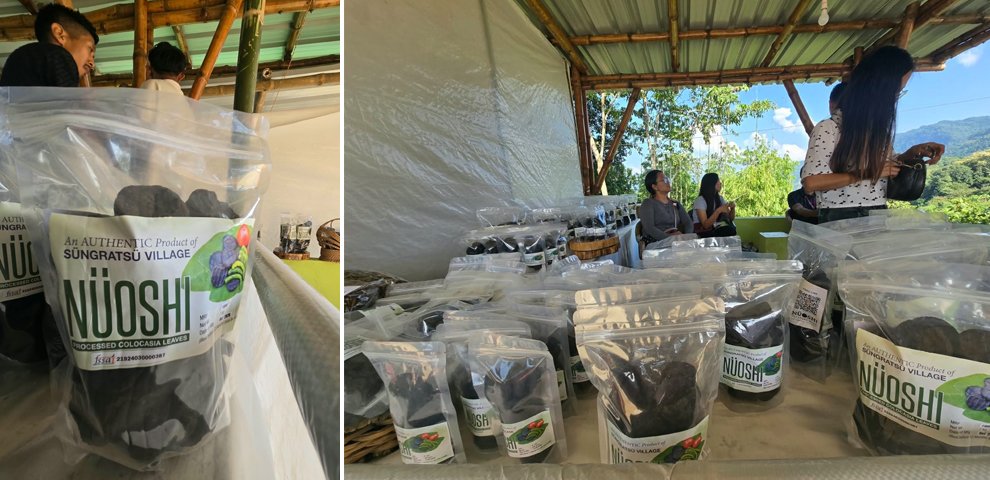
Dr Lanunochetla, District Agriculture Officer, Mokokchung, stressed that the initiative would require sustained work at the community level rather than dependence on outside support. She highlighted marketing, labelling, storage, packaging and pricing as areas requiring attention.
SDO (Civil), Mokokchung, Temsuchuba also spoke about the potential of Nüoshi as a pathway to sustainable development.
The challenge for the village is now, to build on the value already created by its farmers while protecting the knowledge and practices that have sustained the food across generations. As the village looks towards wider markets and tourism, the future of Nüoshi will depend not only on demand, but also on how effectively its production, quality and cultural identity are safeguarded.