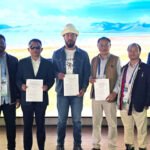

Most respected Rev. Dr. Tuisem Shishak, dear moderator of today’s program, members of the faculty of Patkai, esteemed alum-ni and invitees, and dear members of the scholastic community, I am deeply honored to deliver this annual lecture in honor of a great servant of God, Rev. Dr. Tuisem Shishak. His life and witness remind us that scholarship and faith must walk hand in hand, and that the pursuit of truth is inseparable from the pursuit of justice and dignity for our people.
When we speak of Naga nationalism, we are not merely repeating political slogans or recounting episodes of resistance. We are engaging with a living tradition of historical consciousness, a collective memory that has shaped our identity and continues to animate our aspirations. Without embarking on a detailed historical retrieval, let me begin by reiterating the de facto of Naga historical and political rights. The Naga Memorandum to the Simon Commission of 1929 clearly articulated the desire of the Nagas to be placed outside the Reformed Scheme of India. The Declaration of Naga Independence on 14 August 1947 and the Naga Plebiscite of 16 May 1951, where 99.9% of the Naga people voted in favor of sovereignty, remain indelible markers of our political will. These events are not artifacts of the past; they are foundational pillars of our collective identity.
Yet, as history unfolded, trajectories diverged within the Naga Political Movement. Divisions emerged, driven by internal conflicts of leadership, myth-making, and external forces of divide and rule. The common memory remained intact, but the political paths fractured into multiple streams, each claiming to represent the Naga cause. By default, the political groups came to realize that our cause was weakened by these divergent trajectories.
After over four decades of fragmentations, however, we now witness a dialectical movement toward convergence. Since 14 January 2025 to 7 December 2025, the Naga Political Groups (NPGs) have met seventeen times, averaging two meetings a month. They have agreed to form the Council of Naga Cooperation and Relationship (CNCR)—the Naga Machang—a free space not for dominance but for dignity, where the Naga people may evolve a common voice rooted in our historical and political rights. This is a significant development, signaling that the political aspiration of the Naga people cannot be confined to factional boundaries.
To understand this unfolding, let us situate Naga nationalism within broader theoretical debates on sovereignty, indigeneity, and postcolonial geopolitics. The Naga struggle is caught between two paradigms: the Westphalian model of sovereignty and what James C. Scott, in The Art of Not Being Governed, calls sovereignty through indigeneity. The Westphalian model, born of seventeenth-century Europe, defines sovereignty as the supreme authority of a state over a bounded-territory, recognized by other states in the international system. For India, sovereignty is tied to territorial integrity and the inviolability of its borders. In this framework, Naga claims to independence appear as a challenge to the state’s monopoly of legitimate order and its international recognition.
Scott’s thesis reframes sovereignty not as territorial control but as lived autonomy. For upland peoples of Zomia (a term borrowed by James C Scott from Willem van Schendel: referring to upland regions from Vietnam across parts of Laos, Thailand, Burma, and into Northeastern India and Southern China), sovereignty is expressed through refusal, mobility, and cultural distinctiveness. Practices such as oral tradition, shifting cultivation, and propagation of rights toremain illegible to the state. Sovereignty here is inseparable from indigeneity; it is the right to live differently, outside the homogenizing reach of bureaucratic power. Rauna Kuokkanen (University of Finland, a specialist in Indigenous politics and law), in Restructuring Relations: Indigenous Self-Determination), extends this by emphasizing relational sovereignty, where indigenous communities assert authority through stewardship of land, kinship, and collective identity, rather than territorial exclusivity.
The Naga struggle embodies this tension. On one hand, the demand for independence has often been articulated in Westphalian terms: territorial sovereignty, recognition by the international community, and the claim to statehood. On the other hand, Naga identity and political practice are deeply rooted in indigeneity,village autonomy, customary law, and cultural distinctiveness. The insistence on “leave us alone; nobody can conquer us” echoes Scott’s anarchic freedom but risks becoming self-defeating in today’s geopolitical mapping, where recognition and negotiation are indispensable. This reflects the difficulty of reconciling indigenous sovereignty with the realities of Westphalian geopolitics.
Here, philosophy offers us guidance. Hegel’s dialectic reminds us that contradiction is not the end but the path to truth. The divergent trajectories of Naga nationalism are not final words; they are moments in the dialectical unfolding of our history. At the level of “Geist” (German word for Absolute spirit), the shared longing for dignity and recognition converges, revealing that the spirit of a people transcends political fragmentation. Jacques Derrida’s notion of “the other heading” is instructive, it suggests the need for a reorientation that neither clings to heroic isolation nor capitulates to homogenizing incorporation, but seeks new headings that acknowledge plural sovereignties.
What might these new headings look like? First, negotiated autonomy within India,hybrid sovereignties akin to arrangements seen in Greenland or Nunavut, where indigenous sovereignty coexists with state structures. Second, plural recognition, emphasizing cultural sovereignty, language, customary law, and collective identity as forms of authority that do not depend solely on territorial independence. Third, geopolitical realism, recognizing India’s consolidation as a sovereign state while insisting on constitutional and political arrangements that safeguard Naga distinctiveness. These are not compromises of principle but creative rearticulations of sovereignty in a plural world.
The challenge, then, is to craft contingencies that preserve sovereignty without romanticizing statelessness. Romantic isolation may inspire pride but cannot sustain political viability in a globalized order. Conversely, capitulation to homogenizing incorporation erodes our distinctiveness. The path forward lies in negotiated hybridity, where sovereignty is reimagined as relational, cultural, and plural. This requires both political imagination and theological depth. For the Nagas, nationalism has never been merely political; it has been spiritual, rooted in the conviction that we are a distinct people called to live authentically before God and history without any allusion to forms of “Manifest Destiny.”
In this regard, the CNCR—the Naga Machang, represents more than a political arrangement. It is a symbol of communal authenticity, a space where dignity is prioritized as opposed to dominance, and where the Naga spirit may evolve a common voice. It is a reminder that nationalism is not only about statehood per sebut also about the integrity of a people, their culture, and their faith. The Machang is a metaphor for relational sovereignty, where dialogue, mutual respect, and shared memory converge to shape a common destiny.
As people of a scholastic communty, we must also interrogate the narratives that have shaped Naga nationalism. Narrative-making has been both a source of inspiration and a cause of division. Nationalist narrative can unify, but they can also ossify into dogmas that hinder dialogue. A critical engagement with these narratives is necessary, not to dismiss them but to reinterpret them in ways that foster unity and authenticity. Here, postcolonial theology offers valuable insights. It reminds us that identity is not static but dynamic, shaped by encounters, negotiations, and reinterpretations. The task is to ensure that our myths serve life, not factionalism.
Where, then, are we headed today? The trajectories of Naga nationalism point toward convergence, but the path is fraught with challenges. The dialectical movement toward unity must be nurtured with patience, imagination, and courage. The CNCR is a promising step, but it must be sustained by genuine dialogue and a commitment to dignity. The tension between Westphalian sovereignty and indigenous sovereignty must be creatively negotiated, not denied. The challenge is to craft a nationalism that is both indigenous and globally viable, both rooted and open, both resistant and relational.
In conclusion, Naga nationalism today is at a crossroads. The historical de facto of our rights remains undeniable. The shared memory of being a distinct people continues to inspire. The factions, though real, are not final. The dialectic of history points toward a deeper realization of our spirit, a higher unity where freedom and communal authenticity are realized beyond factional boundaries. The task before us is to reimagine sovereignty in plural terms, to craft new headings that preserve our distinctiveness while engaging with geopolitical realities. This requires not only political negotiation but also theological imagination, for nationalism without practice is empty, and practice without political articulation is ineffective.
Let us, therefore, commit ourselves to this journey,not as isolated factions but as a people united in dignity, authenticity, and hope. The trajectories of Naga nationalism are not merely paths of division; they are movements toward convergence, toward a common destiny that honors our past, engages our present, and envisions a future where the Naga spirit shines with integrity and freedom.
Thank you.
Wati Aier
(This lecture is a personal opinion and does not represent any organization)