

India on Friday raised petrol and diesel prices by Rs 3 per litre across the country, marking the first major revision in over four years, as global crude oil prices surged amid the ongoing West Asia conflict and broader supply disruptions.
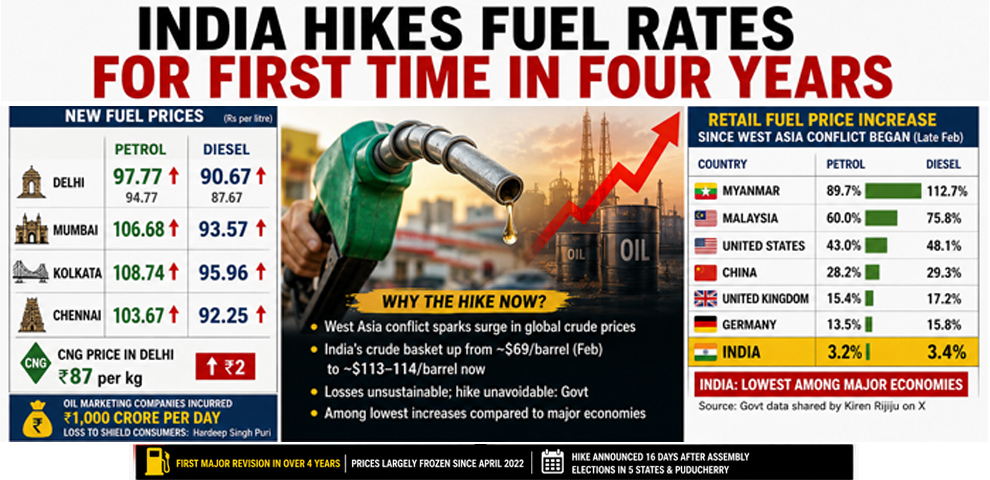
Following the revision, petrol in Delhi increased from Rs 94.77 to Rs 97.77 per litre, while diesel rose from Rs 87.67 to Rs 90.67 per litre. Prices also climbed in other major cities, with petrol reaching Rs 108.74 in Kolkata, Rs 106.68 in Mumbai and Rs 103.67 in Chennai. Diesel rates similarly increased across metros. CNG prices in Delhi were also raised by Rs 2 per kg to Rs 87.
State-run oil marketing companies Indian Oil Corporation, Bharat Petroleum Corporation Limited and Hindustan Petroleum Corporation Limited implemented the hike after keeping retail prices unchanged for nearly 76 days despite rising international crude costs.
Union Minister for Petroleum and Natural Gas Hardeep Singh Puri had earlier said that public-sector oil marketing companies were incurring losses of Rs 1,000 crore per day to shield consumers from the spike in international crude prices.
“At some stage, the government would have to take a call,” Puri said at the CII annual business summit. The three companies absorbed these losses for 76 days before the hike was announced, officials told news agencies.
Puri said the increase was unavoidable given sustained losses and global volatility. Government officials also said India’s price hike remains among the lowest compared to several major economies affected by the same shock.
Brent crude has surged sharply due to geopolitical tensions, with India’s crude import basket rising from around $69 per barrel in February to nearly $113–$114 per barrel, increasing input costs for refiners and adding pressure on inflation management.
ALSO READ | Fuel stations in Mokokchung told to maintain minimum stock, ensure fair supply
Prices have largely been frozen since April 2022, except for a one-time cut of Rs 2 per litre on both petrol and diesel in March 2024 ahead of the Lok Sabha polls. Indian Oil, BPCL and HPCL stopped daily price revisions in April 2022 to protect consumers from sharp hikes after Russia’s invasion of Ukraine pushed global crude prices higher. However, the West Asia conflict has driven global oil prices up by more than 50% again, with India’s crude import basket rising from $69 per barrel in February before the war to $113–$114 per barrel in subsequent months.
The opposition strongly criticised the decision. Congress leaders Rahul Gandhi and Jairam Ramesh alleged that the public was being made to bear the burden of policy choices and questioned why earlier declines in crude prices were not fully passed on to consumers. They also warned of further inflationary pressure and an impact on growth.
The government defended the move, stating that it was necessary to stabilise oil marketing companies and ensure uninterrupted fuel supply during a period of global uncertainty, adding that the revision only partially reflects the rise in international crude prices.
Union Minister Kiren Rijiju defended the fuel price hike by sharing a comparative infographic on X showing retail fuel increases across 25 countries since the West Asia conflict began in late February. According to the data, Myanmar recorded the highest rise, with petrol up 89.7% and diesel 112.7%, followed by Malaysia, the United States, China, the United Kingdom and Germany with varying increases. Rijiju said India’s increase of 3.2% in petrol and 3.4% in diesel was the lowest among major economies.
The hike came 16 days after assembly elections concluded in Assam, Kerala, Tamil Nadu, West Bengal and Puducherry. Fuel prices had remained unchanged throughout the election period despite rising international crude rates.
(With inputs from agencies)