

Nagaland University-led international study has highlighted biochar as a practical and affordable solution to address water scarcity and soil degradation in the hilly regions of Nagaland. Biochar is a carbon-rich material produced by heating crop residues and organic biomass in low-oxygen conditions.
The study demonstrates how agricultural waste can be converted into a sustainable input to improve soil moisture, enhance crop productivity and support climate-resilient farming systems. It brings together researchers from Nagaland University, University of Johannesburg, Amity University Uttar Pradesh and Parul University Gujarat.
Nagaland’s mountainous terrain poses major challenges for agriculture, with sloping fields leading to rapid runoff of rainwater and loss of nutrient-rich topsoil. Dry spells, irregular rainfall and rising temperatures further reduce productivity, creating an urgent need for climate-resilient solutions.
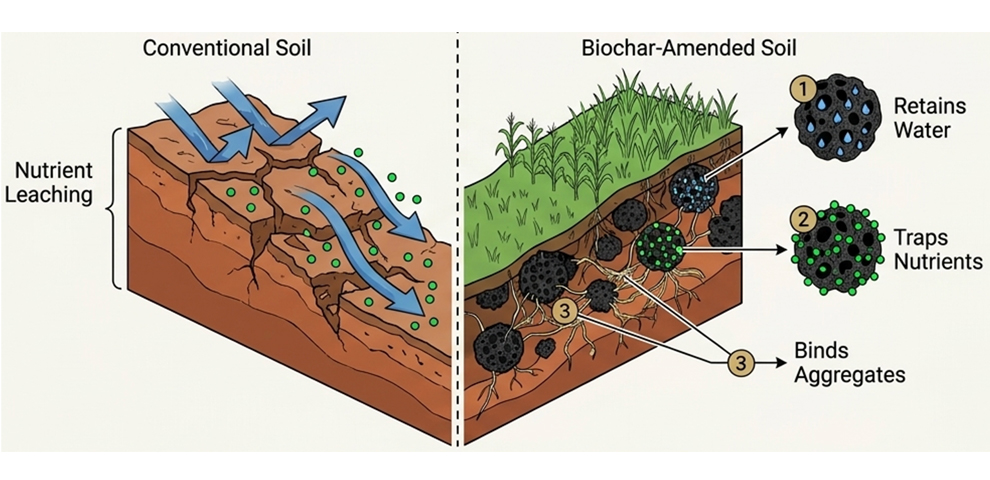
According to the study, biochar can function like a sponge in the soil, improving water retention, reducing irrigation needs and enhancing fertility. It also helps reduce erosion, making it particularly suitable for hill farming systems. Unlike conventional water-saving methods that require costly infrastructure, biochar offers a low-cost, nature-based and circular economy approach by converting farm waste into a valuable soil amendment.
The findings also suggest that biochar can reduce dependence on chemical fertilizers, increase crop yields and support long-term carbon storage in soil. The research highlights its relevance for tackling groundwater depletion, drought stress and declining soil quality across India.
Highlighting the importance of the study, Nagaland University Vice Chancellor Prof. Jagadish K Patnaik said, “This research reflects Nagaland University’s commitment on developing practical, locally relevant solutions for the unique challenges of hill agriculture of surrounding environments. Converting farm waste into biochar not only helps conserve water and improve soil health, but also empowers our farmers with a sustainable and low-cost technology for climate-resilient livelihoods in Northeast India.”
The study was led by Prof. Prabhakar Sharma of the Department of Agricultural Engineering and Technology, Nagaland University, along with Dr. Shakir Ali, University of Johannesburg, Dr. Anamika Shrivastava, Amity University Uttar Pradesh and Dr. Krishna Kumar Yadav, Parul University Gujarat. It has been published in Discover Soil, an open-access peer-reviewed journal by Springer Nature.
Prof. Sharma said, “The study aims to identify suitable locally available biomass for biochar production and evaluate its performance in steep and terraced farming systems. It further examines optimal application rates, long-term impacts on crop yield and soil health, and economic benefits for small and marginal farmers.”
He further added, “most of the existing studies utilize biochar in general agricultural settings, however, our work connects water conservation, soil restoration and climate resilience for hill farming systems, where rapid runoff, moisture loss and soil degradation are major challenges. The study also emphasizes the use of locally available biomass resources for an affordable, scalable and relevant approach for farmers in Northeast India.”
The research team plans to expand the study through pilot demonstrations in university farms, village clusters, terrace fields and horticultural plantations. Future initiatives will also focus on farmer training programmes and collaboration with government agencies to promote wider adoption of biochar-based practices.
The study underscores biochar as a solution that can enhance agricultural productivity while contributing to environmental conservation through soil restoration, reduced biomass burning and improved carbon storage, strengthening climate resilience in fragile hill ecosystems.