
Monthly rent fixed at Rs 1,000 for three years; facility targets low-income groups and migrant workers
More than a decade after construction first began, Nagaland’s long-delayed Rental Housing for Urban Poor project was formally inaugurated at Chümoukedima on Saturday, opening 384 one-bedroom flats aimed at providing affordable accommodation for economically weaker sections, migrant workers, and low-income residents at an initial monthly rent of Rs 1,000.
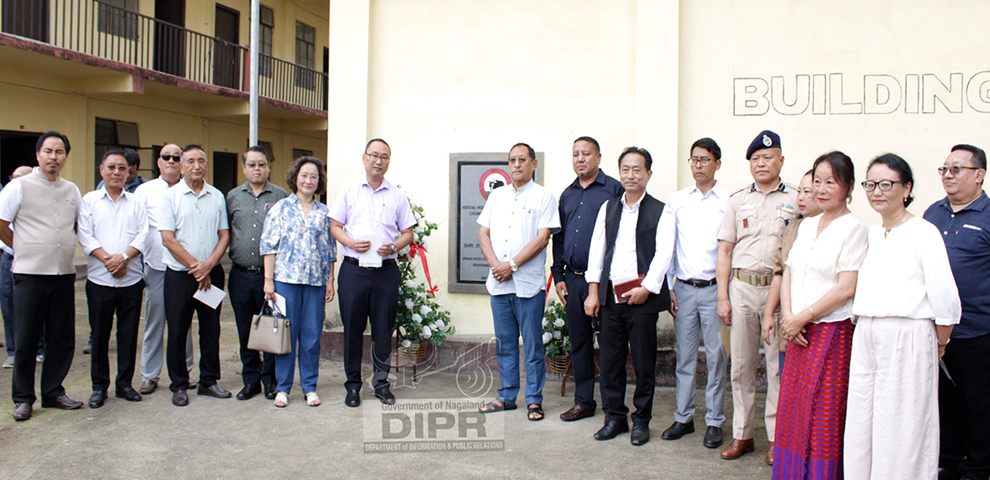
The housing complex, constructed under the Rajiv Awas Yojana (RAY) scheme of the Ministry of Housing and Urban Poverty Alleviation, comprises 384 dwelling units spread across 12 G+3 blocks and was built at a final work order cost of Rs 1,553,266,000.
Advisor for Urban Development & Municipal Affairs, Zhaleo Rio, IAS (Retd.), who inaugurated the project, described its completion as a major milestone and said the facility was intended to provide dignified housing with essential services for vulnerable urban populations.
Rio said the housing units would be allotted not only to indigenous inhabitants but to all Indian citizens residing in the district, including migrant workers, while clarifying that illegal immigrants would not be eligible beneficiaries.
He informed that the initial rent had been fixed at Rs 1,000 for three years, with future revisions subject to approval by the state government through the Chümoukedima Town Council (CTC).
The project’s inauguration comes nearly 12 years after the first work order was issued on August 14, 2014, with construction commencing on August 25 that year. Officials stated that implementation was delayed after the original Detailed Project Report required revision because it excluded key components such as water supply and sanitation infrastructure. A revised work order was issued only on July 20, 2023.
According to the department, the project was completed on May 12, 2024, ahead of the revised schedule and within the sanctioned budget, though its formal inauguration took place in 2026.
Commissioner & Secretary, Municipal Affairs Department, Kekhrievor Kevichusa, termed the project a socially significant initiative despite its prolonged timeline, stating that it would not only provide safe and affordable housing but also serve as a revenue-generating asset for the Chümoukedima Town Council.
He said the project was designed to productively utilize vacant land, strengthen municipal finances, and support low-income residents who could not afford commercial housing. Kevichusa also informed that 5 percent of the housing units had been reserved for persons with disabilities and suggested that concessional rent be considered for them.
The management of the housing complex has been entrusted to the Chümoukedima Town Council.
Alongside the housing inauguration, Rio also flagged off sanitation vehicles under the Swachh Bharat Mission (Urban) and State Plan, calling for stricter waste management practices, transparency in urban governance, and responsible use of public resources.
Stating that this was the fourth such distribution of sanitation vehicles to Urban Local Bodies under the department, Rio urged authorities and citizens alike to ensure proper utilization of sanitation infrastructure and maintain cleanliness through better waste segregation and disposal practices.
Technical details of the project were presented by Er. Olemchila I Yaden, EE-II, UEW, Urban Development, while SBM(U) Mission Director Kezhochole Rhetso highlighted the ongoing urban sanitation initiatives in Nagaland.