
After more than a decade without millet cultivation, Kezoma village in Kohima district has revived the traditional crop, with production reaching an estimated 12–13 tonnes in 2026 as mechanisation and departmental support encourage farmers to expand cultivation.
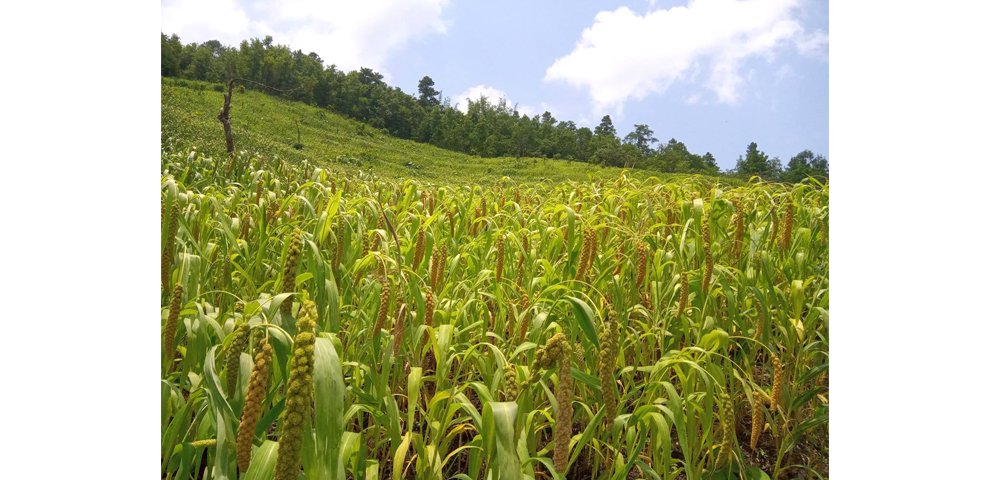
The revival began in 2024 through an initiative by the District Agriculture Office, Kohima, and the Kezoma Village Council. Seeds sourced from different parts of Nagaland were distributed to farmers, while awareness programmes sought to encourage the community to return to a crop that had gradually disappeared from local cultivation.
According to the District Agriculture Office, millet cultivation in Kezoma had remained suspended for over a decade. The gap meant that an entire generation of children had grown up without knowing millet as a traditional crop cultivated in their village.
The initial challenge was to motivate farmers to resume cultivation. Starting from a baseline of zero hectares, the initiative brought one hectare under millet in its first year, in 2024.
A key intervention came with the provision of a millet mill by the District Agriculture Office. The equipment reduced the burden of post-harvest processing, which the department said had previously involved considerable labour. It estimated that the mill reduced post-harvest labour drudgery by 80%.
The department said the ease and speed of processing encouraged more villagers to take up millet cultivation, contributing to the expansion of the crop in subsequent seasons.
The revival gained further momentum in 2025, when Kezoma organised its first millet festival. The event provided a platform to promote the crop, raise awareness about its nutritional and economic potential, and market millet grain and value-added products.
Approximately 4,000 kg of millet grain was showcased and marketed at the festival. The department reported that sales of grain and value-added products generated around Rs 13–14 lakh in a single day.
Cultivation had expanded to two hectares by 2025, with reported productivity of 20–25 quintals per hectare. The festival marked a significant step in linking the revival of a traditional crop with opportunities for local marketing.
In 2026, the area under millet cultivation reportedly doubled again. The District Agriculture Office estimated total village production at 12,000–13,000 kg, with an average yield of 2,000–2,500 kg per hectare.
Building on the response to mechanisation, the department provided Kezoma with a millet thresher and an additional millet mill. The equipment is intended to further ease processing and support farmers as cultivation expands.
Beyond increasing production in the main season, the initiative has also explored whether millet can be cultivated twice within the same year.
The District Agriculture Office introduced second-season millet cultivation on a small experimental scale in 2025 to assess its feasibility. Following a successful harvest, farmers were encouraged to adopt a second crop.
In 2026, approximately two hectares were brought under the second-season crop, with harvesting expected in November.
To address water shortages and support cultivation during the additional season, a sprinkler irrigation system was provided under the Per Drop More Crop (PDMC) component of the Pradhan Mantri Krishi Sinchayee Yojana. The system is intended to improve water availability and help make the fields productive beyond the usual cropping season.
The experience in Kezoma illustrates how the revival of a traditional crop can be supported by a combination of farmer mobilisation, processing equipment, irrigation and opportunities to market produce. The expansion from no cultivation in 2024 to an estimated 12–13 tonnes of production in 2026 represents a substantial change over two years.
The next test will be whether farmers can sustain the expansion, secure reliable markets and continue the second cropping season. The outcome of the November harvest could offer a clearer indication of the feasibility of double-season millet cultivation in the village and its potential for adoption elsewhere. (With inputs from DIPR)